
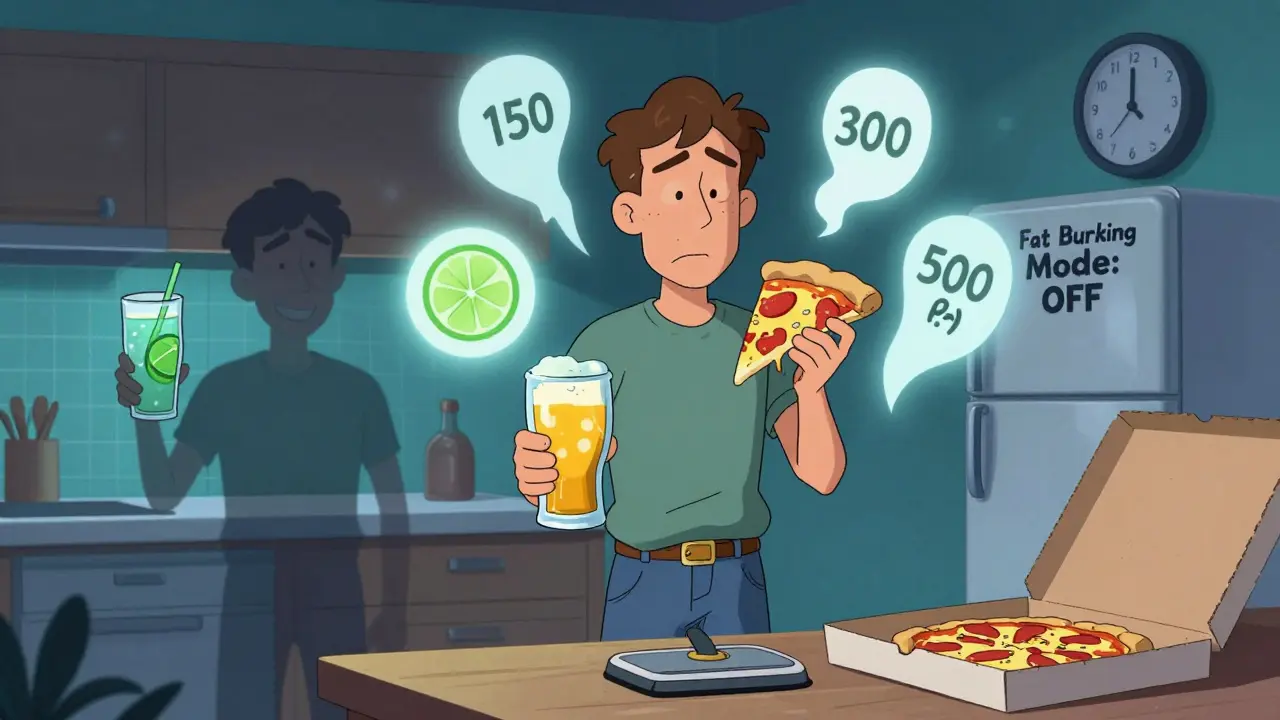
Trying to lose weight but still drinking alcohol? You’re not alone. Millions of people cut back on sugar, count macros, and hit the gym - only to undo progress with a few drinks on the weekend. The problem isn’t just willpower. It’s biology. Alcohol doesn’t just add empty calories; it rewires how your body burns fat, spikes hunger, and makes you reach for junk food - even when you’re not hungry.
Alcohol Has More Calories Than You Think
Let’s start with the basics: alcohol has 7 calories per gram. That’s almost twice as much as protein or carbs (4 calories per gram) and close to fat (9 calories per gram). But unlike food, those calories don’t come with protein, fiber, or vitamins. They’re pure energy with no nutritional value.
Here’s what that looks like in real drinks:
- A 12-ounce beer: ~150 calories
- A 5-ounce glass of wine: ~120-125 calories
- 1.5 ounces of vodka, gin, or whiskey (80-proof): ~100 calories
- A piña colada: 400-500 calories
- A large cocktail with syrup, juice, and cream: up to 700+ calories
That’s not just a snack. That’s a full meal. A pint of lager has about the same calories as a slice of pepperoni pizza. A big glass of wine equals an ice cream sundae. And if you’re pouring at home, you’re likely pouring 30% more than the standard 5-ounce serving - adding 35 extra calories per glass without even realizing it.
Your Body Treats Alcohol Like Poison
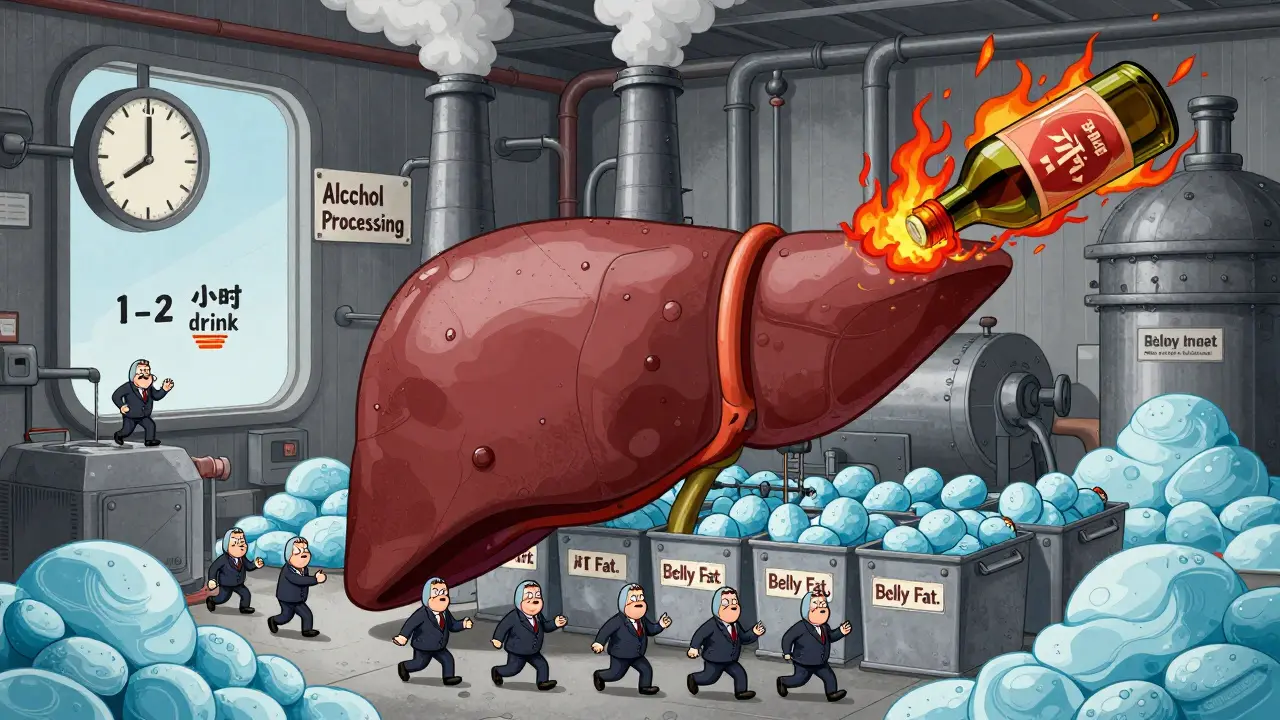
When you drink, your body doesn’t treat alcohol like food. It treats it like a toxin. Your liver prioritizes breaking it down - and that means everything else gets paused.
While your body is busy processing alcohol, fat burning drops by 30-40%. That means the fat you ate with your drink? It’s not being burned. It’s being stored. Especially around your belly. Studies show this metabolic pause lasts 1-2 hours per drink. So if you have three drinks, your body is in fat-storage mode for 3-6 hours - and any extra calories you eat during that time? Almost guaranteed to turn into fat.
This isn’t theoretical. A 2021 study in the American Journal of Clinical Nutrition found that after drinking alcohol, participants stored more dietary fat than when they didn’t drink - even when total calories stayed the same.
Alcohol Makes You Hungrier (Even When You’re Full)
Here’s the sneaky part: alcohol doesn’t just add calories. It makes you eat more.
Research from the Cleveland Clinic showed people who drank alcohol ate 20% more food than those who had the same number of non-alcoholic calories. Why? Alcohol lowers inhibitions, disrupts hunger signals, and increases cravings - especially for salty, fatty, sugary foods.
One 2022 study found that people who drank alcohol were 45% more likely to snack late at night. Another review of 78 studies in the European Journal of Clinical Nutrition confirmed alcohol consistently increases appetite. It’s not just about willpower. It’s biology.
And it’s not just the food you eat while drinking. Alcohol messes with your hormones. It lowers leptin (the hormone that tells you you’re full) and raises ghrelin (the hunger hormone). So even if you stop drinking, your body keeps screaming for food.
Alcohol vs. Soda: Which Is Worse for Weight Loss?
People often compare alcohol to sugary soda. Both have similar calories. But here’s the difference: soda doesn’t shut down fat burning. It doesn’t lower your willpower. It doesn’t make you crave pizza at 2 a.m.
A 2022 randomized trial in Obesity Science & Practice compared two groups: both cut 500 calories per day. One group cut out soda. The other cut out alcohol. The alcohol group lost 3.2% more body fat over 12 weeks - not because they ate less, but because their metabolism restarted. Fat burning returned. The soda group didn’t see the same metabolic shift.
That’s the hidden advantage of cutting alcohol: you’re not just reducing calories. You’re restoring your body’s natural fat-burning rhythm.
Real People, Real Results
Let’s talk numbers. According to the 2022 NHANES survey, people who drank 8 or more drinks per week had 23% higher obesity rates than non-drinkers - even after adjusting for diet and activity.
Another study tracked 12,500 adults for five years. Those who cut their drinking from heavy to moderate (over 14 drinks/week down to 7 or fewer for men, over 7 to 4 or fewer for women) lost an average of 3.7 pounds in a year - without changing anything else.
And it’s not just about weight. A 2023 analysis from HSE Ireland found that for people aged 25-45, alcohol accounted for 10-12% of their daily calories. That’s the equivalent of throwing away your entire daily calorie deficit for weight loss.
How to Drink Smarter - Without Quitting Completely
You don’t have to give up alcohol forever. But you do need a strategy. Here’s what works, based on real clinical data:
- Choose low-calorie drinks. Vodka or gin with club soda and lime is about 100 calories. Skip the syrup, juice, and cream. A margarita? 500+ calories. A simple gin and tonic? 150. That’s a 350-calorie difference - just from the mixer.
- Set alcohol-free days. Try 3-4 days a week with no alcohol. That’s 750-1,200 fewer calories per week for most moderate drinkers. You don’t need to be perfect. Just consistent.
- Pre-load with protein. Eat 20-30 grams of protein (like chicken, eggs, or Greek yogurt) before you drink. Research shows this cuts post-drinking food intake by 18%.
- Pour your own drinks. Don’t let others pour for you. Use a measuring shot glass at home. A standard wine pour is 5 ounces - most people pour 7. That’s 35 extra calories per glass. Multiply that by three drinks? That’s 105 extra calories you didn’t plan for.
- Track your drinks. Most people underestimate alcohol calories by 47%. Use an app. Write it down. Treat it like food.
Why Most People Fail - And How to Avoid It
The biggest reason people slip up? Social pressure and poor tracking.
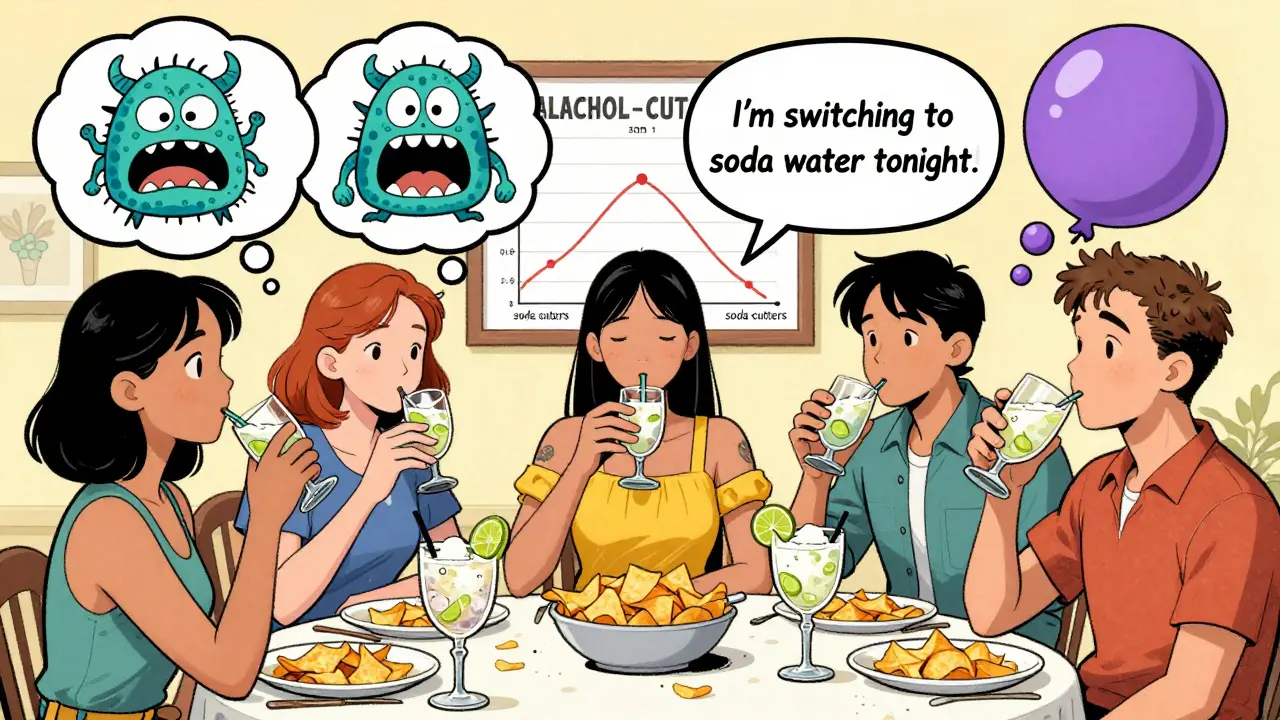
At parties, drinks are a social ritual. Saying no feels awkward. But here’s the trick: you don’t have to say no. Just say, “I’m switching to soda water tonight.” No explanation needed. Most people won’t even notice.
Another trap: thinking “I’ll make up for it tomorrow.” That mindset leads to binge drinking on weekends - and then overeating all week to compensate. It’s a cycle.
And here’s the truth: weight loss from cutting alcohol is sustainable - but only if you pair it with structure. A 2023 study found that 68% of people who lost weight by cutting alcohol regained it within a year - unless they added a simple meal plan. Those who did? 82% kept the weight off.
What’s Next? Personalized Advice Is Coming
Science is moving fast. Researchers have found that people respond to alcohol differently based on genetics, metabolism, and gut health. One 2022 study identified three distinct metabolic types - meaning what works for one person might not work for another.
In the next few years, doctors may use simple blood or breath tests to tell you: “Your body stores fat more easily when you drink. Cutting alcohol will help you lose weight faster.”
Until then, the data is clear: if you’re trying to lose weight, alcohol is one of the easiest things to cut - and one of the most impactful. It’s not about perfection. It’s about awareness. You don’t need to quit. You just need to know what you’re really drinking - and what it’s doing to your body.
Does alcohol stop fat burning?
Yes. When you drink alcohol, your liver prioritizes breaking it down over burning fat. This metabolic pause lasts 1-2 hours per drink. During that time, your body is more likely to store dietary fat - especially around your abdomen.
Can I drink alcohol and still lose weight?
Yes - but only if you account for the calories and avoid overeating. Cutting out sugary cocktails and sticking to 1-2 low-calorie drinks per week can fit into a weight loss plan. Most people who succeed do so by reducing frequency, not eliminating entirely.
Which alcoholic drink has the least calories?
The lowest-calorie options are straight spirits (vodka, gin, whiskey) with zero-calorie mixers like club soda or sparkling water and a squeeze of lime. A 1.5-ounce shot has about 100 calories. Avoid juice, syrup, cream, and soda - they add 150-300+ extra calories.
Why do I crave junk food after drinking?
Alcohol lowers your inhibitions and disrupts hunger hormones. It reduces leptin (fullness signal) and increases ghrelin (hunger signal). Studies show people eat 20% more after drinking, especially high-fat, high-sugar foods - even if they’re not hungry.
How many calories are in a glass of wine?
A standard 5-ounce glass of wine has about 120-125 calories. But most people pour 7 ounces at home - adding 35+ extra calories per glass. That’s 100+ extra calories if you have three glasses.
Will cutting alcohol help me lose belly fat?
Yes. Alcohol is strongly linked to abdominal fat storage. When your body processes alcohol, it prioritizes breaking it down - which slows fat burning and increases fat storage around your midsection. Cutting alcohol, even without other changes, often leads to visible reductions in belly fat within weeks.
How long does it take to lose weight after stopping alcohol?
Many people see results in 2-4 weeks. Cutting 3-4 drinks per week can save 600-1,200 calories - which equals about 1-2 pounds of fat loss per month. Combine that with better food choices, and weight loss can accelerate. The metabolic benefits - like restored fat burning - start within hours of your last drink.
14 Comments

TiM Vince
January 14, 2026 at 20:12 PM
I used to think wine was harmless. Then I tracked my calories and realized I was drinking a whole meal after dinner. Cut it out. Lost 8 lbs in 6 weeks. No gym needed.

gary ysturiz
January 15, 2026 at 08:44 AM
You don't have to quit alcohol to win. Just be smart. Gin and soda. No sugar. One drink on Friday. That's it. Your body will thank you. And so will your mirror.
Small changes add up. You don't need to be perfect. Just consistent.

Jessica Bnouzalim
January 16, 2026 at 16:22 PM
I tried the protein-preload trick. I ate a hard-boiled egg and some Greek yogurt before my Friday night drink. And guess what? I didn't even touch the nachos. I was shocked! I thought I'd be craving pizza like always. But nope. I just sipped my gin and felt fine. Like, actually fine. Not zombie-mode hungry. This might be a game-changer.

laura manning
January 18, 2026 at 01:37 AM
The metabolic suppression effect of ethanol is well-documented in peer-reviewed literature, particularly in the context of hepatic mitochondrial function and fatty acid oxidation inhibition. The 30-40% reduction in fat oxidation is corroborated by multiple randomized controlled trials, including those published in the American Journal of Clinical Nutrition and the Journal of Lipid Research. Furthermore, the postprandial ghrelin elevation and leptin suppression are mediated via hypothalamic signaling pathways, which are acutely disrupted by alcohol consumption. This is not anecdotal; it is biochemical.

Bryan Wolfe
January 18, 2026 at 02:17 AM
I get it. You're tired. You want to unwind. I used to do it too. But here's the truth: your body doesn't care if you had a hard day. It just knows you gave it poison instead of fuel.
Try this: swap one drink for sparkling water with lime. Do it for a week. Then another. You'll feel better. Sleep better. Look better. And you won't even miss it. You're not giving up fun. You're upgrading your life.

Sumit Sharma
January 19, 2026 at 12:37 PM
The data is clear. You're wasting your time with 'strategies.' If you're serious about fat loss, alcohol is a non-negotiable. Period. No 'low-calorie' loopholes. No 'I'll just have one.' Your liver doesn't negotiate. It shuts down fat oxidation and prioritizes ethanol detox. That's biology. Not opinion. Stop rationalizing. Cut it. Or stay fat.

Jay Powers
January 21, 2026 at 04:44 AM
I used to think cutting alcohol was extreme. Then I saw how much I was eating after drinking. It wasn't even about the calories in the drink. It was about the chips, the pizza, the ice cream that showed up like ghosts. Once I stopped, the cravings just... faded. Like a switch flipped. I didn't even try. It just happened.

Lawrence Jung
January 22, 2026 at 15:31 PM
You think alcohol is the enemy? It's just a mirror. It shows you what you're really running from. The stress. The emptiness. The fear of being still. Lose the drink. But what are you going to face when you're sober? That's the real question. Not calories. Not metabolism. You.

Alice Elanora Shepherd
January 23, 2026 at 04:52 AM
I've been tracking my drinks for 18 months now. I used to think a glass of wine was 'one drink.' It's not. At home, I pour 7oz. That's 150 calories right there. Add two more? 450. That's a meal. I started using a measuring cup. Now I pour 5oz. I feel like a scientist. And I've lost 11 lbs without changing my diet. Just the pour.

Christina Widodo
January 24, 2026 at 16:13 PM
Wait-so if I drink vodka with soda, I’m not getting fat? But I still feel bloated and weird the next day. Is that just water retention? Or is my body still storing fat even if the drink is 'clean'?

Prachi Chauhan
January 26, 2026 at 02:56 AM
I think people forget alcohol is a depressant. You don't just get hungry-you get sad. And when you're sad, you eat. It's not the drink. It's the mood. I used to drink to chill. Now I walk. Or call my mom. Or just sit. And I don't crave pizza. I crave silence.

Katherine Carlock
January 27, 2026 at 18:52 PM
I tried the 3 alcohol-free days thing. Day 1: bored. Day 2: weirdly tired. Day 3: I slept 8 hours. Day 4: I didn't even think about wine. Now I do it every week. I feel lighter. Not just in weight. Like... lighter inside. Who knew?
gary ysturiz
January 28, 2026 at 09:28 AM
That's exactly right. The bloating? That's water retention from alcohol messing with your kidneys and sodium balance. The fat storage? That's the liver prioritizing ethanol. Two different things. You can feel bloated even if you're not gaining fat. But if you keep drinking, you'll gain both.
Sonal Guha
January 12, 2026 at 21:01 PM
Alcohol is just liquid carbs with a side of poor decisions. No magic. Just math. Skip the drinks, lose the belly.