
Why Pediatric Medication Errors Are So Common
Children aren’t just small adults. Their bodies process medicine differently, and even a tiny mistake in dosage can lead to serious harm. The biggest culprit? Weight-based dosing errors. According to the World Health Organization, kids are three times more likely than adults to get the wrong medicine dose. Why? Because most pediatric meds are calculated in milligrams per kilogram (mg/kg), and a simple math mistake - or worse, a unit mix-up between pounds and kilograms - can turn a safe dose into a dangerous one.
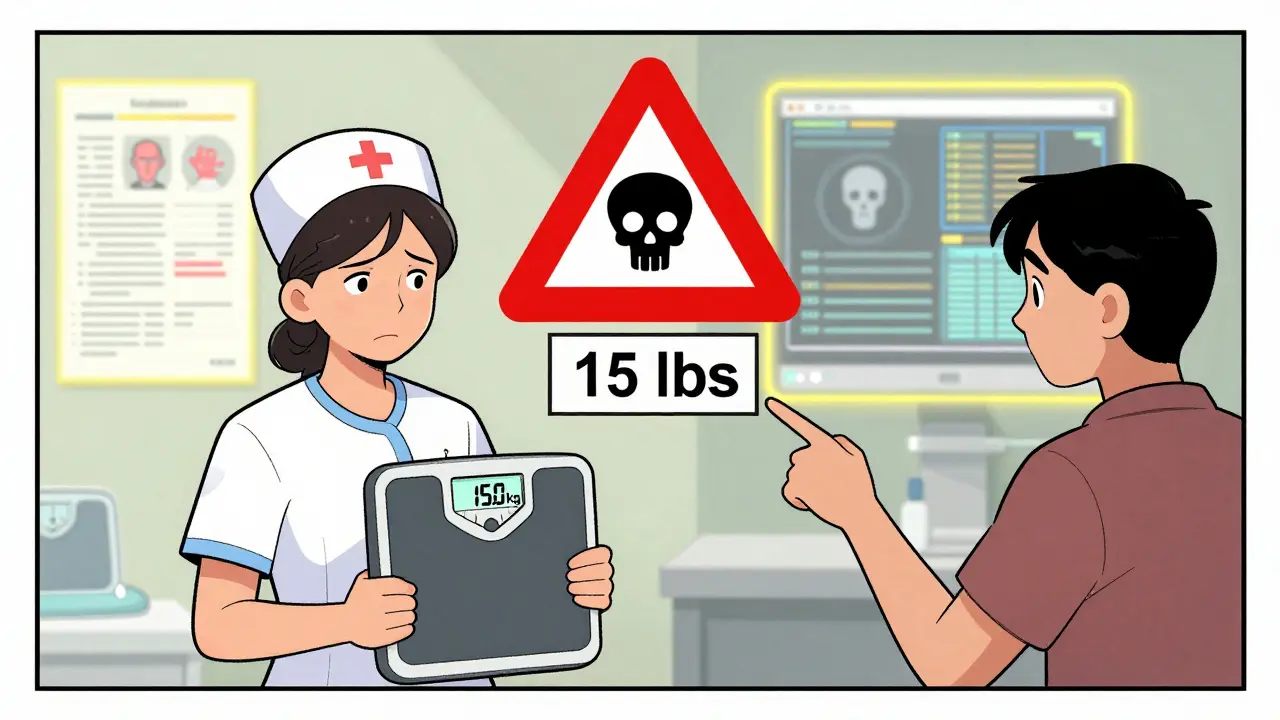
Take a 15-pound infant. If someone mistakenly thinks that’s 15 kilograms, they’re giving over twice the intended dose. That’s not a hypothetical. The CDC’s PROTECT Initiative found that 40% of liquid medication errors in kids under 4 came from this exact mistake. And it’s not just caregivers. Pharmacists, nurses, and even doctors have made the same error under pressure.
How Weight-Based Verification Works
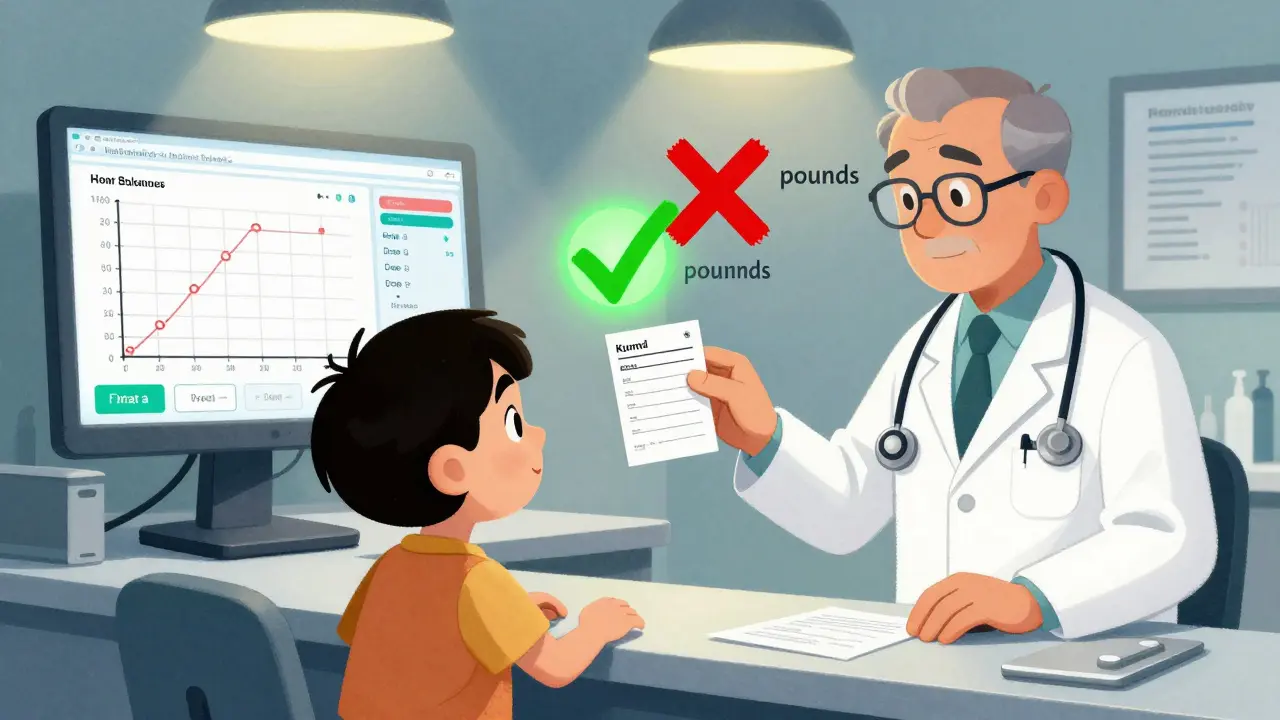
Weight-based verification isn’t just a good idea - it’s now a standard. The American Society of Health-System Pharmacists (ASHP) made it mandatory in 2018: every pediatric prescription must be tied to an accurate, up-to-date weight in kilograms. No pounds. No estimates. No exceptions.
Here’s how it works in practice:
- When a child is admitted or comes in for a visit, their weight is measured on a digital scale that displays only in kilograms, to the nearest 0.1 kg for babies or 0.5 kg for older kids.
- That weight is entered directly into the electronic health record (EHR) - and the system won’t let you proceed to prescribe unless it’s there.
- Once the prescription is entered, the EHR’s clinical decision support system (CDSS) automatically calculates the correct dose based on the child’s weight and flags anything outside safe limits.
- At the pharmacy, the pharmacist sees the weight and the calculated dose side by side. They verify it before dispensing.
- At the bedside, nurses scan the medication barcode, and the system cross-checks the dose against the child’s recorded weight one last time.
This isn’t just theory. A 2022 study in the Journal of the American Medical Informatics Association showed that when these systems are set up right, they cut dosing errors by 87.3%. That’s not a small win - it’s life-saving.
Why Technology Alone Isn’t Enough
Yes, computers help. But if the weight in the system is wrong, the computer will just calculate the wrong dose faster.
At Boston Children’s Hospital, they reduced weight-related errors from 14.3 per 10,000 doses to just 0.8 after enforcing a rule: all weights must be re-measured within 24 hours for inpatients and every 30 days for outpatients. Before that, staff were using weights from months ago - sometimes even from a previous visit.
And here’s the kicker: even with perfect tech, alerts can become noise. A 2021 study found that 41.7% of weight-based safety alerts were ignored by clinicians. Why? Too many false alarms. For example, an adolescent who’s 160 pounds and growing fast might trigger an alert because the system still thinks they’re a child. That leads to alert fatigue - and when alerts get ignored, real dangers slip through.
The fix? Smart systems. Epic’s 2024 Pediatric Safety Module uses growth charts to predict what a child’s weight should be based on age and past trends. If a 5-year-old suddenly shows up with a weight that doesn’t match their growth curve, the system flags it - not as a dosing error, but as a possible documentation error. That cuts false alerts by over 60%.
What Works Best - And What Doesn’t
Not all weight-check systems are created equal. Here’s what the data says:
| Method | Error Reduction | Key Limitation |
|---|---|---|
| EHR + CDSS with mandatory weight entry | 87.3% | Requires full system integration |
| Automated dispensing cabinets with weight check | 68.9% | Adds 2.3 minutes per prescription |
| Preprinted weight-based dosing charts | 82% | Too rigid for complex cases |
| Standalone verbal checks (no tech) | 36.5% | Relies on memory and communication |
| Pharmacist-led verification teams | 15.8% reduction in admin errors | Needs 2.5 pharmacists per 100 beds |
Bottom line: the most effective systems are the ones that force the weight into the process - not just suggest it. If the system lets you skip it, people will. And when they do, errors follow.
Real-World Barriers - And How to Beat Them
Even the best systems fail without buy-in. Here are the biggest roadblocks:
- Outdated weights: 63% of pediatric nurses have seen weight documentation errors in the past year. Solution: Make weight measurement part of every admission, every clinic visit, and every discharge.
- Staff training gaps: 37.8% of pharmacy staff don’t fully understand pediatric pharmacokinetics. Solution: Require 40 hours of training per clinician - not just a one-hour online module.
- System incompatibility: 68% of hospitals report EHRs that don’t talk to each other. Solution: Push for interoperability standards. If a child transfers from a community clinic to a hospital, their weight must come with them.
- Resistance from providers: 41% of doctors say it slows them down. Solution: Show them the data. At one hospital, after implementing the system, medication-related code blues dropped by 42% in six months. That’s not a delay - that’s prevention.
And don’t forget the community pharmacists. A 2023 survey found that nearly 30% of them had a near-miss with pediatric weight errors each month - because they couldn’t access the child’s medical record. That’s a huge gap. If a parent picks up a prescription at the corner pharmacy, the pharmacist needs to know the weight. No exceptions.

What’s Next - And How to Prepare
The future of pediatric safety is smarter, not just more tech. The FDA is pushing for EHRs to integrate growth charts to auto-flag abnormal weights. AI is being tested to predict a child’s expected weight based on age, height, and past data - with 92% accuracy in early trials.
But the real game-changer? Culture. The Institute for Safe Medication Practices says it plainly: “Technology alone cannot prevent errors; a culture of safety with non-punitive error reporting is essential.” That means if a nurse catches a mistake before it happens, they’re praised - not punished. If a pharmacist spots a weight mismatch, they’re thanked - not overruled.
And the rules are tightening. The Leapfrog Group now requires weight verification for hospitals to get an ‘A’ safety grade. Medicare and Medicaid now require it for all pediatric prescriptions. If you’re not doing this, you’re not just risking patient safety - you’re risking your accreditation.
What You Can Do Today
You don’t need a million-dollar system to start reducing errors. Here’s your quick action plan:
- Switch to kilograms only - no pounds, no ounces. Make it the default in all forms, scales, and EHRs.
- Require weight entry before prescribing - no exceptions. Block the system if it’s missing.
- Verify weight at three points: when ordered, when dispensed, and when given.
- Standardize concentrations - use 5 mg/mL for vancomycin, 10 mg/mL for morphine. Fewer calculations = fewer mistakes.
- Train your team - not once, but quarterly. Use real case examples. Make it part of the culture.
It’s not about adding more steps. It’s about making the right steps impossible to skip.
8 Comments

Jesse Ibarra
January 15, 2026 at 08:58 AM
Oh wow. Another sanctimonious tech-bro manifesto dressed up as 'patient safety.' Let me guess-you think if we just shove more EHRs into every pediatric ward, magic will happen? No. The real problem is that hospitals treat nurses like disposable widgets and then blame them when the system fails. You cite an 87% reduction? Great. But you didn't mention how many nurses quit because they were drowning in 17 alerts per shift. The system doesn't save lives-it just makes the paperwork prettier while the staff burns out. Pathetic.

Trevor Davis
January 15, 2026 at 22:55 PM
Hey i just wanted to say i work in a small ER and we dont have all that fancy tech. we just make sure every single time a kid comes in, we weigh them ourselves, right there in front of the parent. no excuses. and we say it out loud: 'okay sweetie, lets get you on the scale'-and we write it down. and we double-check with the mom. its old school. its slow. but we've had zero errors in 3 years. sometimes the dumbest solution is the one that actually works.

lucy cooke
January 16, 2026 at 05:27 AM
Ah yes, the modern gospel of algorithmic salvation. We outsource human judgment to machines that don't understand that a 14-year-old who's 6'2" and 180 lbs isn't a 'child' anymore, yet the system still screams 'DANGER: 10x overdose!' like a broken alarm clock. We've turned healthcare into a video game where the only winning move is not playing. The real tragedy? We're not preventing errors-we're training clinicians to ignore them. This isn't progress. It's the slow death of clinical intuition, wrapped in a shiny EHR skin and sold to administrators as 'efficiency.' We are not machines. Children are not data points. And neither are we.

Randall Little
January 17, 2026 at 14:43 PM
You cite the JAMA study claiming 87.3% reduction, but you omit the fact that this was only in tertiary academic centers with full IT infrastructure. The 68% of hospitals with incompatible EHRs? You didn't mention them. And let's not forget the 30% of community pharmacists who can't access records at all. This isn't a universal solution-it's a privilege for the well-funded. Also, 'no pounds' is a nice slogan, but in the real world, parents still say 'my baby's 15 pounds.' If you don't train staff to translate that accurately, you're just creating a new class of error. Precision without context is just noise.

John Tran
January 19, 2026 at 02:35 AM
You know what's really scary? Not the math errors. Not the scale calibration. Not even the lazy nurses using weights from 2022. It's the fact that we've reduced human beings-tiny, fragile, growing, changing, breathing, crying, sleeping, feeding, dreaming human beings-to a single number on a screen. A number that gets entered wrong because someone was rushing. A number that gets ignored because the alert is too loud. A number that gets misinterpreted because the system doesn't know the kid has a rare metabolic disorder that changes how he metabolizes every drug. We're not fixing pediatric dosing. We're automating our detachment. We're letting the algorithm feel responsible so we don't have to. And when the kid dies? Who gets blamed? The system? The nurse? The parent? Or... the collective moral laziness of an entire industry that would rather build a better calculator than learn how to hold a child's hand?

Pankaj Singh
January 20, 2026 at 14:41 PM
This whole thing is a scam. 87% reduction? Prove it with real data from non-academic hospitals. You think putting weight in kg stops people from guessing? In India we have kids weighing 12kg who look like 8kg because they're malnourished. The system says 'safe dose' but the kid's liver can't handle it. Tech doesn't fix poverty. Training doesn't fix understaffing. And your 'culture of safety'? That's just HR jargon for 'don't report mistakes or you're fired.' This is performative safety. It looks good on a grant application. It doesn't save lives.

Robin Williams
January 20, 2026 at 20:26 PM
bro. just weigh the kid. every time. like, literally. if you're too lazy to pick up a scale, you shouldn't be touching meds. no fancy AI, no blockchain, no 'smart alerts'-just a human being looking at a child and saying 'this feels off.' and if the parent says 'he's been 16 pounds since last month'-ask 'did he eat today?' and then weigh him. that's it. that's the whole system. the rest is just noise.
laura Drever
January 14, 2026 at 08:17 AM
this is why we cant have nice things. weight in kg only? sure. but good luck getting every clinic in rural america to afford digital scales that dont show pounds. also who cares if the nurse used last years weight from a cold visit? its not like the kid will die from 0.5mg extra acetaminophen.