
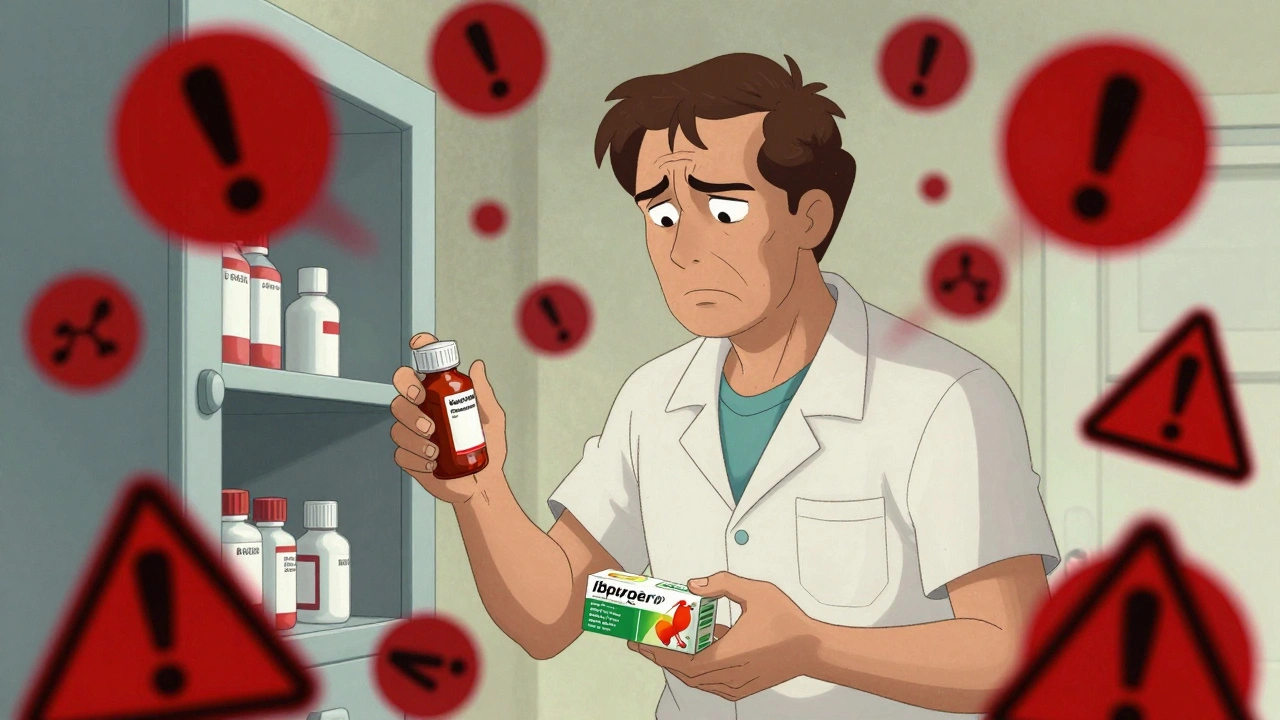
Combining blood thinners with common pain relievers like ibuprofen or naproxen isn’t just a bad idea-it’s dangerous. Every year, thousands of people end up in the hospital because of this mix, and many don’t even realize they’re putting themselves at risk. If you’re on a blood thinner for atrial fibrillation, a past blood clot, or another condition, and you reach for an over-the-counter pain pill for your arthritis or headache, you’re playing with fire. The science is clear: this combination can trigger serious, even fatal, bleeding events-not just in your stomach, but in your brain, lungs, and kidneys.
What Happens When Blood Thinners and NSAIDs Mix?
Blood thinners work in different ways to stop clots from forming. Warfarin, rivaroxaban, apixaban, dabigatran, and edoxaban all interfere with your body’s natural clotting system. NSAIDs-like ibuprofen, naproxen, and diclofenac-do something else entirely: they shut down enzymes called COX-1 and COX-2. This reduces inflammation and pain, but it also weakens your platelets, the tiny blood cells that plug leaks in damaged blood vessels. When you take both, your body loses two layers of protection against bleeding. One drug slows clot formation; the other prevents platelets from doing their job. Together, they create a perfect storm.A massive study in Denmark, published in late 2024 and analyzed by over 51,000 patients on anticoagulants, found that adding an NSAID more than doubled the chance of being hospitalized for bleeding. That’s not a small uptick. That’s a major red flag. The risk didn’t just go up-it exploded depending on which NSAID you took. Naproxen? Four times higher risk. Diclofenac? More than three times. Even ibuprofen, often thought of as the "safer" option, still raised the risk by nearly 80%.
It’s Not Just Your Stomach at Risk
Most people think if something goes wrong, it’ll be a stomach ulcer or black, tarry stools. That’s only part of the story. The same Danish study showed that this drug combo doesn’t just hurt your gut-it attacks your whole body. You’re 2.2 times more likely to bleed in your digestive tract, but you’re also 3.2 times more likely to have bleeding in your brain. That’s a stroke risk you didn’t sign up for. Your lungs? 36% higher chance of bleeding there. Your urinary tract? 57% higher. And anemia from chronic blood loss? Nearly tripled.These aren’t rare side effects. These are real, measurable outcomes in real people. And it doesn’t matter if you’re on warfarin or one of the newer direct oral anticoagulants (DOACs). The risk is the same. Many assume newer drugs are safer, but when paired with NSAIDs, they’re just as vulnerable. There’s no "safe" blood thinner in this mix.
Why OTC Doesn’t Mean Safe
A lot of people don’t think of ibuprofen or naproxen as "medications." They’re just pain relievers, right? Wrong. In Denmark, where this study was done, most NSAIDs are prescription-only. In places like the U.S., Australia, and Canada, you can buy them off the shelf. That’s part of the problem. Patients don’t tell their doctors they’re taking Advil or Aleve because they don’t see it as "medicine." But your doctor needs to know. Every time. At every appointment.Studies show that up to 30 billion OTC ibuprofen tablets are sold each year in the U.S. alone. Millions of people on blood thinners are taking them regularly-sometimes daily-for back pain, knee arthritis, or headaches. They think they’re being careful. But they’re not. Even short-term use increases bleeding risk. One weekend of high-dose ibuprofen after a sprained ankle could be enough to trigger internal bleeding.

What Should You Take Instead?
There’s one clear, safe alternative: acetaminophen (Tylenol). It reduces pain and fever without affecting platelets or clotting. It doesn’t cause stomach irritation like NSAIDs do. And it doesn’t interact with warfarin or any DOAC. That makes it the go-to choice for anyone on blood thinners.But acetaminophen isn’t a magic bullet. Stick to the recommended dose-no more than 3,000 to 4,000 mg per day, depending on your liver health. Too much can damage your liver, especially if you drink alcohol or take other meds. Still, compared to NSAIDs, it’s the safest option by far.
Outside of pills, consider non-drug options. Heat packs for stiff joints. Ice for swollen knees. Physical therapy for chronic pain. Gentle movement like walking or swimming can reduce inflammation and stiffness without drugs. Sometimes, a simple change in posture or footwear can ease joint pain enough to avoid medication altogether.
What If You Really Need an NSAID?
There are rare cases where NSAIDs are unavoidable-like during a flare-up of gout or severe rheumatoid arthritis. If your doctor says you absolutely need one, here’s what to do:- Use the lowest effective dose for the shortest time possible. No long-term use.
- Avoid naproxen and diclofenac. If you must use an NSAID, ibuprofen is the least risky-but still risky.
- Take it with food to reduce stomach irritation.
- Ask your doctor about adding a proton pump inhibitor (PPI) like omeprazole to protect your stomach lining.
But here’s the hard truth: even with a PPI, the risk of bleeding in your brain, lungs, or kidneys doesn’t go down. The stomach protection only helps one part of the problem. The rest? Still dangerous.
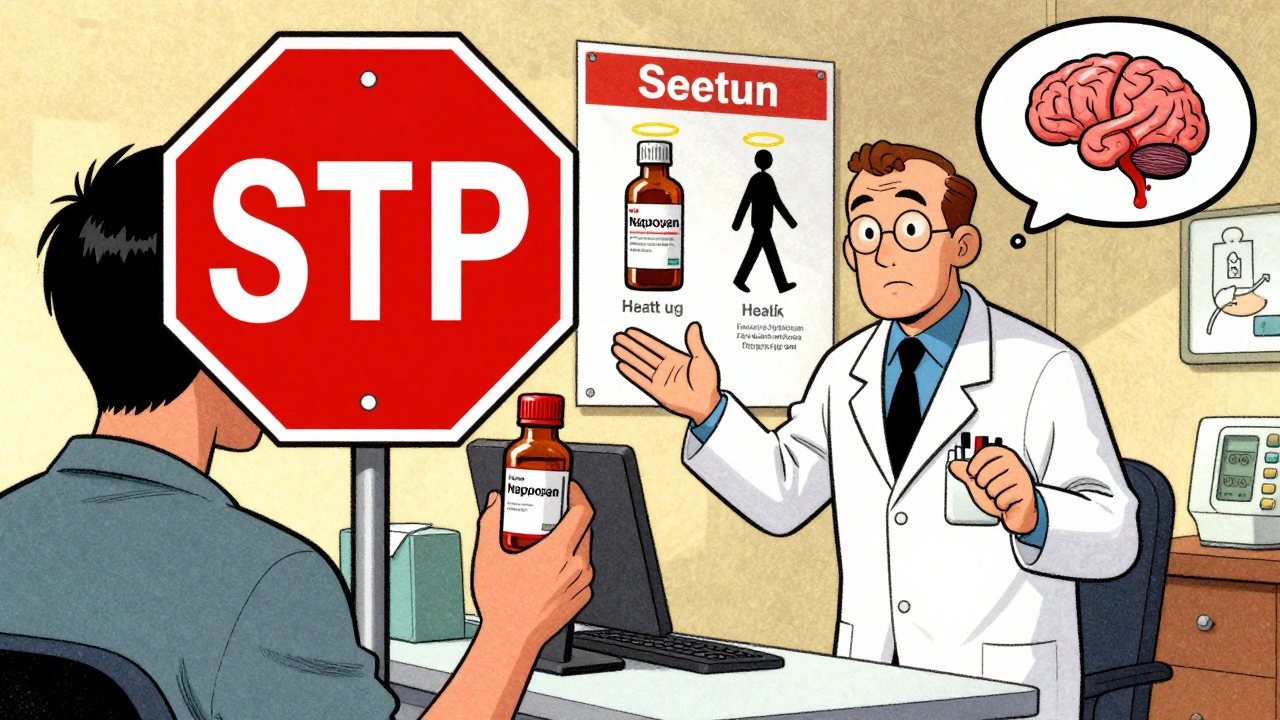
What Your Doctor Should Be Doing
Doctors need to ask about NSAID use-not just prescription ones, but OTC. They need to review every medication, including supplements and herbal products. Many patients don’t mention them because they think it’s "not important." But it is.Health systems are starting to catch on. Some hospitals now have automated alerts in their electronic records that flag when a blood thinner is prescribed alongside an NSAID. Pharmacists are being trained to intervene before the patient even leaves the pharmacy. These are life-saving systems. But they’re not everywhere yet. You can’t rely on them. You have to speak up.
What You Need to Do Right Now
If you’re on a blood thinner:- Check your medicine cabinet. Do you have any NSAIDs? Naproxen? Ibuprofen? Diclofenac? Put them away.
- Replace them with acetaminophen for pain relief.
- Next time you see your doctor or pharmacist, say: "I’m on a blood thinner. What can I take for pain?" Don’t assume they know what you’re using.
- If you’ve taken an NSAID recently and notice unusual bruising, blood in your urine or stool, severe headaches, dizziness, or shortness of breath-get medical help immediately.
This isn’t about being overly cautious. It’s about survival. The data doesn’t lie. The risk is real. The consequences are severe. And the solution is simple: avoid the combo. Use acetaminophen. Talk to your doctor. Protect yourself.
Can I take ibuprofen if I’m on warfarin?
No, it’s not safe. Even though ibuprofen is sold over the counter, it increases your risk of bleeding by nearly 80% when taken with warfarin. The risk isn’t just in your stomach-it can cause bleeding in your brain, lungs, or kidneys. Acetaminophen (Tylenol) is the safer choice for pain relief.
Are newer blood thinners safer with NSAIDs than warfarin?
No. Whether you’re on warfarin, apixaban, rivaroxaban, dabigatran, or edoxaban, combining any of them with NSAIDs raises your bleeding risk by the same amount. The newer drugs aren’t protected from this interaction. The danger is the same across all anticoagulants.
Is naproxen worse than ibuprofen with blood thinners?
Yes. Naproxen increases bleeding risk by over four times compared to blood thinners alone, while ibuprofen raises it by about 1.8 times. Diclofenac is almost as dangerous as naproxen. All NSAIDs carry risk, but naproxen and diclofenac are the worst offenders.
Can I take an NSAID once in a while for a bad headache?
Even one dose can be risky. Studies show that bleeding risk rises within days of starting an NSAID, and it doesn’t require long-term use. If you’re on a blood thinner, skip NSAIDs completely-even for occasional pain. Use acetaminophen instead.
What should I do if I accidentally took ibuprofen with my blood thinner?
If you took one or two doses and feel fine, stop the NSAID immediately and monitor for signs of bleeding: unusual bruising, dark stools, blood in urine, dizziness, or severe headache. Call your doctor or pharmacist to let them know. If you have any symptoms of bleeding, go to the emergency room right away.
Are there any natural alternatives to NSAIDs for joint pain?
Yes. Heat therapy, cold packs, physical therapy, weight management, and low-impact exercise like swimming or cycling can reduce inflammation and pain without drugs. Some people find relief with turmeric or fish oil supplements, but always check with your doctor first-some supplements can also interact with blood thinners.
10 Comments

matthew dendle
December 12, 2025 at 18:51 PM
lol so if u take advil once for a headache while on xarelto u gonna bleed out like a stabbed watermelon?? smh. i know ppl who take both for years and theyre fine. doctors love scare tactics to sell more tests. also tylenol is poison if u drink even 1 beer. so like… whats the real win here??

Monica Evan
December 14, 2025 at 05:46 AM
I’m a nurse and I’ve seen this play out too many times. Grandpa takes naproxen for his knees, doesn’t tell his cardiologist, ends up in the ER with a GI bleed and a hemoglobin of 5.2. It’s not paranoia - it’s pattern. And yes, Tylenol is safer, but don’t ignore the liver risk either. Dose matters. Timing matters. And if you’re on blood thinners? Always. Always. Tell your pharmacist. They’re the ones who catch the stuff doctors miss.

Neelam Kumari
December 15, 2025 at 05:55 AM
Oh wow. Another ‘you’re all idiots for taking OTC meds’ lecture. Let me guess - you also think people shouldn’t breathe near traffic because ‘air pollution is dangerous’? Newsflash: life is risk. You want zero risk? Move to a bunker. Otherwise, stop pretending one pill is a death sentence. My aunt’s on warfarin and takes ibuprofen every Sunday after yoga. She’s 78 and still hikes. Maybe your fear isn’t about science - it’s about control.

Katherine Liu-Bevan
December 16, 2025 at 22:47 PM
The study cited is robust - 51,000 patients, real-world data, adjusted for comorbidities. The risk isn’t theoretical. It’s statistically significant across all DOACs and warfarin. Acetaminophen isn’t perfect, but it’s the only option with a favorable risk-benefit profile in this context. Non-pharmacological interventions like physical therapy are underutilized, not because they’re ineffective, but because our culture treats pain as something to be erased, not managed. This isn’t fearmongering - it’s evidence-based harm reduction.

Jean Claude de La Ronde
December 18, 2025 at 02:00 AM
So we’ve turned medicine into a moral crusade - NSAIDs = evil, Tylenol = holy water. But what if the real problem is that we’ve outsourced our pain tolerance to a pill? We’ve forgotten how to sit with discomfort. How to rest. How to move differently. Maybe the real danger isn’t the drug combo - it’s our refusal to accept that healing sometimes means not taking anything at all.

Courtney Blake
December 18, 2025 at 15:57 PM
As an American, I’m tired of this anti-OTC propaganda. In Europe, they restrict everything - and still have higher death rates from untreated pain. This is just another way for Big Pharma to push their expensive DOACs and ‘specialized’ pain protocols. Meanwhile, real people are suffering because they’re too scared to take an Advil. Wake up. This isn’t safety - it’s control.

Ariel Nichole
December 18, 2025 at 16:04 PM
I really appreciate how thorough this post is. I’ve been on Eliquis for AFib for 3 years and never realized how risky ibuprofen was - even once in a while. I just tossed all my Advil and started using Tylenol. Also started seeing a PT for my lower back - turns out, my posture is trash. Small changes, big difference. Thanks for the clarity.

Mia Kingsley
December 19, 2025 at 22:40 PM
Okay but what if I’m on a blood thinner and I take NSAIDs and I’m fine?? What if I’ve done it for 10 years?? What if I’m one of the 98% who don’t bleed?? Are you gonna tell me I’m wrong because some study says so?? I don’t care about your data - I’m alive. You’re just scared of your own body. And you’re making everyone else scared too.

Jim Irish
December 21, 2025 at 10:44 AM
Thank you for this clear, evidence-based summary. The most important takeaway is that patients must initiate the conversation with their providers. No algorithm will replace human communication. If you’re on anticoagulation, ask about every medication - even the ones you think don’t count. It’s not paranoia. It’s partnership.

Queenie Chan
December 11, 2025 at 04:57 AM
So let me get this straight - we’re telling people to ditch ibuprofen like it’s a toxic ex, but acetaminophen is somehow the saint of pain relief? Cool. Except that same acetaminophen is quietly murdering liver cells in 30% of people who take it long-term. And nobody’s screaming about that. The real villain here isn’t NSAIDs - it’s our healthcare system’s obsession with one-size-fits-all magic bullets. We need nuance, not fearmongering.