Planning an international trip and taking medications that contain controlled substances? You’re not alone. Every year, thousands of travelers get caught off guard at customs because they didn’t bring the right paperwork. A simple doctor’s letter for controlled substances can save you from detention, confiscation, or even arrest. This isn’t just a formality-it’s your legal protection in 186 countries that follow international drug treaties.
Why You Need a Doctor’s Letter
Many medications you take daily-like Adderall, oxycodone, Xanax, or Ritalin-are tightly controlled abroad. Even if they’re legal in your home country, they might be banned or heavily restricted elsewhere. The International Narcotics Control Board (INCB) is the global authority that sets standards for how countries handle travelers carrying these drugs. According to their 2022 report, 142 countries have official rules about this, and 68% of travel incidents involving medications happen because people didn’t carry proper documentation.
Your doctor’s letter isn’t just a note. It’s your proof that you’re not smuggling drugs-you’re managing a medical condition. Without it, border agents have no way to verify your need. In 2022, the INCB documented 127 cases where travelers were detained for an average of 14 days just because their letter was missing key details.
What Must Be in the Letter
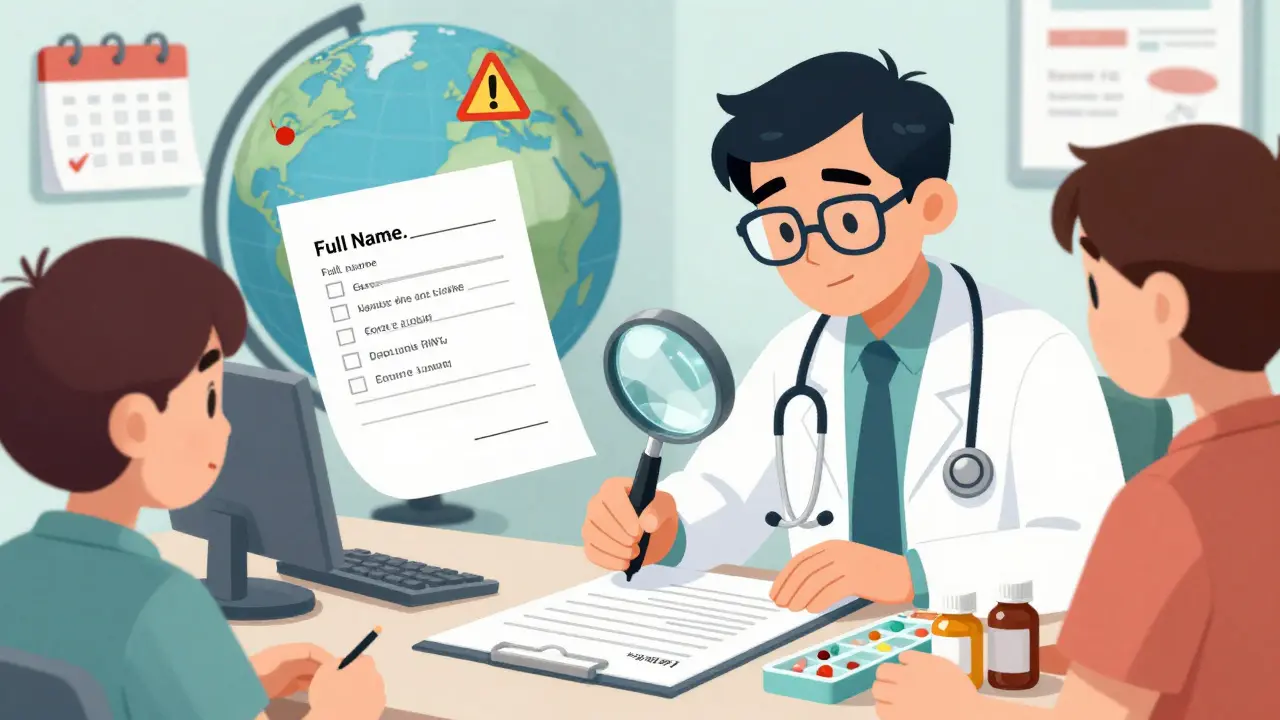
A generic note from your doctor won’t cut it. The CDC’s 2023 Yellow Book template outlines exactly what’s required. Your letter must include:
- Your full name and date of birth (exactly as it appears on your passport)
- The prescribing physician’s full name, license number, title, clinic address, and direct contact information
- The generic name of each medication (not the brand name-brand names vary by country)
- The exact dosage, frequency, and route of administration (e.g., 10 mg orally once daily)
- A clear statement of your medical condition being treated (e.g., “treatment for attention deficit hyperactivity disorder”)
- A formal request that you be allowed to carry these medications for personal use during your trip
- The physician’s original signature and official clinic letterhead
And here’s the catch: if you’re carrying multiple controlled substances, you need a separate letter for each one. The FDA and CBP require a 1:1 match between documentation and medication. One letter for three different pills? That’s a red flag.
How Much Can You Bring?
There’s no universal limit, but most countries follow the 90-day supply rule. This means you should carry no more than what you’d need for three months of treatment. The FDA and CBP explicitly advise against bringing more than this-even if your doctor prescribes a 6-month supply.
Some countries are stricter. Singapore and Malaysia allow only 30 days’ supply. Exceed that, even with perfect documentation, and you risk criminal charges. Japan bans many common ADHD medications entirely-even with a letter. The UAE requires advance approval from their Ministry of Health. Canada accepts doctor’s letters alone for under 100 dosage units. The U.S. requires both a letter and the original prescription.
How Medications Must Be Packaged
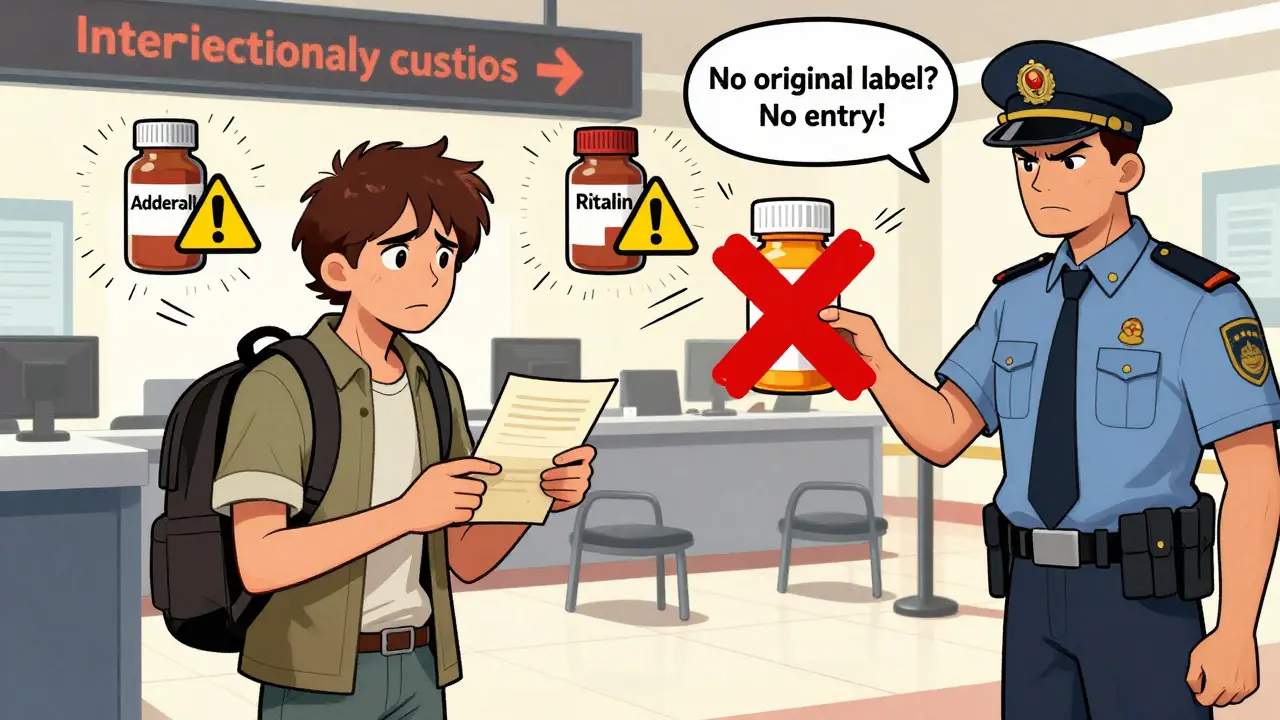
Don’t toss your pills into a pill organizer without thinking. The FDA and DEA require medications to be carried in their original containers with the pharmacy label intact. That label should match the information in your doctor’s letter.
There’s an exception: if you use a pill organizer for daily convenience, you can do so-but only if you also carry the original bottles and all required documentation. Border agents need to be able to verify the medication’s identity instantly. If they can’t read the label, they’ll assume it’s illegal.
Country-by-Country Differences You Can’t Ignore
Not all countries play by the same rules. Here’s what you need to know:
| Country | Requires Doctor’s Letter? | Additional Requirements | Max Supply Allowed |
|---|---|---|---|
| United States | Yes | Original prescription required | 90 days |
| Canada | Yes | None if under 100 units | 90 days |
| Japan | Yes | Bans Adderall, Ritalin, and other stimulants | Not applicable |
| United Arab Emirates | Yes | Advance approval from Ministry of Health | 30 days |
| Singapore | Yes | Criminal penalties for excess | 30 days |
| European Union | Yes | Recognizes letters from other EU countries | 90 days |
And here’s the kicker: 58% of travelers rely on outdated or inaccurate sources for country rules. Google searches, travel blogs, or even pharmacy advice can be dangerously wrong. Always check the official embassy website of your destination. The U.S. Department of State recommends contacting embassies directly-92% of travel medicine specialists say this is the most reliable step.
What to Do Before You Leave
Don’t wait until the airport. Start at least two months before your trip. Here’s a simple checklist:
- Make a full list of all medications you take, including generic names and chemical ingredients
- Call your doctor’s office and request a letter using the CDC’s template
- Confirm with your doctor that the letter includes all required elements-especially the generic name and condition
- Check each country’s official health or customs website for specific rules
- Keep medications in original containers with labels
- Carry printed copies of the letter and prescription in your carry-on
- If traveling to Japan, the UAE, or Singapore, contact their embassy for special instructions
A 2022 survey found that 72% of physicians don’t provide the full generic name or chemical composition. That’s a major gap. If your doctor says, “I’ll just write a note,” push back. Ask them to use the CDC template. If they refuse, find another provider. This isn’t optional-it’s a safety net.
What Happens If You Don’t Have It?
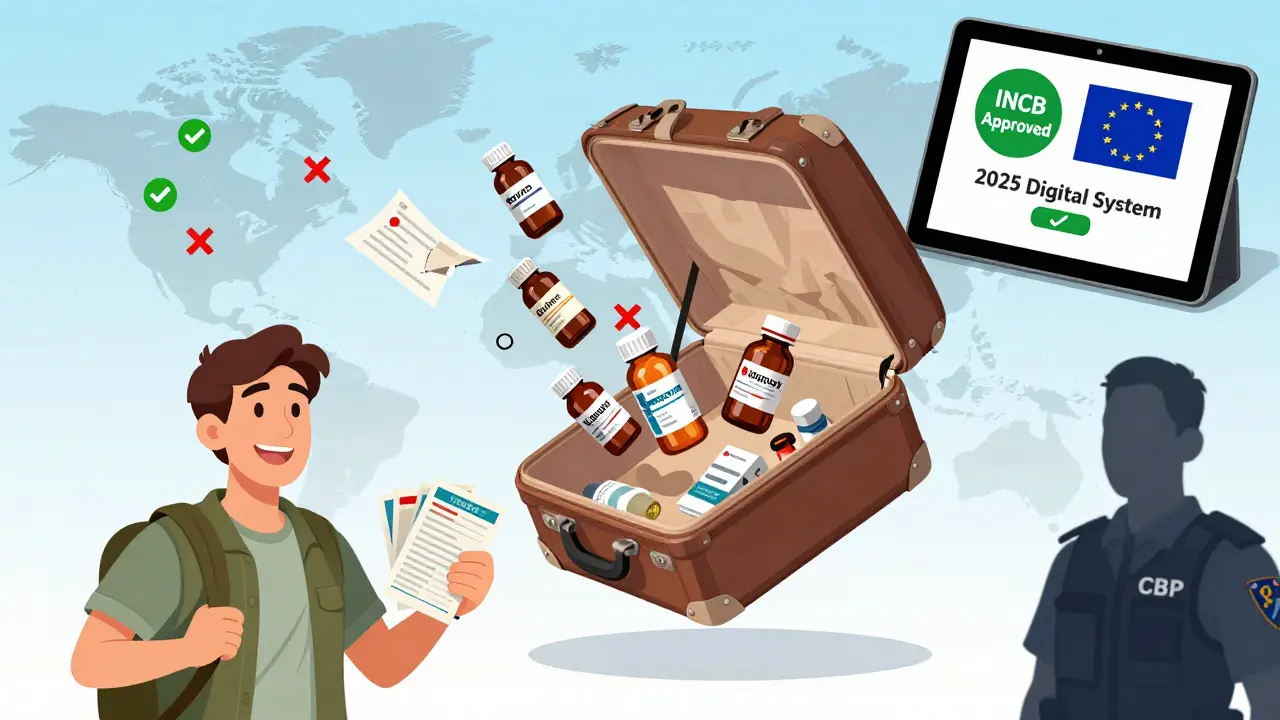
Travelers without proper documentation face serious consequences:
- Medications seized at customs
- Detention for questioning (average 14.3 days)
- Deportation or travel bans
- Criminal charges in countries like Singapore, Malaysia, or Thailand
Dr. Ghada Wible of the UNODC says the absence of documentation is the #1 reason travelers get detained. In one case, a woman from Australia was held in Dubai for 11 days because her Xanax bottle didn’t have the original label, even though she had a letter. She didn’t know the label was required.
What’s Changing in 2025?
The system is slowly getting better. The INCB is piloting a digital medical certificate in 12 European countries. The European Commission is funding a €2.4 million project to create a unified digital system for all EU travelers by late 2024. The FDA now accepts telemedicine prescriptions if they’re properly signed and timestamped.
But don’t wait for the system to improve. Right now, paper letters are still the only reliable method. If you’re traveling in 2026, you still need the same things you needed in 2023: a complete letter, original containers, and verified country rules.
Final Tips
- Always carry the letter and prescriptions in your carry-on-not checked luggage
- Bring extra copies. Give one to a travel companion
- If you’re on a long-term trip, consider getting a local prescription at your destination
- Never rely on pharmacy advice alone-check official government sites
- For ADHD medications, assume you’re facing the strictest rules-89% of countries treat them as high-risk
Traveling with controlled substances isn’t about bureaucracy. It’s about safety-for you and for others. A few hours of preparation can prevent a nightmare. Don’t gamble with your health, your freedom, or your trip.
Do I need a doctor’s letter if I’m only flying domestically?
No. Domestic flights within your own country don’t require a doctor’s letter for controlled substances. These rules only apply when crossing international borders. However, some airlines may still ask for proof of prescription if you’re carrying large quantities, so it’s smart to keep your original prescription with you.
Can I use a telemedicine letter from an online doctor?
Yes, if the letter meets all the same requirements: full physician details, original signature (digital or wet), clinic letterhead, and correct medication details. The FDA and CBP now accept telemedicine documentation as long as it’s verifiable. Make sure the online provider is licensed in your state or country and that the letter includes all required elements.
What if my medication isn’t available in the country I’m visiting?
If your medication is banned or unavailable, you have two options: bring enough for your entire trip (within the 90-day limit), or consult a local doctor before your trip to see if they can prescribe an equivalent. Never try to buy medication abroad without a local prescription-it’s illegal in most countries. The CDC recommends contacting your embassy for help finding local providers.
Do I need a letter for over-the-counter medications?
Generally, no. But some OTC drugs contain controlled ingredients. For example, pseudoephedrine (in cold medicines) is regulated in many countries. If your OTC medication contains a substance listed in international drug treaties, you should still carry a letter. When in doubt, check the active ingredients against the INCB’s controlled substance list.
What if I’m traveling with my child’s medication?
Same rules apply. You’ll need a doctor’s letter for your child, with their full name and date of birth. If you’re not the parent, bring a notarized letter of permission from the parent or legal guardian. Border agents will ask for proof of guardianship if the child is traveling alone or with someone other than a parent.