
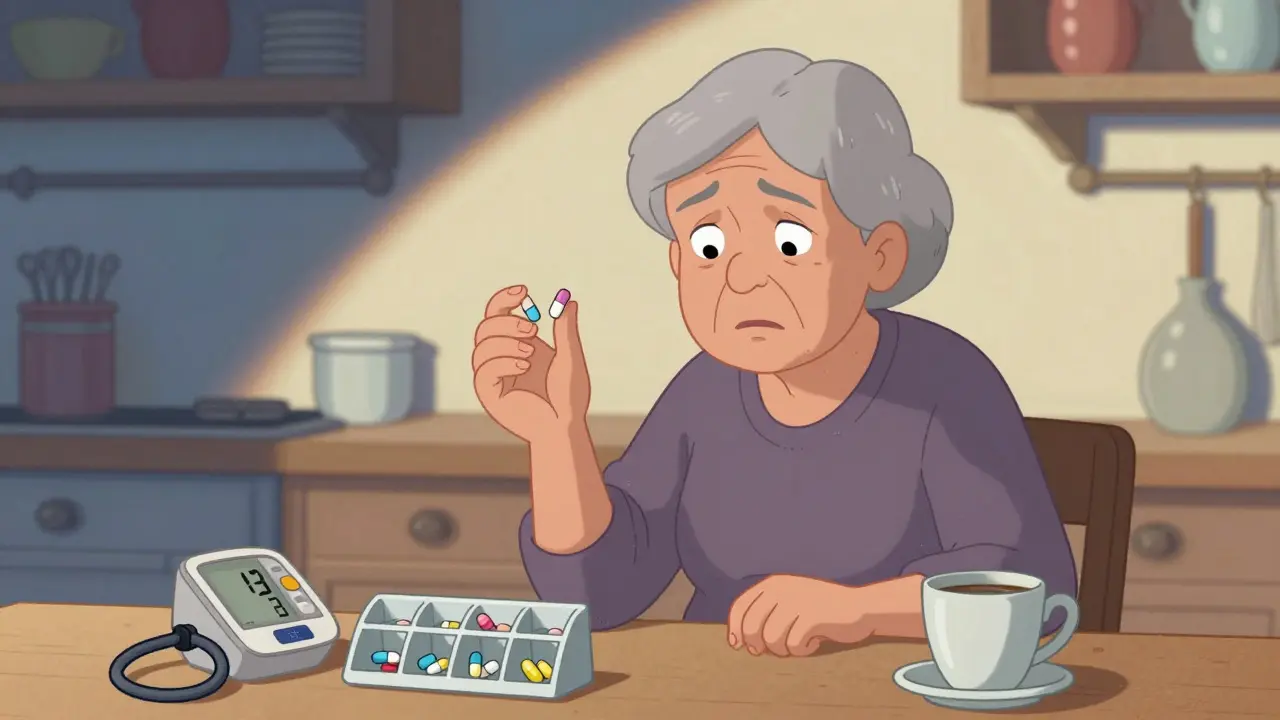
When older adults switch from brand-name drugs to generics, it’s not just a simple swap. For many seniors, it’s a quiet, daily decision that can affect how they feel, whether they take their pills, and even if they end up in the hospital. The cost savings are real-Medicare beneficiaries save an average of $602 a year using generics. But behind that number are real people worrying about whether their new pill will work the same as the old one.
Why Do Seniors Hesitate to Switch?
A 2023 study of 315 Medicare patients in New York found fewer than half believed generic drugs were as safe or effective as brand-name ones. That’s not because they’re being irrational. It’s because they’ve been told-or assumed-there’s a difference. A pill that looks different, has a different name on it, or costs less can feel like a downgrade. For someone managing five or more medications, that uncertainty adds stress.
One patient, 78-year-old Maria from Ohio, switched from brand-name Synthroid to generic levothyroxine after her pharmacy changed her prescription. Within weeks, she felt tired again, gained weight, and her heart started racing. She didn’t tell her doctor right away-she thought it was just aging. When she finally did, her blood test showed her thyroid levels had dropped. Her doctor switched her back to the brand. She’s now back on track, but the experience left her distrustful of generics.
Stories like Maria’s aren’t rare. On Reddit’s r/geriatrics, 73% of 147 commenters said they noticed symptoms returning after switching from brand to generic thyroid meds. These aren’t just anecdotes. Studies show that for drugs with a narrow therapeutic index-where even small changes in blood levels can cause harm-switching can trigger real problems.
What Makes Some Drugs Riskier to Switch?
Not all medications are created equal when it comes to switching. Drugs like warfarin (a blood thinner), levothyroxine (for thyroid), and certain seizure medications have very tight safety margins. Your body needs just the right amount. Too little, and you’re at risk of clots or seizures. Too much, and you bleed or have toxic reactions.
A 2021 Canadian study of over 134,000 patients found that switching warfarin formulations-brand to generic or even one generic to another-led to an 18.3% higher chance of an emergency room visit within 30 days. That’s why the American Geriatrics Society says: don’t automatically switch elderly patients on warfarin without close monitoring. INR blood tests must be checked more often after a switch.
Even small differences in how a generic pill dissolves or is absorbed can matter. Older adults often have slower digestion, weaker kidneys, and less body fat-all of which change how drugs move through the body. A 2002 study in American Family Physician showed that people over 85 often have creatinine clearance below 50 mL/min, meaning their kidneys can’t clear drugs as efficiently. That makes them more sensitive to tiny variations.
For drugs like digoxin, lithium, or phenytoin, even a 5% change in blood concentration can be dangerous. While the FDA requires generics to be within 80-125% of the brand’s absorption, that range is wide. For a healthy 30-year-old, it’s fine. For an 80-year-old with multiple conditions? It’s a gamble.
Cost vs. Confidence: The Real Trade-Off
Medicare Part D filled over 527 million generic prescriptions in 2022-89.2% of all prescriptions. That’s because generics cost far less. On average, a 30-day supply of a brand-name blood pressure pill might cost $80. The generic? $12. That’s $327 saved per year per patient, according to AARP. For fixed-income seniors, that’s rent money, food, or heat.
But money isn’t the only factor. A 2017 NIH study found that one in four low-income seniors believed generics were less effective. One in five thought they were less safe. And nearly half were unsure about key details like dosage, side effects, or how the drug worked.
Health literacy plays a huge role. Nearly 36% of adults 65 and older have trouble reading and understanding health materials, according to the National Assessment of Adult Literacy. If a patient can’t read the label, or doesn’t understand why the pill looks different, they’re more likely to skip doses or stop taking it altogether.
And here’s the catch: when patients stop taking their meds because they think the generic doesn’t work, their condition worsens. Blood pressure spikes. Blood sugar climbs. Heart failure gets worse. The result? More ER visits, more hospital stays, and higher long-term costs.

What Works: How to Make Switching Safer
Switching to generics doesn’t have to be risky. It just needs to be done right.
First, don’t switch without a plan. If a patient is stable on a brand-name drug, especially for a narrow-therapeutic-index medication, switching should only happen with the doctor’s approval-and a clear monitoring plan. For warfarin, that means an INR test within 1-2 weeks after the switch. For thyroid meds, a TSH test in 6-8 weeks.
Second, use the teach-back method. Instead of just handing a patient a new prescription, ask them to explain it back. “Can you tell me why you’re taking this pill now, and how it’s different from the one you had before?” Studies show this simple technique improves adherence by 42%. It also uncovers misunderstandings early.
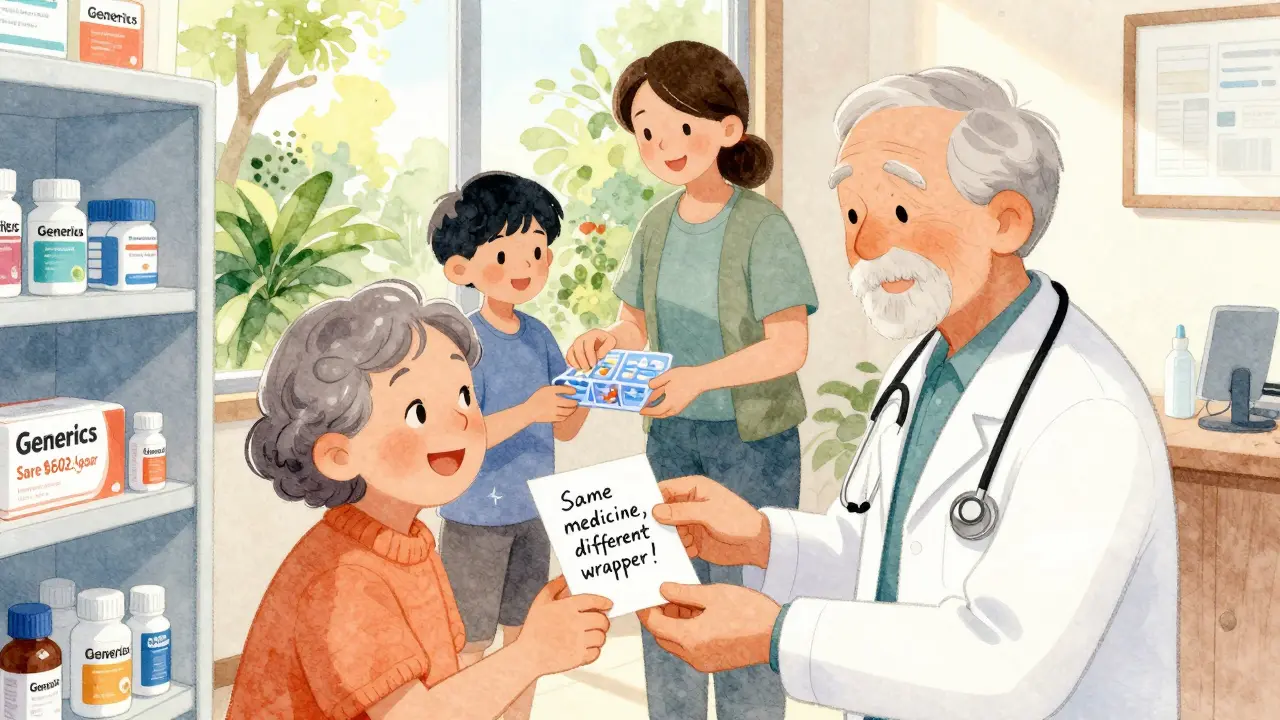
Third, show them the pills. A picture or physical comparison helps. Hold up the old brand pill and the new generic side by side. Say: “This is the same medicine, just made by a different company. The color and shape changed, but the active ingredient is identical.” Visuals reduce fear.
Fourth, involve a pharmacist. Clinical pharmacists who review all medications during hospital discharge or clinic visits reduce inappropriate prescriptions by 37.2%, according to a 2024 JAMA study. They catch interactions, spot duplicates, and explain why a switch is safe.
Finally, track outcomes. If a patient switches to a generic and starts feeling worse, don’t assume it’s “just aging.” Re-evaluate. Check labs. Consider switching back. Sometimes, the generic works fine. Other times, the patient’s body responds better to one formulation over another-even if both are FDA-approved.
When Generics Work Just Fine
Not every switch is risky. For most common conditions-high blood pressure, high cholesterol, diabetes, depression-generics are just as effective. A Medicare survey found 82% of seniors reported no difference after switching to generics for hypertension meds. The same holds true for statins, metformin, and many antidepressants.
For these drugs, the benefits far outweigh the risks. The cost savings are massive. The side effect profiles are nearly identical. And the evidence is solid. Harvard Health Publishing says: “There is really no hard proof that generic medications are any less effective or safe than the originals.”
The key is matching the drug to the patient. If someone is doing well on a brand-name drug with no issues, there’s no need to switch. But if they’re struggling to afford it, or their insurance won’t cover the brand, switching to a generic-with proper support-is not just smart. It’s essential.
What’s Changing in 2025
The American Geriatrics Society is updating its guidelines this year to include stronger recommendations for pharmacist-led medication reviews in emergency departments. The 2024 National Action Plan for Adverse Drug Event Prevention is now targeting NSAIDs-like ibuprofen and naproxen-which cause 15.4% of all drug-related hospitalizations in seniors, more than blood thinners.
The FDA is also tightening rules for complex generics, especially those used by older adults. In 2022, they issued draft guidance requiring extra bioequivalence testing for drugs like warfarin and levothyroxine, recognizing that older bodies don’t always respond the same way.
Three NIH-funded studies are currently recruiting seniors aged 75+ with multiple chronic conditions to compare brand and generic outcomes over time. Results from these trials-expected by 2027-could reshape how we think about switching for the oldest patients.
Bottom Line: Don’t Assume. Ask. Monitor.
Switching elderly patients to generics isn’t about cutting costs alone. It’s about making care safer, more affordable, and more sustainable. But it can’t be done blindly.
For every patient, ask: What are they taking? Why? Are they stable? Can they afford it? Do they understand the change?
For high-risk drugs, monitor closely. For common ones, switch confidently-with clear communication. And always, always listen when a patient says, “This doesn’t feel right.” Sometimes, it’s just the pill. Sometimes, it’s the body telling you something’s off.
The goal isn’t to force generics. It’s to make sure the right drug, in the right form, reaches the right person at the right time-with understanding, not fear.
12 Comments

Raven C
December 18, 2025 at 09:09 AM
One cannot help but observe, with profound dismay, the alarming conflation of pharmacological equivalence with economic expediency-a trend that, in its unchecked proliferation, threatens to erode the very foundations of clinical trust in geriatric therapeutics.

Sam Clark
December 19, 2025 at 13:49 PM
Thank you for this thoughtful and evidence-based breakdown. It’s easy to assume cost savings are the only factor, but the real issue is patient-centered care. Clear communication, monitoring, and respect for individual responses are non-negotiable.

Anu radha
December 20, 2025 at 21:19 PM
My aunt switched to generic thyroid medicine and felt very weak. She told doctor, they checked blood, and changed back. Now she is fine. Simple thing, but important.

Jigar shah
December 22, 2025 at 01:55 AM
While the FDA’s 80–125% bioequivalence range is statistically acceptable for the general population, its applicability to elderly patients with polypharmacy, reduced renal clearance, and altered pharmacokinetics remains empirically underexplored. A one-size-fits-all regulatory framework may be inadequate.

Marie Mee
December 23, 2025 at 18:11 PM
They swap the pills and then say 'it's the same' but they know what's really going on... the government and pharma are in bed together. They want you sick so they can keep selling you more stuff. Look at the color change-it's a tracking chip. I know it.

Michael Whitaker
December 25, 2025 at 15:33 PM
One must, with the utmost intellectual rigor, acknowledge that the assertion that 'generics are just as effective' is a gross oversimplification-a reductionist fallacy that ignores the nuanced pharmacodynamics of aging physiology. The data, while statistically significant, lacks clinical granularity.

Brooks Beveridge
December 26, 2025 at 23:00 PM
Great post. 😊 So many seniors are scared because no one takes the time to explain. A picture, a conversation, a little patience-that’s all it takes. You’re not just saving money, you’re saving trust.

Joe Bartlett
December 28, 2025 at 18:02 PM
Same medicine, different label. Brits have been doing this for decades. No problems. Stop overthinking it.

Erik J
December 29, 2025 at 23:51 PM
Interesting. I wonder if there’s data on whether patients who switch back to brand-name after adverse effects ever switch again-or if they just stay on the brand indefinitely.

BETH VON KAUFFMANN
December 30, 2025 at 21:22 PM
The bioequivalence paradigm is fundamentally flawed for narrow-therapeutic-index agents. The 80–125% window is a regulatory artifact, not a clinical safeguard. We’re conducting a nationwide pharmacokinetic experiment on geriatric populations with zero longitudinal tracking. That’s not science-it’s negligence.

Donna Packard
January 1, 2026 at 04:57 AM
It’s so important to listen when someone says, 'This doesn’t feel right.' Sometimes the body knows before the lab does. Thank you for reminding us to honor that.


Jody Patrick
December 17, 2025 at 11:19 AM
Generics are just Big Pharma’s way to keep you hooked on cheap pills while they rake in cash from the next brand-name scam. If it ain’t the same name, it ain’t the same medicine.