

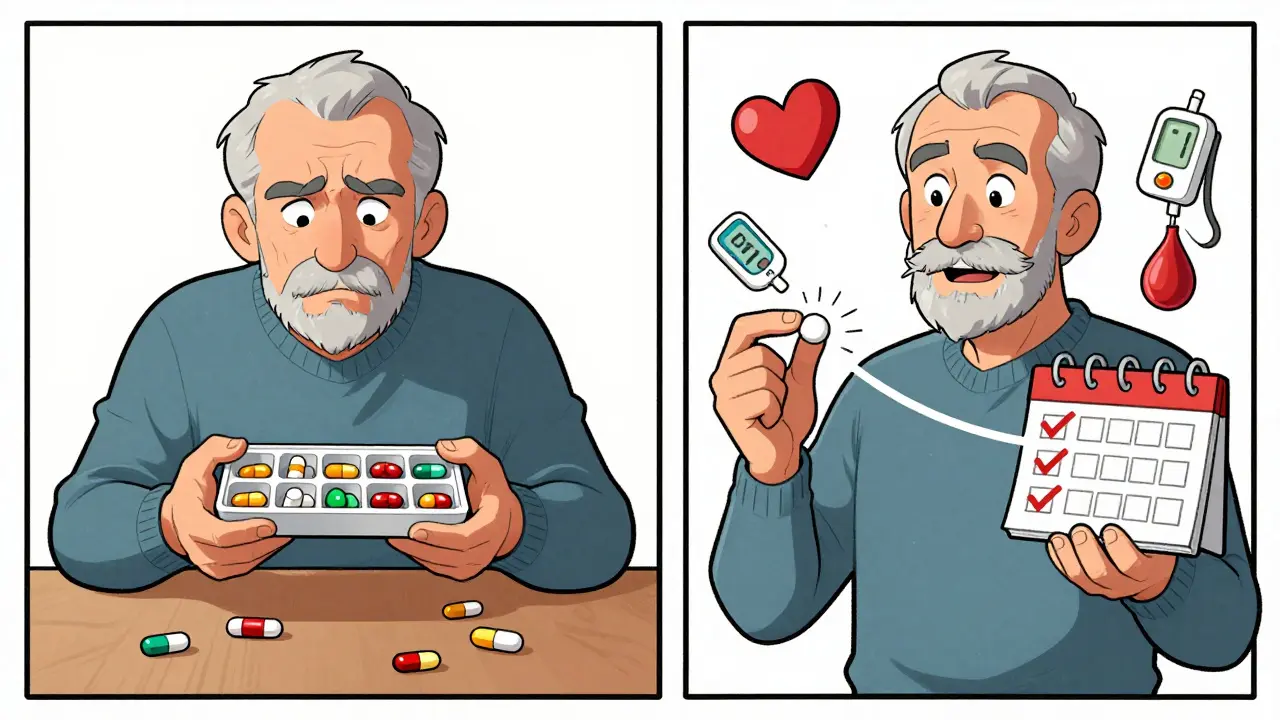
Imagine taking 12 pills a day-some at breakfast, some after lunch, others before bed, and a few scattered between meals. Now imagine cutting that down to just four. For millions of people managing multiple chronic conditions, this isn’t a fantasy. It’s a proven way to get back control of their lives. The truth is, complex medication regimens don’t just confuse patients-they break adherence. And when people miss doses, hospital visits go up, complications grow, and quality of life drops. The good news? You don’t need to take more pills to get better. You need fewer, smarter ones.
Why Fewer Daily Doses Make a Real Difference
It’s not about cutting corners. It’s about matching medicine to real life. Studies show that for every additional pill someone takes per day, adherence drops by about 5%. That means if you’re on 10 pills a day, you’re likely missing nearly half of them. And it’s not because people are careless. It’s because the schedule is impossible to follow. A 2014 JAMA Internal Medicine study found that nearly 30% of older adults were taking medications seven or more times daily. Only 15% organized their doses into four or fewer time slots. That mismatch is why simplification works.
When you reduce daily doses, you’re not just making things easier-you’re making them stick. One trial with 1,500 older adults showed that 41% of their medication regimens could be simplified without losing effectiveness. In aged care homes, that number jumped to 56%. The reason? Fewer times to remember means fewer missed doses. And when people take their meds as prescribed, their blood pressure stabilizes, their diabetes stays under control, and their heart attacks and strokes drop.
How Fixed-Dose Combinations Cut Pill Burden
One of the most powerful tools in simplification is the fixed-dose combination (FDC). This is when two or more medications are combined into a single pill. For example, instead of taking a blood pressure pill, a cholesterol pill, and a diabetes pill separately, you might get one tablet that contains all three. About one-third of all successful simplifications use this method.
FDCs aren’t new. They’ve been used for years in HIV treatment, where once-daily triple-combination pills turned a once-daunting routine into something manageable. But now they’re showing up for heart disease, hypertension, and even mental health. In 2022 alone, the FDA approved 12 new FDCs-a 25% increase from 2020. That’s not random. It’s demand-driven.
But FDCs aren’t magic. They only work if the doses match up. You can’t combine a 5mg and a 10mg dose into one pill if the patient needs 7.5mg of one drug. That’s why this has to be done by a pharmacist or doctor who understands pharmacokinetics. A patient on multiple antihypertensives might not be able to use an FDC if one drug needs to be taken at night and the other in the morning. The timing matters.
Once-Daily Dosing: When Timing Is Everything
Not every drug can be taken once a day. But many can-thanks to extended-release formulations. These are specially designed to release medicine slowly over 24 hours. Think of them like a slow drip instead of a splash. This works for antidepressants, statins, some blood pressure meds, and even certain antibiotics.
For people on antiretroviral therapy (ART), switching to once-daily regimens cut missed doses from 12% to 4% monthly. That’s a huge win. But here’s the catch: not all medications can be converted. Drugs with short half-lives-like some antibiotics or insulin-need to be taken multiple times. Pushing them into once-daily dosing can lead to treatment failure or even toxicity.
That’s why this isn’t a DIY project. A pharmacist needs to check each medication’s half-life, absorption window, and interaction risks. The goal isn’t to force everything into one pill-it’s to find what can safely be grouped. A 2018 study found that even when adherence improved with once-daily ART, clinical outcomes didn’t always follow. That’s because adherence isn’t the only factor. Nutrition, liver function, and other meds still matter.
Medication Synchronization: One Day, One Trip
Here’s a hidden problem: people don’t miss doses because they forget. They miss them because they run out. If your blood pressure med runs out on Tuesday, but your diabetes med runs out on Thursday, you’re stuck choosing which one to skip. That’s where synchronization comes in.
Medication synchronization means all your prescriptions are due on the same day each month. Instead of visiting the pharmacy three times a month, you go once. Your pills are ready. You pick them up. You’re set for 30 days. This cuts pharmacy visits by 60% and reduces gaps in therapy by nearly half.
This isn’t just convenient-it’s lifesaving. In cardiovascular patients, synchronization reduced missed doses by 22%. But it only works if your pharmacy supports it. And not all do. Insurance formularies can block it if the preferred brand isn’t covered. Some pharmacies charge extra. Others don’t have the system to track it. Talk to your pharmacist. Ask if they offer sync programs. If they don’t, ask them to start.
Compliance Packaging: The Organizer That Saves Lives
For older adults with memory issues or caregivers managing multiple meds, a simple pill organizer can be a game-changer. Multi-dose compliance packaging sorts pills into compartments labeled by time of day: morning, noon, evening, bedtime. Some even have alarms or Bluetooth alerts.
Studies show patients using these organizers improve adherence by 22% compared to keeping pills in their original bottles. One caregiver on AgingCare.com said, “My mother went from confusion and missed doses to taking everything on time-just because she could see it all in one box.”
But it’s not free. Packaging costs 15-20% more than standard prescriptions. Medicare doesn’t always cover it. Private insurers vary. And if you’re on a fixed income, that extra cost can be a dealbreaker. Some community pharmacies offer subsidized programs. Ask. Some nonprofit groups help low-income seniors with packaging. Don’t assume it’s out of reach.
The Universal Medication Schedule: Four Times a Day Is the Sweet Spot
There’s a simple rule that works for most people: aim for four times a day. Morning, noon, evening, bedtime. That’s the Universal Medication Schedule (UMS). It’s not arbitrary. It’s based on how people naturally structure their days. Most folks eat three meals and sleep once. Aligning meds to those cues makes them easier to remember.
Hospitals that use UMS see 35% fewer dosing errors. Why? Because it cuts down on confusing instructions like “take with food,” “take on an empty stomach,” or “every 8 hours.” Instead, you say: “Take your heart pill with breakfast. Your cholesterol pill at dinner. Your pain med at bedtime.”
Even if you can’t get everything down to one pill, you can still group what you can. If you have five meds, try to fit them into four time slots. Maybe one pill goes with breakfast and lunch. Another with dinner and bedtime. It’s not perfect-but it’s better than seven.

What Doesn’t Work-and Why
Simplification isn’t a one-size-fits-all fix. Some meds just won’t play nice. Oral diabetes drugs like metformin or sulfonylureas rarely benefit from simplification because their timing is tied closely to meals. Same with some antibiotics. You can’t stretch a 12-hour dose into 24 without risking resistance.
Also, don’t assume that if a pill looks the same, it’s safe to combine. A patient once told me she started taking her blood pressure pill and her thyroid pill together because they were both small white tablets. Turns out, the thyroid med needs to be taken on an empty stomach, 30 minutes before food. Mixing them ruined her absorption. That’s why medication reconciliation is non-negotiable.
Reconciliation means comparing what your doctor thinks you’re taking vs. what you’re actually taking. In one study, the average patient had six discrepancies between their list and reality. That’s not a typo. That’s six times someone could’ve been hurt.
How to Start the Process
You don’t need a PhD to simplify your meds. But you do need a plan. Here’s how to begin:
- Make a complete list of every pill, patch, inhaler, or injection you take-including vitamins and supplements.
- Bring it to your pharmacist or doctor. Don’t rely on memory. Write it down. Bring the bottles if you can.
- Ask: “Can any of these be combined or moved to fewer times a day?” Be specific. Say, “I’m taking six pills in the morning. Is there a way to cut that?”
- Request a medication therapy management (MTM) session. Medicare covers this for Part D enrollees. It’s free. A pharmacist spends 30 minutes reviewing your whole regimen.
- Follow up in 30 days. Did the new plan work? Did you forget any doses? Tell them what happened.
Success isn’t about getting to one pill a day. It’s about getting to a schedule you can live with. If you can go from 10 doses to 4, that’s a win. If you can go from three pharmacy trips a month to one, that’s a win. If you stop worrying about missing a pill because you can see it all in one box-that’s the real victory.
Barriers You Might Face-and How to Beat Them
Even the best plan hits roadblocks. Here are the most common ones-and how to handle them:
- Insurance denies the new pill: If your insurer won’t cover the FDC, ask for a prior authorization. Your doctor can write a letter explaining why the simpler version improves adherence. Many insurers approve it after appeal.
- Your doctor says no: Sometimes, doctors don’t know the latest options. Bring research. Say, “I read that 56% of seniors’ regimens can be simplified. Can we look at mine?”
- You’re confused about the new schedule: Ask for a written chart. Or use a free app like Medisafe or MyTherapy that sends reminders and tracks doses.
- Cost is too high: Ask about patient assistance programs. Many drugmakers offer free or discounted FDCs to low-income patients. Pharmacies sometimes have discount cards.
The biggest barrier? Thinking it’s too late to change. It’s never too late. Even if you’ve been taking 12 pills a day for 10 years, you can still simplify. One 82-year-old woman in Sydney switched from 11 daily doses to four after a pharmacist spent 45 minutes with her. She said, “I finally feel like I’m in charge again.”
Can I just combine my pills myself?
No. Crushing or mixing pills can change how they work. Some are time-released, and breaking them can cause dangerous spikes in drug levels. Others need to be taken on an empty stomach. Mixing them without professional guidance can be unsafe. Always talk to a pharmacist before changing how you take your meds.
Will simplifying my meds lower their effectiveness?
Not if done correctly. Studies show that when simplification is guided by a pharmacist or doctor using evidence-based tools, effectiveness stays the same-or improves. The goal isn’t to reduce dosage. It’s to reduce complexity. You’re still getting the same amount of medicine, just in a smarter way.
How long does it take to simplify a medication regimen?
It usually takes one or two appointments. The first is a full review-about 30 to 60 minutes. The second is a follow-up 30 days later to check if the new plan is working. Some changes, like switching to a fixed-dose combo, may take a few weeks to process through insurance or pharmacy systems.
Does Medicare cover medication simplification services?
Yes. Medicare Part D covers Medication Therapy Management (MTM) services for people with multiple chronic conditions who take several high-cost medications. These sessions are free and include regimen review, simplification recommendations, and follow-up. Ask your pharmacist if you qualify.
What if I don’t have a pharmacist I trust?
Start with your local pharmacy. Most have pharmacists on staff who can review your meds at no extra cost. If you’re on Medicare, ask for an MTM session. If your pharmacy doesn’t offer it, call another one. Many chain pharmacies like CVS, Walgreens, and independents all provide this service. Don’t wait-your health is worth the call.
If you’re taking multiple medications, you’re not alone. But you don’t have to live with the chaos. Simplifying your regimen isn’t about giving up-it’s about taking back control. One fewer pill a day. One less trip to the pharmacy. One less moment of doubt. That’s the power of fewer daily doses.
14 Comments

Desaundrea Morton-Pusey
January 27, 2026 at 07:58 AM
so let me get this straight... you're telling me the entire healthcare system is just too lazy to make simple pills? we pay billions and still can't get one pill that does everything? wow. america.

John O'Brien
January 27, 2026 at 16:52 PM
bro this is wild. my grandma took 14 pills a day for 12 years. last year her pharmacist put her on a 4-pill schedule. she started cooking again, went on cruises, stopped crying at the pharmacy counter. this isn't medicine. this is magic.

Kegan Powell
January 29, 2026 at 04:45 AM
i think we forget that meds aren't just chemicals they're rhythms. we're creatures of habit not calculators. when your pill schedule matches your coffee, your dinner, your bedtime... it stops being a chore and starts being part of you. that's the real win 🌅

April Williams
January 29, 2026 at 05:29 AM
i can't believe people still fall for this. you think combining pills is safe? what about the pharmaceutical companies pushing this to save money? they don't care if you live or die as long as you keep buying. wake up.

Candice Hartley
January 29, 2026 at 15:08 PM
my mom uses a pill box with alarms. it changed everything. she even laughs now when she hears it beep. 📱❤️

Kirstin Santiago
January 31, 2026 at 09:15 AM
i work at a clinic and we started doing med sync last year. patients who used to miss 3+ doses a week now miss less than one. it's not sexy. but it's the quietest revolution in healthcare.

Paul Taylor
February 1, 2026 at 06:06 AM
you know what's crazy? the fact that we still have people taking meds at 2am because their doctor wrote 'every 8 hours' instead of 'morning noon evening'. nobody lives like that. why do we treat patients like robots? the universal medication schedule makes so much sense it's almost embarrassing we didn't do this 20 years ago

Murphy Game
February 3, 2026 at 02:34 AM
this is all a cover. they're putting everything in one pill so they can track you. next thing you know your pill bottle is sending your vitals to big pharma. and you think you're saving time? you're being monitored.

Harry Henderson
February 3, 2026 at 17:02 PM
STOP WASTING TIME. GO TO YOUR PHARMACIST TODAY. RIGHT NOW. OPEN YOUR MEDS. WRITE THEM DOWN. ASK FOR A REVIEW. YOU DON'T NEED PERMISSION. YOU NEED ACTION. DO IT NOW.

suhail ahmed
February 4, 2026 at 15:26 PM
in india we call this 'meds ka jadoo' - medicine magic. my uncle was on 11 pills, now he takes four. he says he sleeps better, walks faster, even remembers his wife's birthday again. the real miracle isn't the pill. it's the peace.

astrid cook
February 5, 2026 at 13:24 PM
i'm sorry but if you're taking supplements with your meds, you're basically playing russian roulette. i've seen people end up in the ER because they thought 'natural' meant 'safe'. this post is great but please stop mixing your tea with your blood pressure pills.

Andrew Clausen
February 6, 2026 at 07:37 AM
the term 'universal medication schedule' is misleading. it's not universal. it's a suggestion. the study cited had a sample size of 1,500. that's not statistically significant for a population of 330 million. also, 'four times a day' ignores circadian rhythms. this article is oversimplified and potentially dangerous.

Anjula Jyala
February 6, 2026 at 18:41 PM
FDCs are pharmacokinetically problematic without TDM. the therapeutic window for antihypertensives is narrow and CYP450 interactions are underreported in real-world settings. you're conflating adherence with efficacy. without pharmacogenomic profiling, you're just redistributing risk.


Kathy McDaniel
January 26, 2026 at 14:02 PM
i literally just started taking 8 pills a day last month and was about to lose my mind. this post saved me. i called my pharmacist today and we got 3 of them combined into one. i feel like a new person 🙌