
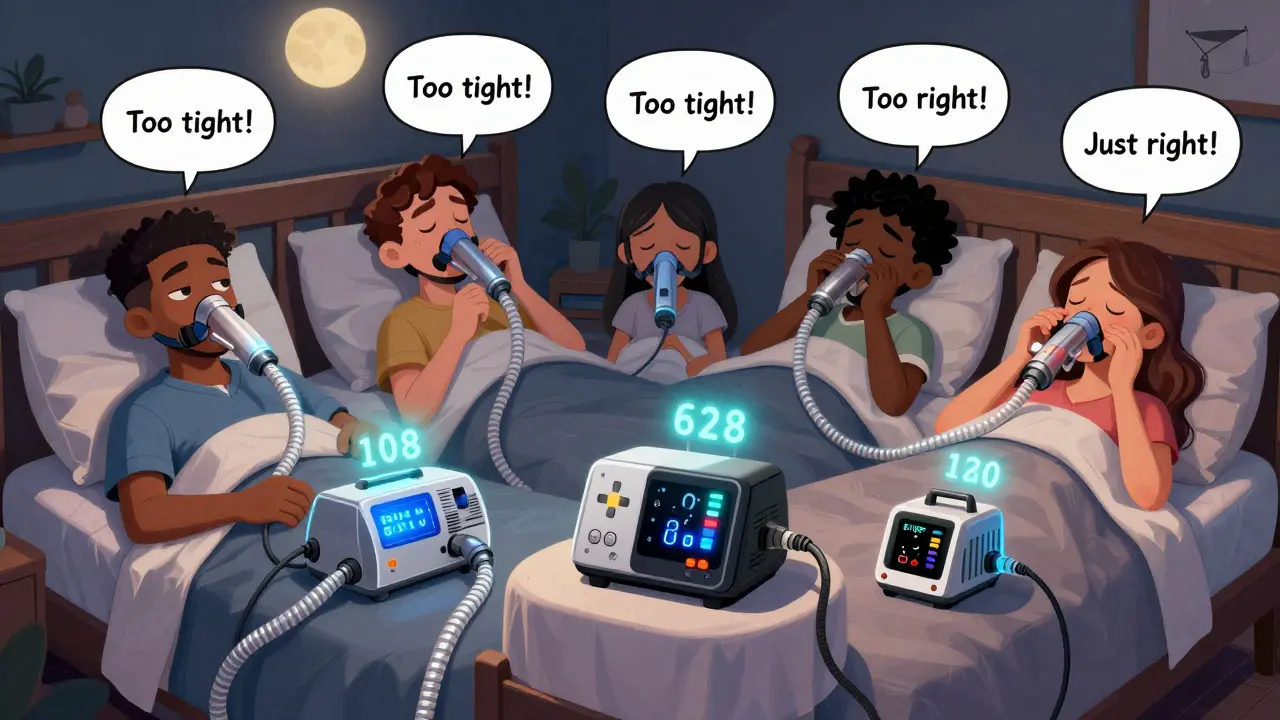
If you’ve been told you have sleep apnea, you’re not alone. Around 22 million Americans have it, and most don’t even know it. The good news? CPAP therapy works-when you actually use it. The problem? About half of people who start CPAP stop within the first few months. It’s not because the machine doesn’t work. It’s because the mask feels wrong, the air feels forced, or the machine is too loud. This isn’t about willpower. It’s about matching the right machine and mask to your life-and knowing how to stick with it.
What Kind of CPAP Machine Do You Really Need?
Not all CPAP machines are the same. There are four main types, and picking the wrong one can make your nights miserable.Traditional CPAP delivers one steady pressure all night. It’s the cheapest option, usually between $500 and $1,000. Models like the ResMed AirSense 10 and Philips DreamStation are common. If your breathing pattern is stable and your doctor has already figured out your exact pressure needs, this works fine. But if you toss and turn, wake up often, or your pressure needs change from night to night, this machine will feel like wearing a too-tight belt.
APAP (Auto-Adjusting CPAP) is smarter. It watches your breathing and changes pressure on the fly-higher when you snore or choke, lower when you’re breathing smoothly. Most people don’t need the same pressure all night. APAP adjusts between 4 and 20 cm H2O automatically. It costs more-$1,700 to $3,000-but studies show it improves adherence by 15% compared to regular CPAP. If you’re new to therapy or your sleep is unpredictable, APAP is now the top pick for many sleep doctors.
BiPAP gives you two pressures: one for inhaling, a lower one for exhaling. This makes breathing out feel easier, especially if you need high pressure (over 15 cm H2O). It’s not for everyone. BiPAP is usually reserved for people with other health issues like COPD, heart failure, or neuromuscular conditions. It costs $600 to $1,600, but you’ll need an extra sleep study to set it up, adding $300-$500. If you’ve tried CPAP and felt like you couldn’t breathe out, BiPAP might be your solution.
EPAP devices are tiny, cheap ($50-$150), and don’t need electricity. They’re nasal valves that create resistance only when you breathe out. They work for mild sleep apnea only-AHI under 15. For moderate or severe cases, they’re ineffective. Don’t waste money on these if your doctor says you need real pressure therapy.
Travel CPAPs like the ResMed AirMini are game-changers for people who move around. Weighing less than a pound, they fit in your coat pocket. But they’re not full-featured: no built-in humidifier, no large screen, and they’re louder (52 dBA vs. 30 dBA for standard machines). You can add a humidifier for $80, but it’s still a compromise. Great for trips. Not ideal as your main machine.
Mask Fit Is Everything-Here’s How to Get It Right
The machine matters, but the mask matters more. A bad fit means leaks, dry mouth, red cheeks, and frustration. And leaks mean your therapy isn’t working.There are four main mask types:
- Nasal pillows: Small silicone cushions that sit at the nostrils. Best for side sleepers and people who feel claustrophobic. Only 32% of users choose these, but they have the lowest leak rates. The AirFit P10 is the most popular. If you’ve struggled with leaks before, try this.
- Nasal masks: Cover your nose only. The most common type-45% of users. Good balance of comfort and seal. If you breathe through your nose and don’t mind a bit of coverage, this is your sweet spot.
- Full-face masks: Cover nose and mouth. Needed if you breathe through your mouth while sleeping (18% of users). But they’re bulkier, more prone to leaks, and cause more facial pressure sores. Only go here if nasal masks fail.
- Hybrid/oral masks: Rare. Designed for people with severe nasal blockages. Only 5% of users need these.
Proper fitting isn’t guesswork. You need to measure your nasal bridge width, cheekbone structure, and facial contours. Most clinics offer fitting kits with multiple sizes. Don’t settle for the first one you try. It’s normal to need 2-4 fittings before you find the right one.
Leak rates above 24 L/min mean your mask isn’t sealed. If your machine shows high leaks, check for:
- Too-tight straps (they dig in and create gaps)
- Wrong cushion size (too big or too small)
- Facial hair interfering with seal
- Worn-out cushion (replace every 1-3 months)
Pro tip: Use a CPAP pillow with cutouts. It lets your mask sit flat without pressure. Users report 40% fewer leaks with these.

Why People Quit-And How to Stay on Track
The biggest reason people stop CPAP? Discomfort. Not the disease. Not the machine. The mask. Studies show 20-30% of failures come from poor fit, not pressure intolerance.Here’s what actually works to stick with it:
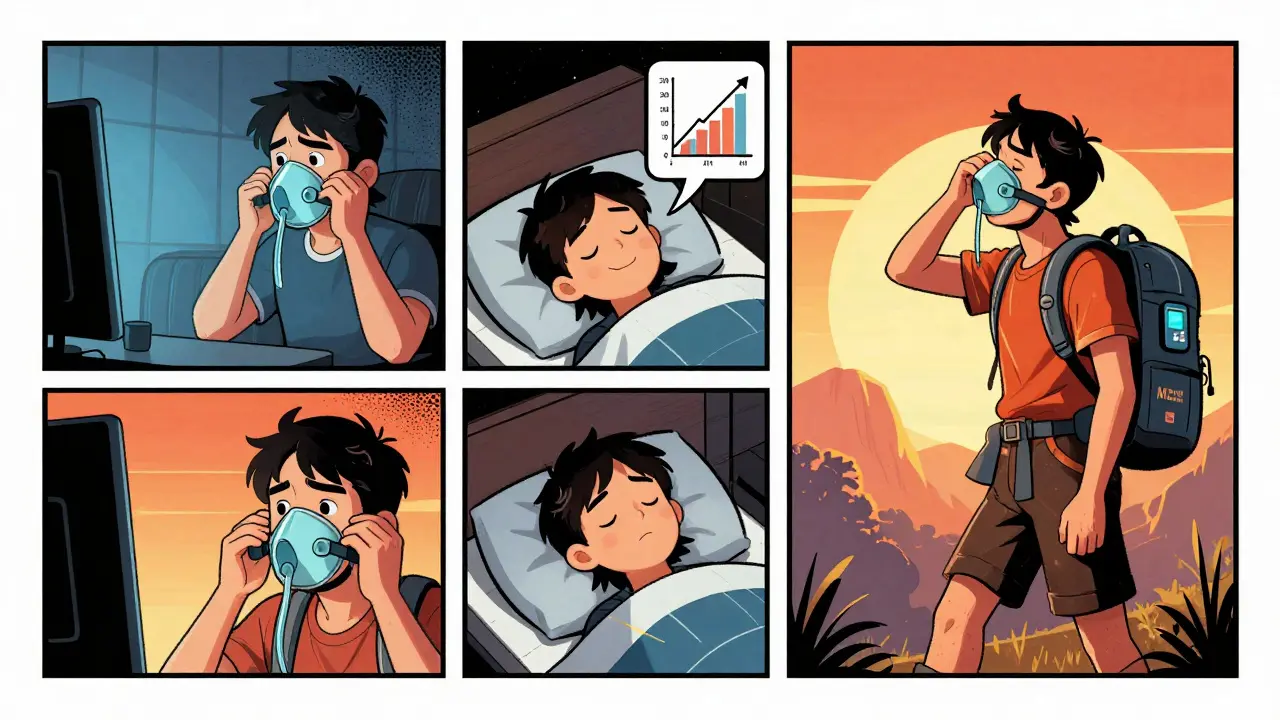
- Start slow. Don’t try to wear it all night on day one. Wear it for 2 hours while watching TV. Get used to the feel. Then add 30 minutes each night. This builds tolerance faster than forcing yourself to sleep with it.
- Use the ramp feature. Almost all machines have this. It starts at low pressure and slowly increases over 5-45 minutes. Use it. 75% of successful users do.
- Get humidification. Dry nose, sore throat, congestion-these are the top complaints. Heated humidifiers cut these issues by 50%. Make sure yours is on and set between 86°F and 95°F.
- Track your data. Modern machines log your usage, AHI, and leak rates. If you’re not checking it, you’re flying blind. ResMed’s myAir app gives daily feedback and coaching. Users who use it have 27% higher adherence.
- Don’t wait for perfection. You’ll have bad nights. The mask will slip. You’ll wake up with it on the floor. That’s normal. The goal isn’t 8 hours every night. It’s 4+ hours, 5+ nights a week. That’s enough to reduce your heart attack risk by 20-30%.
One Reddit user, u/SleepyEngineer, switched from CPAP to APAP and dropped his AHI from 8.2 to 2.1. Another, u/NasalPillowFan, went from 15 L/min leaks to 3 L/min after switching to nasal pillows. These aren’t miracles. They’re fixes.
What to Do If It’s Still Not Working
You’ve tried the mask, the ramp, the humidifier. Still struggling?- Check your pressure range. If you’re on CPAP and your AHI is still above 5, your pressure might be too low. APAP can help find the right level.
- Consider BiPAP. If you’re on high pressure (>15 cm H2O) and it feels like you’re fighting the air, BiPAP could be the answer.
- Try a different mask type. If you’re on a full-face mask and it’s irritating your skin, switch to nasal pillows. If you’re on nasal pillows and keep breathing through your mouth, go full-face.
- Use a 60-night guarantee. CPAP.com and other retailers offer this. If it doesn’t work, return it. No penalty. You’re not stuck with a bad fit.
- Ask about telemedicine. Many sleep clinics now do remote titration. You can adjust pressure from home without another sleep lab visit. Saves time and money.
If you’re still failing, talk to your sleep specialist. You might have treatment-emergent central sleep apnea-a condition that develops after starting CPAP. In that case, an ASV machine like the ResMed AirCurve 10 might be needed. It’s more expensive ($2,800), but it’s designed for exactly this problem.
What’s Changing in CPAP Therapy (2025)
The field is moving fast. New machines are quieter, smarter, and more comfortable.ResMed’s AirSense 11 AutoSet (2023) uses AI to predict breathing disruptions before they happen. It’s reduced AHI by 22% compared to older models. Philips’ DreamStation 3 runs at 25 dBA-quieter than a whisper. Fisher & Paykel’s SleepStyle uses a new algorithm that cuts exhalation pressure by up to 50%, making breathing out feel natural.
Insurance rules are tightening too. Starting in 2024, Medicare and most insurers require proof of 4+ hours of use, 70% of nights, to keep covering your machine. That’s why data tracking isn’t optional anymore.
And the user base is changing. More people under 45 are being diagnosed. Trucking companies now require CPAP for drivers with AHI over 20-because sleep apnea causes 32% more accidents. Awareness is rising, stigma is fading.
But the biggest change? Doctors are no longer saying, “Just wear it.” They’re saying, “Let’s find what works for you.”
Can I use a CPAP machine without a prescription?
No. In the U.S., all CPAP machines require a prescription. This is because pressure settings must be tailored to your specific sleep apnea severity, determined by a sleep study. Buying a machine without a prescription risks using incorrect pressure, which can be ineffective or even harmful. Insurance also won’t cover it without a doctor’s order.
How long does it take to get used to a CPAP machine?
Most people need 2 to 4 weeks to adjust. Some take longer-up to 3 months. The key is consistency. Don’t give up after a few bad nights. Use the ramp feature, wear the mask during daytime activities for short periods, and track your progress. Improvement isn’t overnight, but it’s real.
Are CPAP machines noisy?
Modern machines are very quiet. Standard models run around 26-30 dBA-quieter than a library. Travel models like the AirMini are louder (52 dBA) because they’re smaller and lack sound-dampening features. If noise is an issue, check for newer models like the DreamStation 3 (25 dBA) or ResMed AirSense 11, which are designed for near-silent operation.
How often should I replace my CPAP mask and supplies?
Replace the mask cushion every 1-3 months, the headgear every 6 months, and the tubing every 3-6 months. Filters should be changed monthly. Worn parts cause leaks and reduce effectiveness. Most insurance plans cover replacement supplies every 3-6 months-check your policy.
Will CPAP help me lose weight?
CPAP doesn’t directly cause weight loss, but better sleep helps. Sleep apnea disrupts hormones that control hunger and metabolism. Once you’re sleeping well, many people find it easier to manage appetite, have more energy for exercise, and lose weight naturally. Studies show CPAP users are more likely to lose weight over time than those who don’t use therapy.
What if I can’t tolerate any mask?
You’re not out of options. Some people do well with oral appliances that reposition the jaw. Others benefit from positional therapy (sleeping on their side). In severe cases, surgery or newer devices like transnasal systems (e.g., Transcend Micro 3) may help. Talk to a sleep specialist-there’s always another path.
Final Thought: This Isn’t a Life Sentence
CPAP isn’t about giving up your freedom. It’s about getting back your nights. Your energy. Your focus. Your health. The machine is just a tool. The real work is finding the right fit-mask, pressure, routine-and sticking with it. You don’t need to be perfect. You just need to be consistent. And with the right setup, you can sleep better than you have in years.11 Comments

Nicole Rutherford
December 21, 2025 at 14:11 PM
People who quit CPAP are just lazy and don't want to adapt
It's not hard you just have to suffer through the first week
I saw someone on Reddit say they gave up because the mask hurt their nose
Bro it's a medical device not a spa pillow
Stop treating it like a trend and start treating it like your life depends on it because it does

Allison Pannabekcer
December 23, 2025 at 13:24 PM
I get where you're coming from but not everyone has the same experience
I struggled for months with full face masks until I tried nasal pillows
It wasn't about willpower it was about finding the right tool for my face
And the ramp feature saved me honestly
Wearing it while watching TV for 20 minutes at a time made all the difference
You don't have to be perfect you just have to show up
Even 4 hours a night 5 days a week changes everything
It's not about being strong it's about being consistent

Mahammad Muradov
December 23, 2025 at 21:39 PM
Anyone who uses EPAP devices for moderate sleep apnea is just wasting money and risking their health
These aren't toys they're not FDA approved for anything beyond mild cases
And yet people on Reddit act like they're magic
It's dangerous to recommend them without context
If your AHI is above 15 you need real pressure therapy not a plastic valve
Stop enabling bad decisions with feel good advice

Alex Curran
December 25, 2025 at 10:00 AM
Just wanted to add that the new Fisher & Paykel SleepStyle algorithm is insane
It reduces exhalation pressure by almost half and makes breathing feel natural
I didn't think it was possible to make CPAP feel effortless
But this thing actually made me forget I was wearing it
And the noise level is ridiculous for a machine that's doing this much
Also the AI predictive feature on the AirSense 11 is next level
It catches disruptions before you even wake up
Insurance is finally catching up too
They're requiring usage data now which is annoying but necessary
It's not surveillance it's accountability
And if you're under 45 and getting diagnosed you're not an outlier anymore
We're seeing this everywhere now
Truckers pilots even office workers
It's not just older men anymore

Aboobakar Muhammedali
December 27, 2025 at 02:57 AM
I tried CPAP for two weeks and gave up
Mask felt like a vice grip
Leaked everywhere
Woke up with red cheeks and dry throat
Then I found out my clinic had a fitting kit with five different masks
I tried three before I found the right one
Now I use nasal pillows and it's like night and day
Not because I'm stronger
But because I finally let someone help me find the right fit
Don't suffer in silence
Ask for help
It's not weakness it's wisdom

anthony funes gomez
December 27, 2025 at 23:41 PM
The paradigm shift here is not technological it's epistemological
CPAP adherence is not a behavioral problem it's a phenomenological mismatch between the apparatus and the embodied experience of the user
Traditional models assume a homogenous physiological response to fixed pressure
But the human respiratory system is a dynamic nonlinear system
APAP and BiPAP acknowledge this
And the emerging AI predictive algorithms represent a move toward anticipatory rather than reactive intervention
Furthermore the shift from physician-centered titration to telemedicine-enabled home adjustment decentralizes authority and democratizes care
But this requires a reconfiguration of the patient-provider relationship
From passive recipient to active co-architect of therapeutic experience
Which is why data tracking isn't just compliance it's co-creation
And the 60-night guarantee is not a return policy it's a hermeneutic space for iterative self-discovery

Kathryn Featherstone
December 29, 2025 at 09:50 AM
For anyone feeling overwhelmed start with just 15 minutes a night
Wear the mask while you read or scroll on your phone
Get used to the sound the feel the weight
Don't aim for sleep right away
Just get comfortable with the device
Then add five more minutes each day
It's not about forcing yourself to sleep with it
It's about letting it become part of your routine
And if you're struggling with dry mouth
Try a chin strap instead of switching to full face
It's cheaper and less invasive
Also your insurance probably covers new masks every 3 months
Don't keep using a worn out cushion
It's not worth the leaks or the frustration

William Storrs
December 29, 2025 at 17:25 PM
You got this
It's not easy but it's worth it
I used to hate my CPAP
Thought it was ridiculous
Then I started sleeping through the night for the first time in years
My wife said I stopped snoring so loud the dog started sleeping in another room
Now I travel with my AirMini and I don't even think about it
It's not perfect but it's mine
And it's giving me back my life
One night at a time
Don't quit before the magic happens
It's not about being perfect it's about being persistent

James Stearns
December 30, 2025 at 23:09 PM
It is imperative to underscore that the utilization of any Continuous Positive Airway Pressure device without a formal prescription constitutes a violation of U.S. federal regulatory statutes under the Food and Drug Administration guidelines
Furthermore the procurement of such apparatuses via non-medical channels introduces significant clinical risk due to the absence of individualized pressure titration
One must also acknowledge that the imposition of insurance-based adherence metrics reflects a necessary evolution in healthcare accountability
While potentially burdensome to the patient
It is an ethically defensible mechanism to ensure therapeutic efficacy and resource stewardship
Therefore the assertion that CPAP is merely a "tool" is an oversimplification
It is a life-sustaining medical intervention requiring professional oversight
And the notion that one can "find the right fit" without clinical guidance is not merely misguided
It is dangerous

Edington Renwick
January 1, 2026 at 16:31 PM
My ex left me because I wouldn't stop using CPAP
Said the noise was "soul-crushing"
And the mask made me look like a cyborg
So I got a new one
Now I sleep alone
And I'm alive
So who's the real monster here
Monte Pareek
December 20, 2025 at 06:20 AM
Most people think CPAP is about the machine but it's 100% about the mask fit and that's the part nobody talks about enough
Try nasal pillows if you're even slightly claustrophobic they're not for everyone but if they work for you it's a game changer
I went from 30 L/min leaks to 4 after switching and I didn't even change the machine
Also ramp feature is non negotiable if you're struggling
And humidification isn't optional it's essential stop pretending it's a luxury