
Opioid Driving Safety Calculator
How Long Should You Wait Before Driving?
Based on medical guidelines and FDA recommendations for opioid use.
Recommended waiting time appears here after calculation.
Driving while on opioids isn’t just risky-it’s illegal in every state in the U.S. and in Canada. Yet, many people who take prescription opioids for chronic pain don’t realize they’re putting themselves and others in danger. You might think, "I’m taking it as prescribed, so it’s fine." But the truth is, even when taken exactly as directed, opioids can slow your reaction time, blur your vision, and make you so drowsy that you fall asleep at the wheel. And if you get pulled over? You could lose your license, face criminal charges, or worse-cause a crash that changes lives forever.
How Opioids Affect Your Ability to Drive
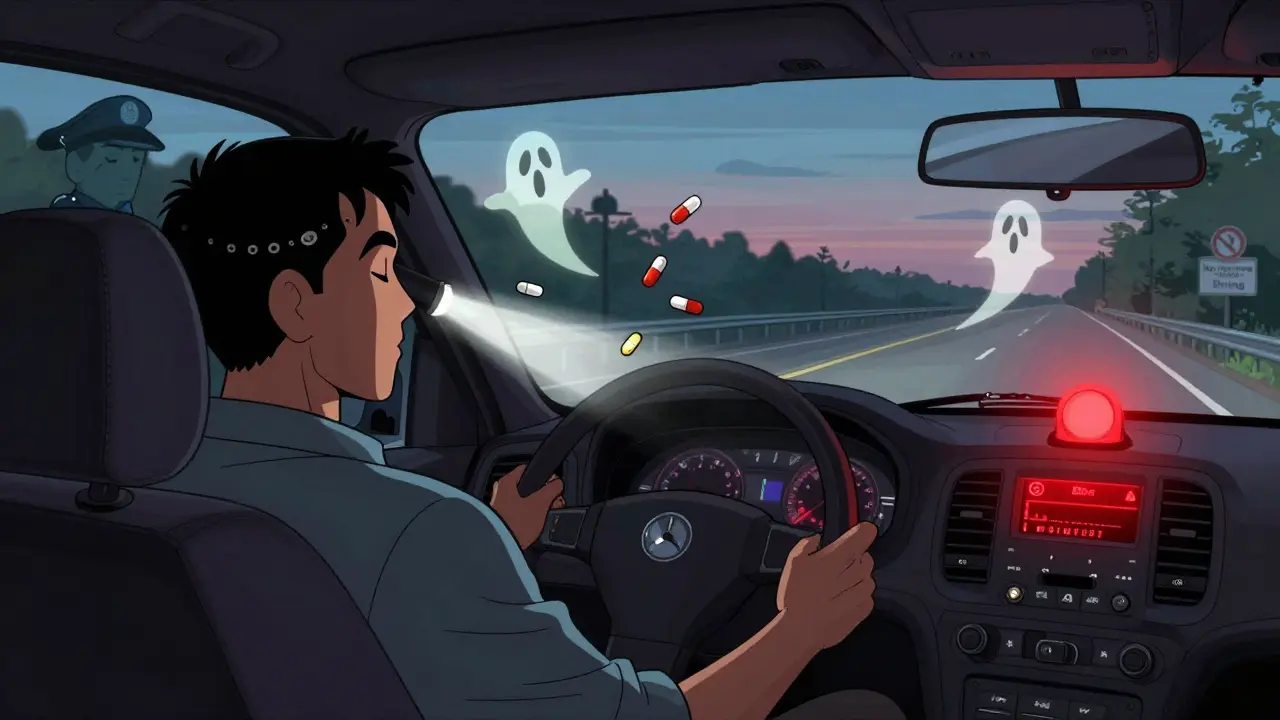
Opioids like oxycodone, hydrocodone, fentanyl, and morphine don’t just relieve pain. They also affect your brain’s ability to process information, make decisions, and react quickly. The National Institute on Drug Abuse (NIDA) says opioids can cause drowsiness, dizziness, and impaired thinking. In simple terms: your brain doesn’t work as fast. Studies show that driving under the influence of opioids can double your risk of a crash.
Unlike alcohol, where we know that a blood alcohol concentration (BAC) of 0.08% means impairment, opioids don’t have a clear threshold. One person might feel fine after 5 mg of oxycodone, while another could be dangerously impaired on the same dose. Why? Because everyone’s body reacts differently. Age, weight, tolerance, and whether you’re mixing opioids with alcohol or sleep aids all play a role. And here’s the scary part: you might not even realize you’re impaired. Opioids can make you feel calm or even normal while your driving skills are slipping.
Legal Consequences: It’s Not Just About Illicit Drugs
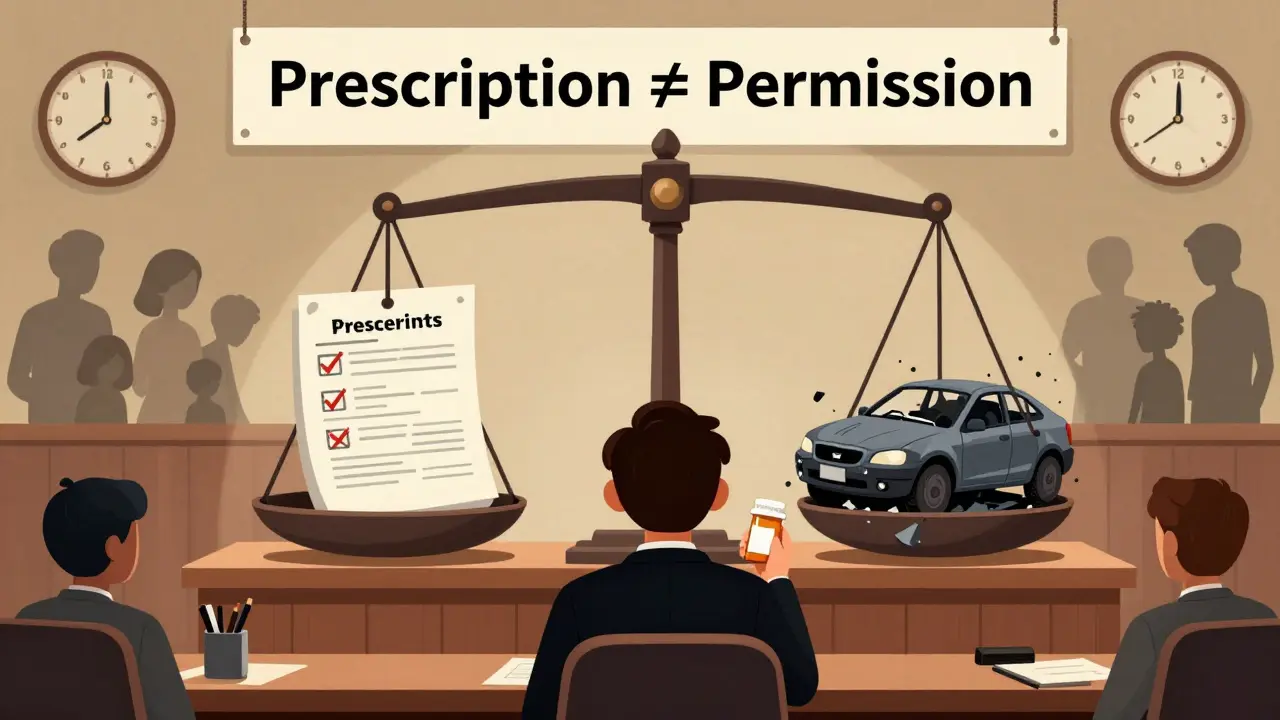
Many people assume that if a doctor prescribed the opioid, they’re safe from legal trouble. That’s a dangerous myth. In the U.S., 16 states have zero-tolerance laws for certain drugs-including opioids. That means if any amount of the drug is found in your system while driving, you can be charged, even if you took it legally. Five other states have per se laws, which set specific legal limits for drugs in your blood, similar to the 0.08% BAC rule for alcohol.
Canada treats opioid impairment exactly like alcohol impairment under its Criminal Code. If you’re pulled over and found to be impaired by opioids, you face the same penalties as a drunk driver: license suspension, fines, mandatory education, and possible jail time. In some states like Utah and Wisconsin, you can defend yourself if you have a valid prescription-but you still have to prove it in court. And in Georgia, drivers under 21 can claim "therapeutically appropriate amounts" as a defense. But these exceptions are rare, hard to prove, and don’t guarantee you won’t be charged.
Real stories prove how easy it is to get caught. One Reddit user, u/PainPatient88, wrote: "My doctor said it was fine to drive on 5mg oxycodone twice daily, but I failed a field sobriety test after my prescription was filled." Another user, u/RecoveryJourney, lost their license for six months and paid $12,000 in legal fees-even though they took their medication exactly as prescribed. The Pain News Network found that 63% of chronic pain patients didn’t know driving on opioids could lead to a DUI. That’s not ignorance-it’s a systemic failure in patient education.
How Law Enforcement Detects Opioid Impairment
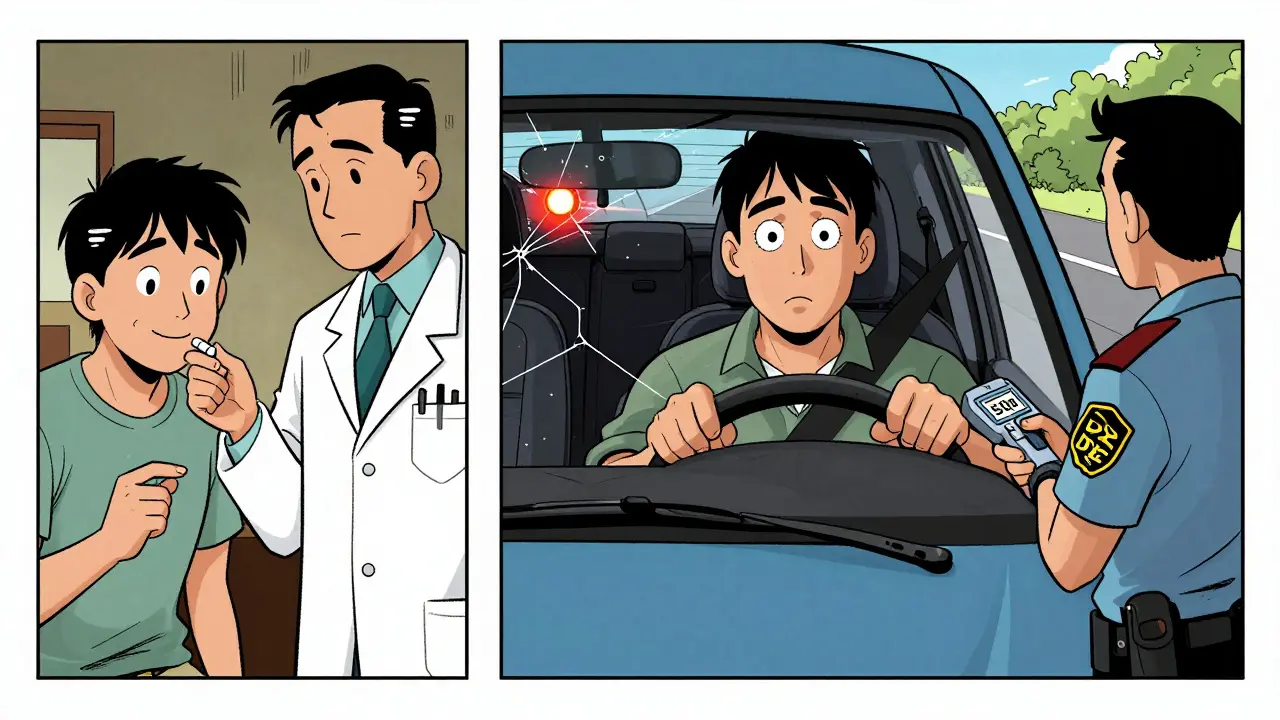
Police can’t just pull out a breathalyzer for opioids. Instead, they use a two-step process. First, they conduct a Standardized Field Sobriety Test (SFST)-the same one used for alcohol. This includes walking in a straight line, standing on one foot, and following a pen with your eyes. If you fail, they may call in a Drug Recognition Expert (DRE). These are officers specially trained to spot signs of drug impairment, like pinpoint pupils, slow reaction time, or slurred speech.
Then comes the chemical test: blood, urine, or oral fluid. Since 2023, 47 states now use oral fluid screening devices like the Dräger DrugTest 5000, which can detect fentanyl and other synthetic opioids on the roadside. These tests are faster and harder to cheat than urine tests. But here’s the catch: they only prove the drug was in your system, not that it was impairing you. That’s why many states still rely on officer observations to build a case.
Why Prescription Opioids Are Especially Dangerous on the Road
Prescription opioids are more dangerous than people think because they’re often taken daily. Unlike someone who drinks alcohol occasionally, chronic pain patients might be on opioids for months or years. Over time, their bodies adapt-but their driving skills don’t. The brain still processes information slower. Reaction time still lags. And because they feel "normal," they don’t realize how much they’ve changed.
Dr. Richard Halpern, Chief Medical Officer of the National Safety Council, says even therapeutic doses of opioids can impair driving like a 0.05% BAC-higher than the legal limit in many countries. That’s why the FDA now requires all opioid medication labels to include a clear "Do Not Drive" warning. But that warning doesn’t always make it to patients. A 2022 study found that 72% of people prescribed opioids received inadequate counseling from their doctors about driving risks.
What You Should Do If You’re on Opioids
If you’re prescribed opioids, here’s what you need to do:
- Ask your doctor-not your pharmacist-whether it’s safe to drive. Pharmacists can’t override a doctor’s judgment, and they often don’t know your full medical history.
- Wait at least 3-4 hours after taking an immediate-release opioid (like hydrocodone) before driving. For extended-release versions (like OxyContin), wait 6-8 hours. Mayo Clinic recommends this as a minimum safety buffer.
- Plan ahead. If you know you’ll be taking a dose during the day, arrange for a ride. Use public transit, a rideshare app, or ask a family member to help.
- Never mix opioids with alcohol, sleep aids, or anti-anxiety meds. Combining them multiplies the risk. Even one extra pill can push you over the edge.
- Check your state’s laws. Zero-tolerance rules vary. Some states don’t care if you have a prescription. Others require proof. Know what you’re up against.
The California Office of Traffic Safety says it best: "Plan ahead for a sober driver. If you plan to use an impairing drug, don’t drive." That’s not just advice-it’s your best defense.
What’s Changing in 2026
The fight against opioid-impaired driving is heating up. In January 2023, the National Highway Traffic Safety Administration launched a $9.2 million program to train 5,000 new Drug Recognition Experts by 2025. Seven more states are considering per se laws for opioids, building on the five that already have them. The Transportation Research Board is pushing for scientifically backed blood limits for opioids within the next five years-something we’ve had for alcohol for decades.
Companies are reacting too. UPS started requiring medical reviews for all employees prescribed opioids in 2021. Since then, medication-related incidents dropped 37%. That’s proof that clear policies save lives.
But the biggest threat? Fentanyl. The DEA reports a 262% increase in fentanyl-related impaired driving cases between 2020 and 2023. This synthetic opioid is 50 to 100 times stronger than morphine. A tiny amount can knock you out. And because it’s often mixed into counterfeit pills, people don’t even know they’re taking it.
Where to Get Help
If you’re unsure about your medication and driving, call the Substance Abuse and Mental Health Services Administration (SAMHSA) at 1-800-662-4357. They fielded over 12,000 calls in 2022 about medication-impaired driving. They can connect you with local resources, counseling, or even help you talk to your doctor about alternatives.
And if you’ve already been charged? Don’t panic. But do get legal help. And don’t assume your prescription protects you. Courts don’t care if you were following your doctor’s orders. They care if you were safe on the road.
Driving on opioids isn’t a gray area. It’s a clear line: don’t do it. Your life, and someone else’s, depends on it.
Can I get a DUI for taking my prescribed opioid medication?
Yes. Even if your doctor prescribed the opioid, you can still be charged with a DUI if you’re found to be impaired while driving. In 16 U.S. states, any detectable amount of the drug in your system is enough for a charge, regardless of prescription status. In other states, prosecutors must prove you were impaired-so even with a prescription, you can still be convicted if you failed a field test or caused an accident.
How long should I wait after taking opioids before driving?
Wait at least 3 to 4 hours after taking an immediate-release opioid like hydrocodone or oxycodone. For extended-release versions like OxyContin or MS Contin, wait 6 to 8 hours. These are minimum guidelines-some people need longer. Always check the medication label and talk to your doctor. If you feel drowsy, dizzy, or mentally foggy, don’t drive-no matter how much time has passed.
Do all states have the same laws about driving on opioids?
No. Laws vary widely. Sixteen states have zero-tolerance laws for specific drugs, meaning any trace of the drug in your system is illegal. Five states have per se laws that set specific blood concentration limits. Other states require proof of actual impairment. Canada treats opioid impairment exactly like alcohol impairment under its Criminal Code. Always check your state’s specific rules before driving.
Can I fight a DUI charge if I have a valid prescription?
In some states, yes-but it’s difficult. States like Utah and Wisconsin allow you to argue that the drug was taken as prescribed and that you weren’t impaired. But you must prove it with medical records and expert testimony. In most states, having a prescription doesn’t protect you. Courts focus on whether you were safe to drive, not whether you followed your doctor’s instructions.
What should I do if my doctor says it’s okay to drive on my opioid medication?
Ask for written documentation. Then, still proceed with extreme caution. Doctors aren’t always trained on the specific effects of opioids on driving. Studies show 72% of patients receive inadequate counseling. If you’re unsure, get a second opinion from a pharmacist or a pain specialist. When in doubt, don’t drive. Your safety-and the safety of others-is worth more than convenience.
8 Comments

Arshdeep Singh
February 23, 2026 at 01:48 AM
bro u just described my entire life. i’ve been on oxycodone for 5 years for back pain. my doc said "drive if u feel okay" - so i did. then i got pulled over for swerving, failed the sobriety test, and lost my license. turns out my "okay" was just the drug making me feel calm while my brain was on vacation. now i take the bus. and honestly? it’s better. less stress, more time to read. also, fentanyl is scaring the shit outta me. my cousin died from a fake pill that said "oxycodone 30" but was actually fentanyl. i’m not even gonna touch my meds before a drive anymore. peace.

Marie Crick
February 23, 2026 at 18:18 PM
Driving on opioids is not a gray area. It’s a crime scene waiting to happen. No exceptions. No excuses. No "but my doctor said." If you can’t drive sober, don’t drive. Period.

Jonathan Rutter
February 25, 2026 at 14:42 PM
Look, I get it - chronic pain is hell. I’ve been there. I’ve been on 80mg of oxycodone a day. I’ve driven to work. I’ve driven to the grocery store. I’ve driven to my mom’s funeral. And I’m not proud of it. But here’s the thing nobody talks about: the system is rigged. Doctors are paid by volume, not by safety. Pharmacies don’t warn you - they just hand you the script. Insurance won’t cover physical therapy or acupuncture because it’s "too expensive." So you’re left with this: take the pill and drive, or don’t take the pill and suffer. And guess what? The state doesn’t care which you pick. They’ll arrest you either way. I lost my job. My wife left me. I had to move in with my parents. I’m 42. I can’t even drive my kid to school without a court order. And you know what’s worse? No one’s helping. We’re just being criminalized for being sick. So yeah - I know I should’ve stopped. But who told me to? Who warned me? Who offered me an alternative? No one. So don’t come at me with your moral high ground. Come at the system. Because I didn’t break the law - the law broke me.

Jana Eiffel
February 27, 2026 at 12:14 PM
It is of paramount importance to recognize that the pharmacological effects of opioid agonists upon the central nervous system are not merely transient or subjective in nature. Empirical data from the National Institute on Drug Abuse, corroborated by longitudinal studies conducted at Johns Hopkins and the Mayo Clinic, demonstrate unequivocally that even therapeutic dosing induces measurable deficits in psychomotor performance, visual tracking, and executive function. These are not anecdotal observations - they are quantifiable, reproducible, and statistically significant. Furthermore, the legal framework governing drug-impaired driving in the United States is not uniformly punitive, but rather stratified by jurisdictional interpretation of neuropharmacological evidence. To assert that "I was prescribed" is a legal defense is to misunderstand the foundational principle of public safety jurisprudence: the state’s interest in preventing harm supersedes individual autonomy when public risk is objectively elevated. Therefore, while empathy for chronic pain sufferers is both appropriate and necessary, it cannot override the imperative of public safety. One must, in all conscience, defer to the science - and to the silence of those who never made it home.

aine power
February 28, 2026 at 11:46 AM
My doctor never mentioned driving. So I assumed it was fine. I was wrong. Now I can’t get my license back. Lesson learned. Don’t trust doctors. Don’t trust pills. Don’t trust yourself.

Tommy Chapman
March 2, 2026 at 06:08 AM
Look, I don’t care if you’re in pain. You got a prescription? Good. Now stay off the road. This isn’t Europe. We don’t let people drive while drugged just because they have a piece of paper. You think Canada’s soft? They lock you up faster than you can say "fentanyl." And we’re not far behind. Every time someone gets killed because some guy took his pain meds and thought he was fine - that’s on YOU. Not the doctor. Not the system. YOU. You had the choice. You chose convenience over lives. So don’t act surprised when you’re on trial. You’re not a victim. You’re a danger. And if you’re reading this, you’re probably the next one who’s gonna get caught. Better start planning your ride-share now.

Amrit N
March 3, 2026 at 21:19 PM
hey i just wanna say thanks for this post. i’ve been on tramadol for 3 years and never thought about driving. now i use uber for everything. also, i got my first fentanyl test strip last week - just in case. small steps, right? peace out ✌️


Chris Beeley
February 22, 2026 at 10:57 AM
Let me just say this - if you’re driving on opioids and think you’re fine because your doctor said so, you’re not just ignorant, you’re a walking liability. I’ve seen this play out in ERs across three continents. Opioids don’t just dull pain, they dull your entire cognitive architecture. Your reflexes? Sluggish. Your spatial awareness? Gone. Your decision-making? Reduced to toddler-level impulse control. And don’t even get me started on the myth that "I feel fine" means I’m safe. That’s the drug talking, not your brain. The FDA’s warning isn’t a suggestion - it’s a forensic timestamp waiting to happen. You think you’re managing your pain? You’re actually managing your way into a coroner’s report. And let’s not pretend this is just about "bad drivers." It’s about systemic medical negligence. Doctors are trained to prescribe, not to evaluate motor function. They don’t have the tools. They don’t have the time. And they sure as hell don’t have the incentive to tell you the truth. So who’s left? You. And your poor, unsuspecting passengers. Wake up. Or don’t. But don’t blame anyone else when your SUV ends up in a tree with a 7-year-old in the backseat. That’s not an accident. That’s a choice.