
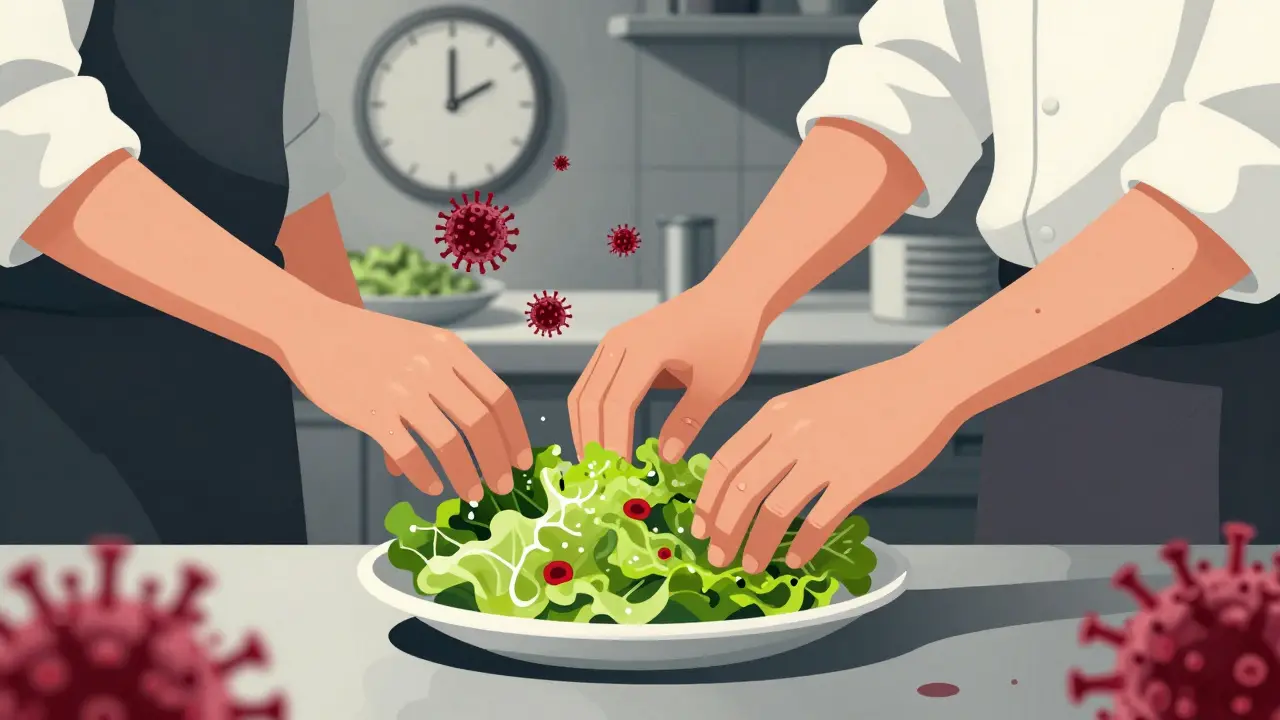
It doesn’t take much to spread hepatitis A. A single infected person handling food with unwashed hands can set off an outbreak that affects dozens - even hundreds - of people. This isn’t science fiction. It’s happening right now in restaurants, food trucks, and grocery stores across the country. The virus doesn’t need to be in the food itself. It just needs to get there - through a dirty hand, a contaminated surface, or a food handler who doesn’t know they’re sick.
How Hepatitis A Moves Through Food
Hepatitis A is a tiny, tough virus. It can survive for weeks on stainless steel counters, months in frozen food, and even survive brief exposure to heat. You won’t see it. You won’t smell it. And you won’t know it’s there until someone gets sick - often two to four weeks later.
The main way it spreads through food? Human hands. Studies show that nearly 10% of the virus on a contaminated finger can transfer to a piece of lettuce during a simple touch. That’s enough to infect someone. Food handlers who don’t wash their hands after using the bathroom are the most common source. Even worse, many don’t know they’re infected. Between 30% and 50% of adults with hepatitis A show no symptoms at all - but they’re still contagious.
Shellfish are another major risk. They filter water, and if that water has sewage contamination, the virus gets trapped inside. The FDA says shellfish from waters with more than 14 fecal coliforms per 100 milliliters are unsafe. Yet, 92% of shellfish outbreaks trace back to harvesting in waters that fail this test.
Ready-to-eat foods - sandwiches, salads, sushi, fruit - are especially dangerous. Once they’re cooked or washed, there’s no further step to kill the virus. If it gets on them after that point, it stays there. And unlike bacteria, hepatitis A doesn’t multiply in food. It just waits. One person, one slip-up, and the whole kitchen becomes a risk zone.
When You’re Exposed - What You Must Do
If you’ve eaten food from a place linked to a hepatitis A case, time is critical. You have only 14 days after exposure to act. After that, the virus may already be in your liver, and nothing you take now will stop it.
There are two options for post-exposure prophylaxis (PEP): the hepatitis A vaccine or immune globulin (IG). The CDC recommends the vaccine for healthy people aged 1 to 40. It’s a single shot that gives you protection for at least 25 years. It costs between $50 and $75. For people outside that age range, pregnant women, or those with weakened immune systems, immune globulin is used instead. It’s an injection of antibodies that gives you short-term protection - 2 to 5 months - and costs $150 to $300.
Neither option works instantly. You still need to avoid bare-hand contact with food for six weeks. You still need to wash your hands like your life depends on it - because it does. The vaccine doesn’t stop you from spreading the virus in the first few weeks. That’s why public health teams tell exposed people to stay home from work, avoid cooking for others, and be extra careful with bathroom hygiene.
And here’s the hard truth: if you’re a food handler and you’ve been exposed, you can’t just go back to work after getting the shot. Rules vary by state. In Iowa, you must wait seven days after jaundice appears - or two weeks after symptoms start. In California, it’s 14 days from symptom onset. Even if you feel fine, you’re still contagious. Returning too soon risks another outbreak.
Why Vaccination for Food Workers Isn’t Enough
Public health experts agree: the best way to stop hepatitis A outbreaks is to vaccinate food workers before they get sick. But here’s the problem - only about 30% of food service employees in the U.S. are vaccinated. In fast-food chains and seasonal jobs, the rate drops to 15%.
Why? Turnover. In quick-service restaurants, staff turn over 150% every year. Someone gets hired on Monday, works for two weeks, gets sick, quits - and no one ever knows they had hepatitis A. By the time the outbreak is noticed, the worker is long gone. And no one checks their vaccine records.
Language barriers make it worse. In big cities, 45% of kitchen staff don’t speak English fluently. Training materials in English won’t help. Visual guides, videos in multiple languages, and hands-on demos are needed. But only 31% of restaurants use practical training. Most just hand out a pamphlet.
And then there’s cost. Employers don’t pay for vaccines. Workers have to buy them themselves. A $75 shot is a lot when you’re making minimum wage. But studies show that for every dollar spent on vaccinating food workers, $3.20 is saved in outbreak response costs - investigations, closures, lost sales, legal fees.

What Works in Real Life
Some places are getting it right. As of early 2024, 14 U.S. states now require hepatitis A vaccination for food handlers. California’s 2022 law prevented an estimated 120 infections and saved $1.2 million in outbreak costs. That’s not just policy - that’s money saved.
Other innovations are working too. In pilot programs, restaurants are testing wastewater for hepatitis A RNA. If the virus shows up in the drain, they know someone in the kitchen is shedding it - even if they feel fine. This lets them act before anyone gets sick.
Some employers are trying financial incentives. Offering a $50 bonus for getting vaccinated increased uptake by 38 percentage points. That’s not a small win. That’s a game-changer for high-turnover workplaces.
And simple fixes matter. One study found that 78% of restaurants still let workers touch ready-to-eat food with bare hands. Just using gloves or tongs cuts transmission risk dramatically. But only 42% do it consistently. Why? Because no one checks. No one enforces.
What You Can Do - Whether You’re a Customer or a Worker
If you’re a customer: Watch how food is handled. Are workers using gloves or tongs? Do they wash their hands after using the bathroom? If you see someone touching food with dirty hands, speak up. Ask to see the manager. Your voice matters.
If you’re a food worker: Wash your hands - for at least 20 seconds - after every bathroom break, every time you handle trash, every time you touch your face. Use soap. Water alone cuts risk by only 30%. Soap cuts it by 70%. And if you’re feeling off - even just a little tired, nauseous, or yellow-eyed - don’t come to work. Get tested. You could be saving lives.
If you’re a restaurant owner: Pay for your staff’s vaccines. Make handwashing stations clean and accessible. One station per 15 employees isn’t a suggestion - it’s a minimum. Train with videos, not papers. Use bilingual materials. Make it part of your culture, not just your compliance checklist.
Hepatitis A isn’t a distant threat. It’s in your local diner, your favorite food truck, your grocery store salad bar. It doesn’t care about your income, your job title, or your health insurance. It only cares if someone touched food with a dirty hand.
Prevention isn’t complicated. It’s just hard to do consistently. But when it’s done right - when vaccines are given, hands are washed, and gloves are used - outbreaks stop. People stay healthy. Restaurants stay open. And no one has to wonder if their last meal made them sick.

How to Know If You’ve Been Infected
Symptoms don’t show up right away. They take 15 to 50 days - usually around 28. Early signs include fever, fatigue, loss of appetite, nausea, vomiting, stomach pain, and dark urine. Later, you might notice jaundice - yellow skin or eyes. But remember: half the cases have no symptoms at all.
Diagnosis is simple: a blood test for HAV IgM antibodies. These appear 5 to 10 days before symptoms and last for 3 to 6 months. If you’ve been exposed and you’re worried, get tested. Don’t wait for symptoms. If you’re infected, you need to know so you don’t spread it to others.
And if you’re unsure whether you’ve had hepatitis A before - or been vaccinated - check your records. If you were born before 1996 in the U.S., you likely weren’t routinely vaccinated. If you’ve traveled to countries with poor sanitation, you may have been exposed without knowing it.
What Happens If You Don’t Act After Exposure
If you miss the 14-day window for PEP, the virus will run its course. Most people recover fully within a few weeks. But for some - especially those over 50 or with liver disease - hepatitis A can cause severe liver damage, hospitalization, or even death.
And if you’re a food worker and you don’t report your illness? You could be the reason an entire restaurant closes. Outbreak investigations cost between $100,000 and $500,000. That’s not just lost sales - it’s lost jobs, lost trust, lost reputation.
One restaurant in Pennsylvania shut down for six weeks after a single food handler passed the virus to 27 customers. The cost? Over $400,000. The human cost? 27 families who spent weeks sick, scared, and wondering how it happened.
It doesn’t have to be that way.
Can you get hepatitis A from cooked food?
Hepatitis A virus can survive temperatures up to 60°C (140°F) for an hour. That means undercooked food - like shellfish, sushi, or lightly steamed vegetables - can still carry the virus. Complete inactivation requires heating to 85°C (185°F) for at least one minute. So yes, if food is contaminated after cooking or not heated thoroughly, it can still spread the virus.
Is the hepatitis A vaccine safe?
Yes. The hepatitis A vaccine has been used safely for over 25 years. Common side effects are mild: soreness at the injection site, headache, or low-grade fever. Serious reactions are extremely rare. It’s safe for pregnant women, people with chronic liver disease, and those with weakened immune systems - though immune globulin is preferred in those cases for immediate protection.
Can you get hepatitis A more than once?
No. Once you recover from hepatitis A, your body develops lifelong immunity. You won’t get it again. That’s why the vaccine - which mimics a natural infection - gives long-term protection. If you’ve had it before, you don’t need the vaccine.
Do I need the vaccine if I’ve already had hepatitis A?
No. If you’ve had a confirmed hepatitis A infection, you’re immune for life. You don’t need the vaccine. Blood tests can confirm past infection by detecting HAV IgG antibodies. If you’re unsure, ask your doctor for a blood test before getting vaccinated.
How long is a person contagious with hepatitis A?
A person with hepatitis A is contagious for about two weeks before symptoms appear and up to one week after jaundice starts. That means someone can spread the virus without knowing they’re sick. This is why asymptomatic carriers are such a big problem in food service - they’re often the hidden source of outbreaks.
Can hepatitis A be spread through water?
Yes. Contaminated drinking water is a major cause of hepatitis A in countries with poor sanitation. In the U.S., outbreaks from water are rare because of treatment standards. But in places without proper sewage systems or clean water, waterborne outbreaks are common. The WHO recommends at least 0.2mg/L of free chlorine in drinking water to kill the virus.
Should I get the hepatitis A vaccine before traveling?
Yes - if you’re traveling to areas with moderate or high risk of hepatitis A, including parts of Central and South America, Africa, Asia, and Eastern Europe. The CDC recommends the vaccine for all travelers over 1 year old going to these regions. One dose gives protection for at least one year; a second dose, given 6 to 12 months later, provides lifelong immunity.
Can hepatitis A cause long-term liver damage?
In most people, hepatitis A causes only a short-term illness and does not lead to chronic liver disease. However, in rare cases - especially in older adults or those with existing liver conditions - it can cause severe liver failure. This is called fulminant hepatitis and requires emergency care. The risk is low, but it’s real.
15 Comments

Jon Paramore
December 23, 2025 at 08:41 AM
Hep A is non-enveloped, so it's resistant to alcohol-based sanitizers. That's why soap and water are non-negotiable. The virus binds to organic matter-grease, biofilm, even dried food residue. If you're not scrubbing for 20 seconds, you're just wetting your hands.

Michael Ochieng
December 24, 2025 at 11:18 AM
I work in a food truck in Chicago. We started using color-coded gloves and posted pictograms in Spanish, Somali, and Arabic. Turnover dropped 40%. People feel seen. And yeah, we pay for the vaccine. It’s cheaper than shutting down for two weeks.

Cara C
December 25, 2025 at 15:39 PM
I know it's easy to blame workers but the system is broken. No one checks if your hands are clean. No one asks if you got the shot. It's all on the person who's already overworked and underpaid. We need to fix the structure, not shame the individual.

Christina Weber
December 26, 2025 at 22:18 PM
This post is dangerously incomplete. You mention PEP but fail to clarify that immune globulin is derived from human plasma and carries a theoretical risk of prion transmission. The CDC’s recommendation for the vaccine in 1–40 year-olds ignores the fact that 15% of that cohort have undiagnosed immunodeficiencies. This is not public health-it’s negligence dressed as guidance.

Ben Warren
December 27, 2025 at 22:20 PM
The real issue is the erosion of personal responsibility. In the 1980s, food handlers were trained to wash hands after every bathroom visit. Now? We outsource hygiene to gloves, which are often reused, and then we blame the system. The truth is, no policy will fix a culture that treats cleanliness as a bureaucratic checkbox. The virus doesn’t care about your union card or your immigration status. It only cares if you washed your hands. And if you didn’t? You’re not a victim. You’re a vector.

Swapneel Mehta
December 28, 2025 at 05:13 AM
I’m from India and we’ve had Hep A outbreaks for decades. What worked? Community health workers going door to door with posters in local languages. No fancy apps. No pamphlets. Just a person with a picture of a hand washing and a smile. Sometimes simple beats smart.

Jerry Peterson
December 29, 2025 at 20:27 PM
I used to work in a kitchen where the owner said "gloves make you lazy." So we didn't use them. Then two people got sick. One was my cousin. She was 22. We lost her. Don’t let your pride kill someone.

Southern NH Pagan Pride
December 30, 2025 at 23:09 PM
They don’t want you to know this but Hep A is linked to 5G towers and water fluoridation. The CDC is hiding the real data because Big Pharma profits from vaccines. Look at the wastewater studies-those RNA traces? They’re planted. The real solution is a detox tea and a Faraday cage in the kitchen.

Stacey Smith
December 31, 2025 at 05:24 AM
This is why America is crumbling. Foreign workers don’t wash their hands. They bring their diseases here. We need border checks for hepatitis. No more letting people from "high-risk" countries near food. Vaccines? Waste of money. We need walls. And bans.

Meina Taiwo
December 31, 2025 at 11:04 AM
Handwashing works. Soap cuts risk by 70%. That’s the whole thing.

Dan Adkins
January 1, 2026 at 19:48 PM
The data is unequivocal. The transmission coefficient of Hep A via fomites is 0.08–0.12 per touch event. A single contaminated fingertip introduces approximately 10^3 viral particles. The infectious dose is as low as 10–100 particles. Ergo, the probability of transmission during a single touch of ready-to-eat food exceeds 8%. This is not anecdotal. This is virology.

Orlando Marquez Jr
January 3, 2026 at 01:30 AM
In Nigeria, we have a saying: "The hand that feeds is the hand that heals." But only if it’s clean. We train kitchen staff with drums, songs, and dance. If you can’t remember to wash, you remember the rhythm. Culture isn’t the problem-it’s the solution.

Grace Rehman
January 3, 2026 at 14:58 PM
So we’re supposed to trust the same system that gave us lead in the water and asbestos in the schools? Sure. Let me just go get my $75 vaccine while the boss pockets the $3.20 savings. Funny how the people who need the shot the most are the ones who can’t afford to take the day off to get it. And no, I’m not being sarcastic. I’m just... disappointed.

John Hay
January 4, 2026 at 17:45 PM
I’ve worked in food service for 15 years. I’ve seen people get sick. I’ve seen places shut down. I’ve seen coworkers lie about symptoms because they can’t afford to miss a shift. This isn’t about policy. It’s about dignity. Pay people enough to care. Then the rest follows.



Jackie Be
December 21, 2025 at 15:42 PM
I just ate a salad from that place last week 😭 I'm so done with this. No gloves no wash no care. People are literally playing russian roulette with their liver.