
Don’t Let Your Medication Run Out While You’re Away
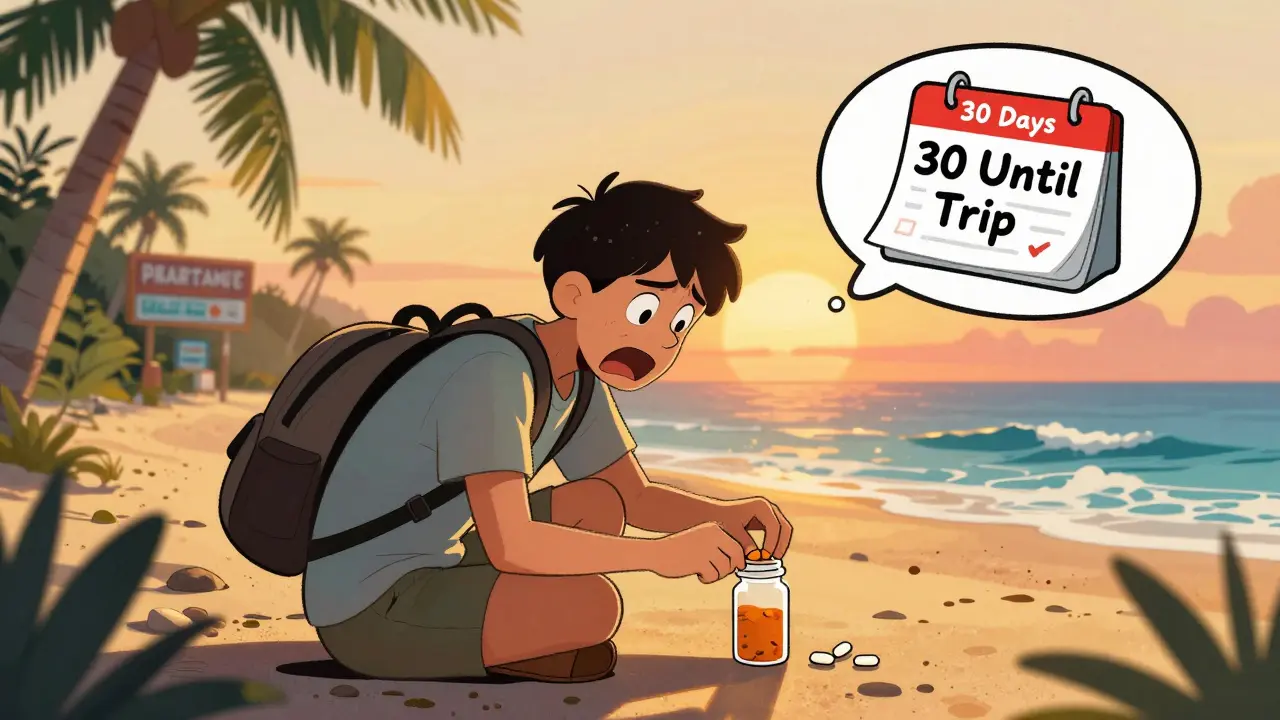
Imagine this: you’re on a beach in Bali, the sun is down, and you realize you’re out of your blood pressure pills. You’ve got three days left on your trip, no pharmacy nearby, and no idea how to get a refill. This isn’t rare. Medication refills during extended travel are one of the most common-and preventable-health emergencies travelers face. According to the CDC, nearly 1 in 4 international travelers with chronic conditions experience a treatment interruption, and over 20% of those end up in urgent care or the hospital. It doesn’t have to be this way.
The key isn’t luck. It’s planning. Whether you’re heading to Europe for three months or backpacking through Southeast Asia, managing your meds isn’t just about packing extra pills. It’s about understanding your insurance, knowing what’s legal abroad, and having backups ready. Here’s how to do it right.
Start Early-At Least 30 Days Before You Leave
Waiting until the week before your trip is the #1 mistake people make. Most pharmacies won’t refill a prescription until you’ve used 75-80% of your current supply. If you’re leaving in 10 days and only have 20 pills left on a 30-day script, you’re stuck. That’s why the CDC and major pharmacy chains recommend starting your refill plan 30 days before departure.
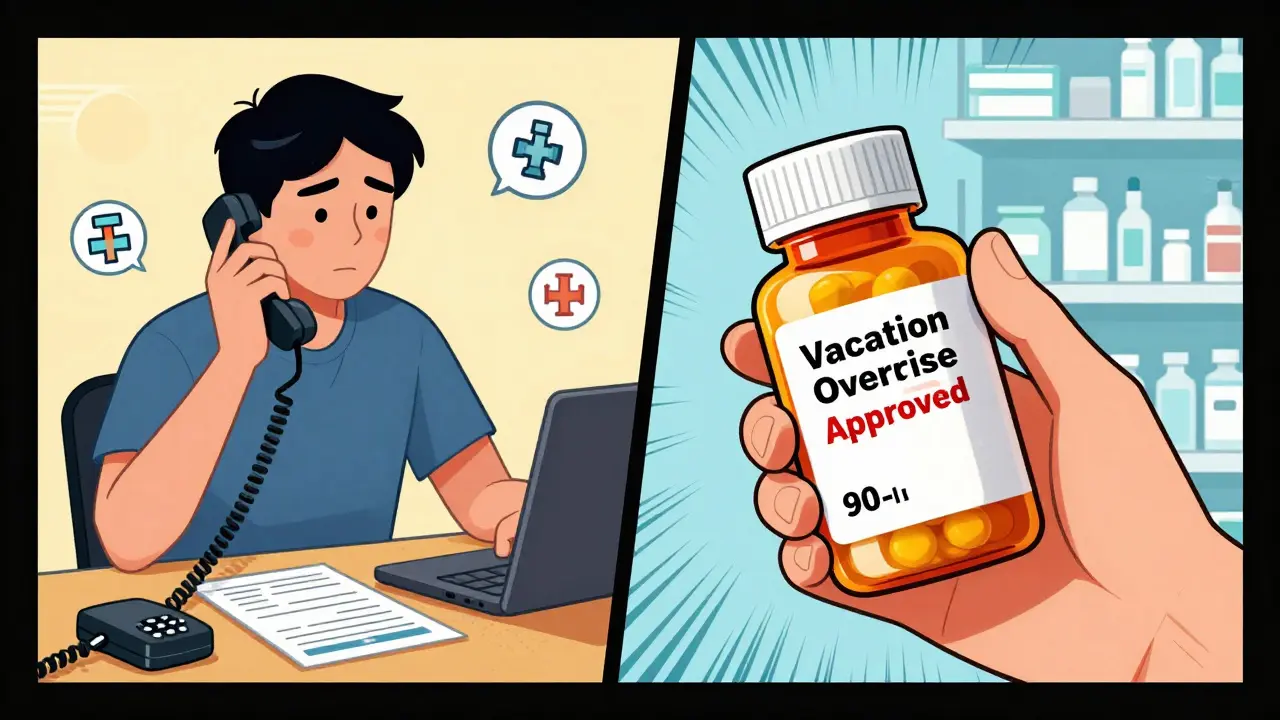
Call your pharmacy and ask: “I’m traveling for two months. Can I get a 90-day supply now?” Most insurers allow this if you’ve been stable on your medication for at least 30 days. A 90-day supply cuts your refill trips from three to one. It’s simpler, cheaper, and safer. A 2021 Kaiser Permanente study showed travelers who used 90-day supplies had 67% fewer refill-related issues.
But here’s the catch: not all medications qualify. Controlled substances like opioids, benzodiazepines, or stimulants are trickier. In 48 U.S. states, you can’t refill these more than every 28 days. That means if your last refill was on January 1, you can’t get another until January 29. Plan around that. Talk to your doctor about adjusting your prescription timing before you leave.
Use Your Insurance’s “Vacation Override”
Most major U.S. insurers-UnitedHealthcare, Aetna, Cigna, Blue Cross-have something called a “vacation override.” It lets you get an early refill if you’re traveling. You don’t need to be sick. You just need to prove you’re leaving.
Here’s how to get it:
- Call your insurance company’s member services line. Ask: “Do you offer vacation overrides for extended travel?”
- Give them your travel dates and destination.
- Ask if they’ll approve an early refill or a 90-day supply.
- Get a reference number and write it down.
According to the 2022 Express Scripts report, 92% of major insurers now offer this. But policies vary. Blue Cross Blue Shield of Michigan lets you refill up to 14 days early. UnitedHealthcare only allows 7 days. Don’t assume. Ask. And if they say no, ask to speak to a supervisor. Many pharmacists have the authority to override denials if you show proof of travel-like a flight itinerary or hotel booking.
Know What’s Legal in Your Destination (and Layovers)
This is where things get complicated. Just because your medication is legal in the U.S. doesn’t mean it’s legal in Thailand, Japan, or the UAE.
For example:
- Thailand limits opioid prescriptions to 30 days-even if you have a U.S. prescription.
- Japan bans many ADHD medications, including Adderall.
- The UAE requires a special permit for any controlled substance, even if it’s for pain.
Before you go, check the embassy website of every country you’ll visit-including layovers. The CDC’s Travel Health Notices have country-specific guides, but they’re not always up to date. A better move: email the embassy directly. Ask: “Can I bring [medication name] into your country? What documentation is required?”
Always carry:
- A copy of your original prescription (with the doctor’s signature and stamp)
- A letter from your doctor on letterhead explaining why you need the medication
- The medication in its original bottle with your name on it
Never pack meds in checked luggage. If your bag gets lost, you’re out of luck. Keep them in your carry-on.
Pack Smart-Two Containers, Two Places
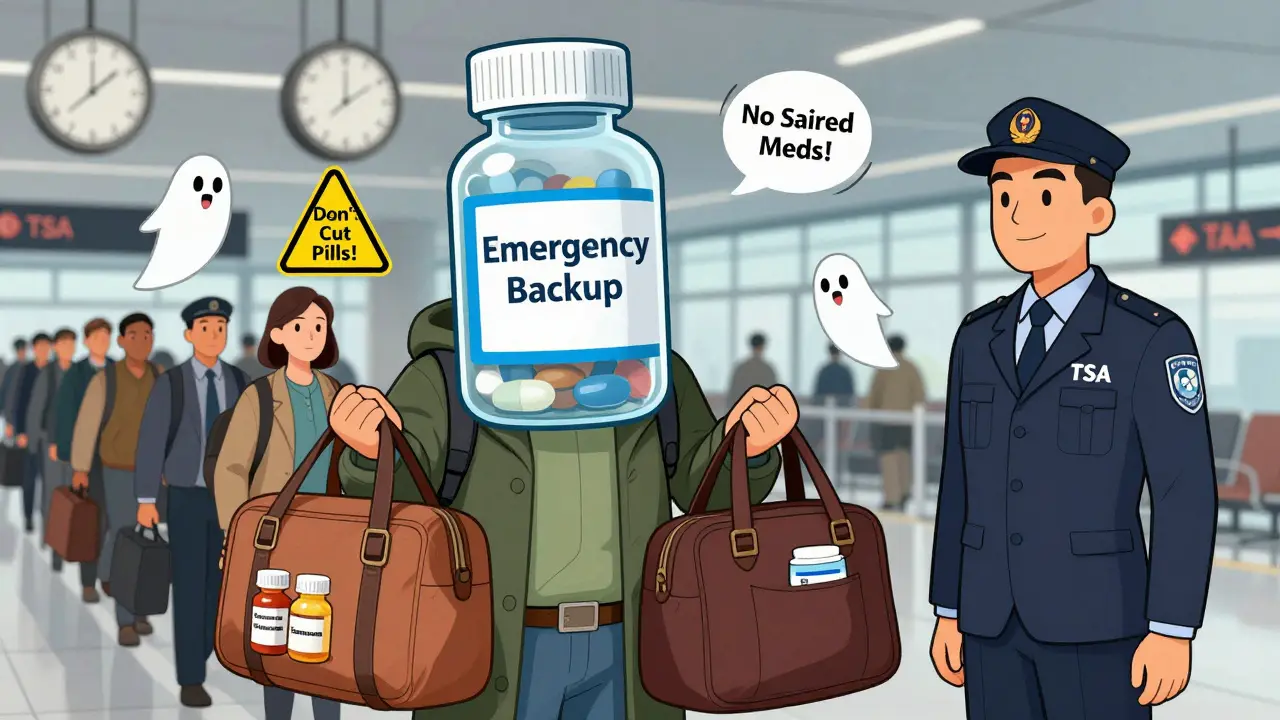
Dr. Jennifer Schaefer from the American Pharmacists Association says it best: “Take your medication in two separate containers that you keep in two separate places.”
Here’s how:
- Keep your main supply in your carry-on, in the original bottles.
- Put a second, smaller supply in a different bag-maybe your purse, backpack, or coat pocket.
- If you’re flying, declare any liquid meds over 3.4 oz at security. TSA allows medically necessary liquids if you tell them. 98% of U.S. airports accept this without issue.
Also, don’t mix pills. Keep each medication in its own container. Mixing them makes it hard to prove what they are if customs asks. And never throw away the original labels. They have your name, the drug name, dosage, and prescriber info-all critical if you need help abroad.
What If You Lose Your Meds? Here’s Your Backup Plan
People lose meds all the time. It happens. The good news? There are solutions.
If you’re in the U.S.:
- Go to any CVS, Walgreens, or Rite Aid with your prescription info. Most will give you a 3-day emergency supply if you’ve got refills left.
- Use CVS MinuteClinic. They can renew maintenance meds once per year-even if your doctor’s office is closed.
- Call your insurance. Many now have telehealth services built into their apps. You can get a virtual consult and e-prescription in under an hour.
If you’re overseas:
- Find a local pharmacy. Show them your prescription and doctor’s letter. Many countries have pharmacists who can help, even if they can’t refill your exact brand.
- Ask for the generic version. It’s often available even when the brand isn’t.
- Use telehealth services like Teladoc or Doctor on Demand. They’ve helped over 1.2 million travelers in 2022 get emergency refills.
Pro tip: Save your doctor’s contact info in your phone. If you’re stuck, they can fax or email a new prescription to a local clinic.
Time Zones? Don’t Guess-Plan
Jumping across time zones messes with your routine. Taking your pill at 8 a.m. your time might mean taking it at 3 a.m. local time. That’s a recipe for skipped doses.
The American Academy of Sleep Medicine recommends this:
- For trips under 3 time zones: Stick to your home schedule.
- For trips over 3 time zones: Keep your home schedule for the first 24-48 hours. Then slowly shift to local time.
- Never take a dose more than 3 hours early or late unless your doctor says it’s okay.
Use a pill timer app or set alarms on your phone. Even if you’re jet-lagged, don’t skip a dose. Missing one can trigger a flare-up-especially for conditions like epilepsy, diabetes, or heart disease.
What You Shouldn’t Do
Here are three big mistakes travelers make:
- Don’t cut pills in half to stretch your supply. Many meds are time-release or coated. Cutting them changes how they work.
- Don’t share your meds with someone else-even if they have the same condition. It’s illegal and dangerous.
- Don’t assume your doctor will be available while you’re away. Save their number, email, and clinic address. You might need them.
Also, avoid buying meds abroad unless you have no other option. Counterfeit drugs are common in some countries. The WHO estimates 1 in 10 medical products in low-income nations are fake. Even if the packaging looks real, the active ingredient might be missing or wrong.
Final Checklist: 7 Things to Do Before You Go
- Call your pharmacy 30 days before departure to request a 90-day supply.
- Contact your insurer to confirm vacation override eligibility.
- Check embassy websites for each country you’ll visit (including layovers).
- Get a doctor’s letter and copies of your prescriptions.
- Pack meds in two separate containers in your carry-on.
- Download your insurance app and save your doctor’s contact info.
- Set phone alarms for your medication times, using your home time zone.
If you do these seven things, you’re in the top 5% of travelers when it comes to medication safety. You won’t be the one in the ER because you ran out of pills. You’ll be the one enjoying your trip-because you planned ahead.
Can I get my prescription refilled at a different pharmacy while traveling?
Yes, if you have refills left on your prescription. Most U.S. pharmacy chains like CVS, Walgreens, and Rite Aid can transfer your prescription and give you a refill at any location. Just call ahead to confirm they have your medication in stock. For international travel, you’ll need a new prescription from a local doctor-unless you have a doctor’s letter and original prescription, which may help you get a similar medication locally.
What if my insurance denies my vacation override request?
Ask to speak to a supervisor. Many denials happen because the initial rep doesn’t know the policy. If you have proof of travel (flight itinerary, hotel reservation), mention that. Also, ask if you can pay out-of-pocket for an early refill and submit for reimbursement later. Some insurers allow this. If all else fails, your doctor can write a new prescription with a shorter duration to get you through your trip.
Can I bring liquid medications on a plane?
Yes, medically necessary liquids like insulin, liquid antibiotics, or eye drops are allowed in quantities over 3.4 ounces. You must declare them at the security checkpoint. Keep them in their original containers and bring a doctor’s note if possible. TSA allows these without limit, as long as they’re for your personal use.
Is it safe to use a pill organizer while traveling?
Only if you keep the original bottles with you. Pill organizers are great for daily use, but customs or security may not recognize the pills inside. Always carry your prescriptions and doctor’s letter with you. Use the organizer as a convenience, not your only storage method.
What’s the best way to store meds in hot or humid climates?
Keep them in a cool, dry place. Avoid leaving them in your car, suitcase in direct sun, or bathroom. Some meds, like insulin or epinephrine, need refrigeration. If you’re in a place without reliable power, use a small insulated cooler with a cold pack. Ask your pharmacist if your meds are heat-sensitive. Most can handle short-term exposure, but prolonged heat can reduce effectiveness.
Do I need a letter from my doctor for every medication?
You only need one letter that lists all your medications, dosages, and reasons for use. It should be on your doctor’s letterhead, signed, and dated. Include your full name and date of birth. This single letter covers all your meds. Don’t carry separate letters for each drug-it’s unnecessary and harder to manage.
What should I do if I’m traveling with a child who needs medication?
Pack the child’s meds in their original containers with their name on the label. Bring a doctor’s letter explaining the condition and dosage. If the child is on a controlled substance, check the destination country’s rules carefully-some ban even common ADHD meds for minors. Always carry extra doses. Kids can be unpredictable, and delays happen. Never rely on getting a refill abroad for a child’s medication.
What’s Next? The Future of Travel Medication Access
Things are getting better. By 2026, the FDA may approve cross-border digital prescriptions. The International Pharmaceutical Federation is creating a global travel medication document that will be accepted in 195 countries. And more insurers are adopting vacation overrides as standard.
But right now, the system still depends on you. You’re the one who has to call the pharmacy, check the embassy, pack the backups, and set the alarms. No app or policy can replace your planning. The good news? Once you’ve done it once, it becomes routine. And next time you travel, you won’t just survive-you’ll thrive.
10 Comments

Claire Wiltshire
January 30, 2026 at 12:40 PM
While I appreciate the casual approach, I’d strongly encourage travelers to prioritize safety over convenience. Medication management isn’t just about avoiding discomfort-it’s about preventing potentially life-threatening complications. A simple checklist and a doctor’s letter can make all the difference when you’re far from home.

Russ Kelemen
February 1, 2026 at 02:32 AM
There’s something beautiful about how a little foresight turns panic into peace. I used to be the guy who waited until the last minute, then panicked in a foreign pharmacy wondering if the pill in front of me was even real. Now I plan like I’m packing for a moon mission. Turns out, the real adventure isn’t the destination-it’s knowing you’ve got your back.

Sidhanth SY
February 1, 2026 at 08:39 AM
I’ve been traveling across Asia for 8 months with my diabetes meds. The key? Always carry the original bottle + doctor’s note. Local pharmacists are usually super helpful once they see you’re not trying to scam them. Also, Google Translate + a smile goes a long way.

Adarsh Uttral
February 2, 2026 at 14:08 PM
lol i once lost my meds in thailand and just bought some random pills from a street stall. turned out they were just sugar. survived. kinda.

April Allen
February 3, 2026 at 12:18 PM
The pharmacoeconomic implications of 90-day supply adoption are statistically significant-particularly in reducing non-adherence-driven ED utilization. The CDC’s 67% reduction metric aligns with the 2021 Kaiser Permanente longitudinal cohort analysis, which demonstrated a 0.84 hazard ratio reduction in acute care events among patients with stabilized regimens who utilized extended-fill prescriptions. Also, don’t forget to verify bioequivalence of generics abroad-some formulations have different excipients that can trigger adverse reactions in sensitive populations.

Sheila Garfield
February 4, 2026 at 06:24 AM
I just carry my meds in my purse and never think twice. I’ve been to Japan, Italy, Mexico-never had a problem. Maybe I’m just lucky? Or maybe people are too scared to ask questions when they see you’re just a normal person with pills?

Shawn Peck
February 4, 2026 at 13:21 PM
YOU’RE ALL DOING IT WRONG. I’ve been to 47 countries and I ONLY take my meds in the original bottle with the prescription taped to the lid. If you don’t do that, you’re one TSA scan away from being arrested. Also, NEVER use a pill organizer. That’s how people get deported.

Niamh Trihy
February 5, 2026 at 23:35 PM
I’ve been a pharmacist for 18 years, and this guide is spot-on. One thing I’d add: always check if your medication is on the WHO’s List of Essential Medicines. If it is, it’s far more likely to be available abroad-even if the brand name isn’t. Also, carry a printed copy of your medication list in the local language. It saves hours when you’re lost and confused.

Beth Beltway
February 7, 2026 at 02:46 AM
I’m sorry, but if you need a 90-day supply, you’re clearly not managing your condition properly. Why are you traveling at all? And why are you relying on insurance overrides instead of being responsible? This article reads like a guide for people who want to be lazy and still expect the world to accommodate them. Maybe you shouldn’t leave home.
Mike Rose
January 30, 2026 at 01:57 AM
bro i just throw all my pills in a ziplock and hope for the best. been to 12 countries and never died.