
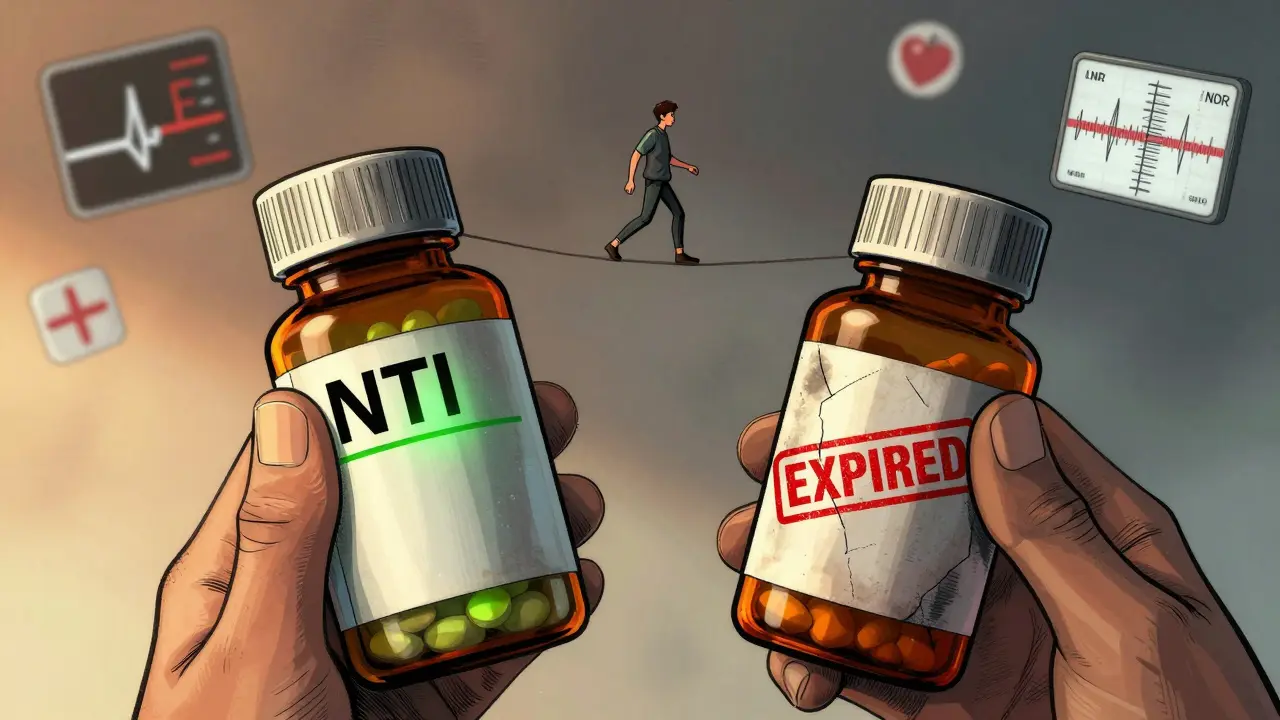
Some medications don’t just lose effectiveness when they expire-they can turn dangerous. This isn’t true for most pills, but for a small group called narrow therapeutic index (NTI) drugs, even a tiny drop in potency or a slight change in how your body absorbs them can mean the difference between life and death.
What Makes a Drug Have a Narrow Therapeutic Index?
NTI drugs are the medical equivalent of walking a tightrope. The gap between the dose that helps you and the dose that harms you is razor-thin. For example, warfarin, a blood thinner, keeps your blood from clotting too much. Too little, and you could have a stroke. Too much, and you could bleed internally. The safe range? Just a few points on the INR scale. Digoxin, used for heart failure, works at concentrations between 0.5 and 0.9 nanograms per milliliter of blood. Above 1.2, and you risk serious heart rhythm problems. That’s less than a 35% jump from safe to toxic.
The U.S. Food and Drug Administration defines NTI drugs as those where small changes in blood levels can cause serious harm-like hospitalization, disability, or death. These aren’t just strong drugs. They’re drugs where precision matters more than strength. Other common NTI drugs include lithium (for bipolar disorder), phenytoin (for seizures), cyclosporine (for organ transplants), and theophylline (for asthma). Even small differences in how a generic version is made can affect how much of the drug gets into your bloodstream. That’s why the FDA requires stricter testing for generic NTI drugs than for most others.
Why Expiration Dates Matter More for NTI Drugs
Most pills are fine to take a year or two past their expiration date. Studies show many retain over 90% of their potency even after a decade, if stored properly. But that 10% loss? For a regular painkiller, it’s no big deal. For warfarin? That’s enough to push your INR out of the safe zone. A 10% drop in potency could mean your blood starts clotting again. If you’re on a mechanical heart valve, that’s a stroke waiting to happen.
It’s not just about losing strength. Some drugs break down into harmful compounds. Tetracycline, though not an NTI drug, turns toxic when expired. While no NTI drugs are known to become poisonous this way, we can’t assume they’re safe. The chemistry of these drugs is complex. Even slight degradation can change how your body absorbs them. That’s why pharmacists are told to treat NTI drugs as high-alert medications-double-checks, careful monitoring, and no room for error.
For NTI drugs, the acceptable range for bioequivalence in generics is 90% to 111% of the brand-name drug’s effect. That’s tighter than the usual 80% to 125%. If a warfarin tablet loses just 5% of its potency after expiration, that’s a 45% deviation from the safe window. That’s not a small change. That’s a medical risk.
What Happens When You Take an Expired NTI Drug?
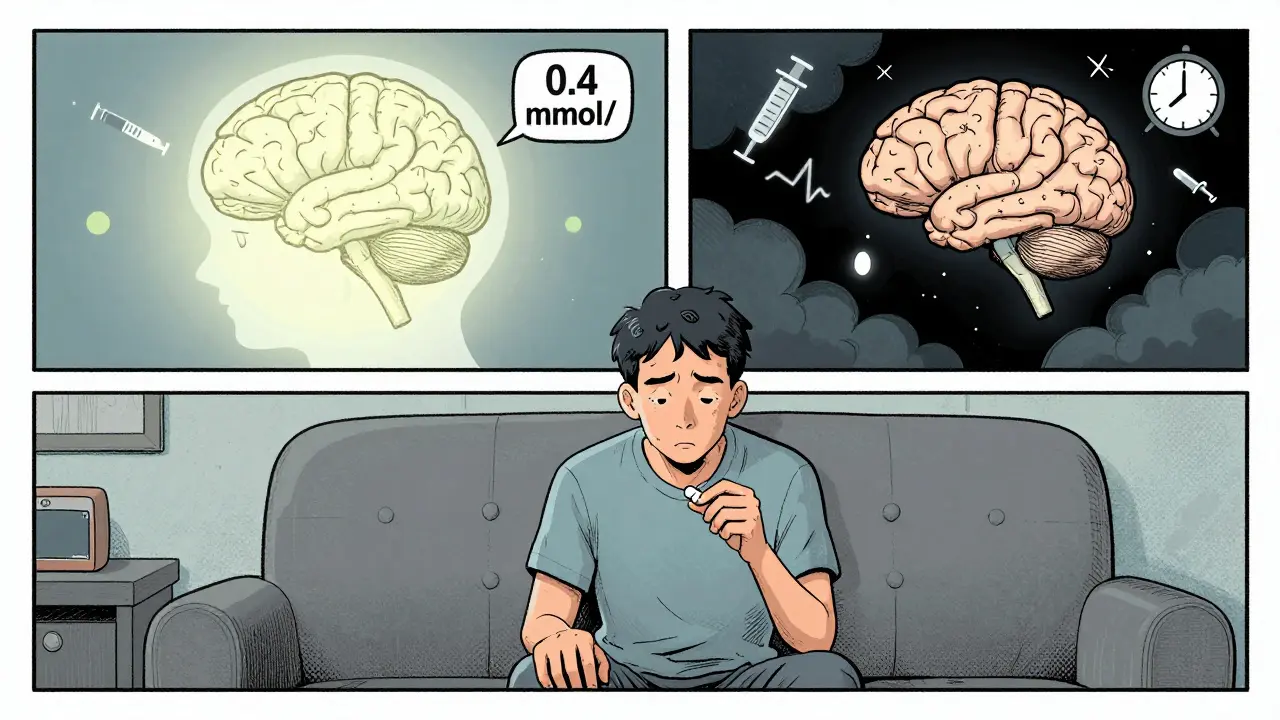
Let’s say you’re on lithium for bipolar disorder. Your doctor carefully adjusted your dose until your blood level hit 0.6 mmol/L-perfect. You’ve been stable for months. Then you run out and take a bottle you found in the back of the cabinet. It expired six months ago. You don’t feel different. You take your usual dose.
But the lithium has degraded. Your blood level drops to 0.4 mmol/L. Within days, you feel sluggish, forgetful, depressed. Your doctor thinks you’re noncompliant. You’re not. The drug just didn’t work anymore. Now you’re at risk of a relapse, possibly hospitalization.
Or imagine you’re on digoxin. Your heart is stable. You take an expired pill. The concentration spikes to 1.1 ng/mL. You feel nauseous. Your heart skips. You end up in the ER with a dangerous arrhythmia. No one knew the pill was old. No one tested it.
These aren’t hypotheticals. Studies show NTI drugs cause serious adverse reactions far more often than other medications. A 2014 study in the Journal of Clinical Pharmacy and Therapeutics found that drug-related problems with NTI drugs were more likely to result in hospitalization. The American Society of Health-System Pharmacists says even minor changes in concentration require dose adjustments. Expired drugs introduce uncontrolled changes.
What Should You Do If You Have an Expired NTI Drug?
Don’t take it. Don’t guess. Don’t hope it’s still good.
Here’s what to do instead:
- Check the expiration date on every NTI medication you take. Write it on your calendar or set a reminder.
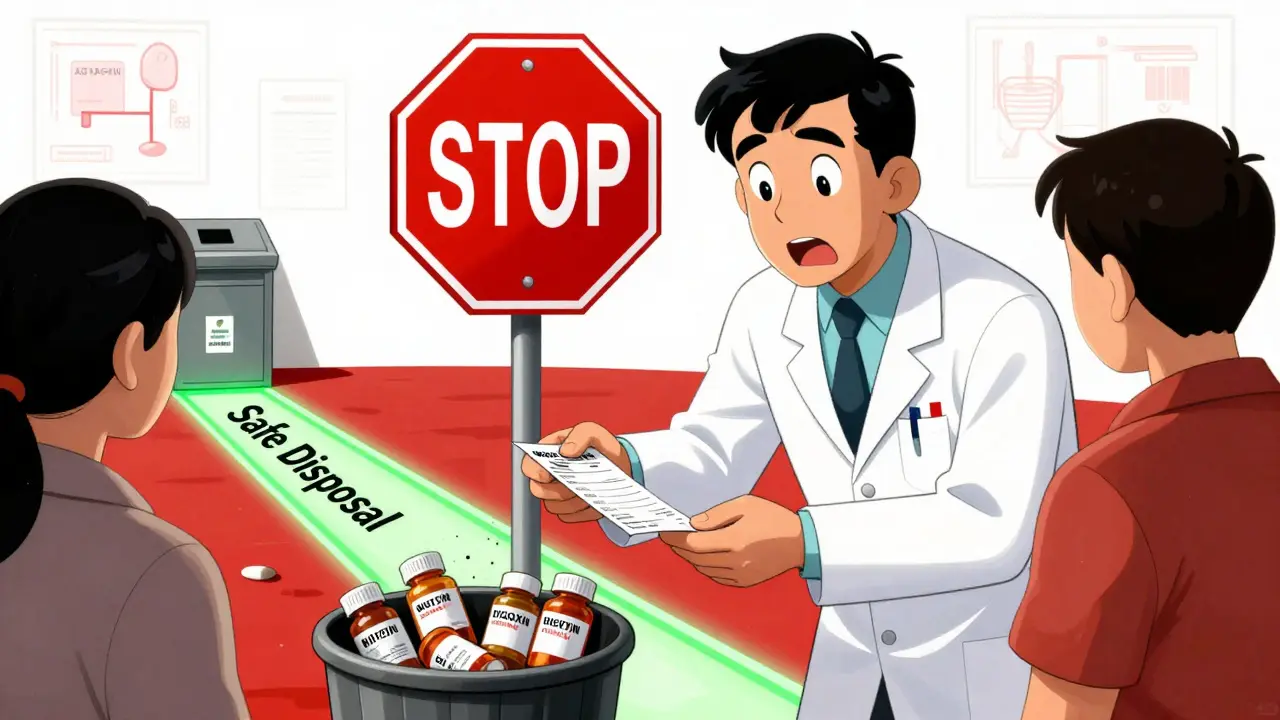
- If it’s expired, take it to a pharmacy for safe disposal. Most pharmacies offer free take-back programs.
- Call your doctor or pharmacist. Don’t wait for your next appointment. Get a new prescription. Many insurance plans cover early refills for NTI drugs if you explain the situation.
- Never use someone else’s medication-even if it’s the same name. Generic versions vary slightly, and dosing is personal.
- Store these drugs properly: cool, dry, away from sunlight and moisture. Bathroom cabinets are a bad idea.
Pharmacists are trained to flag NTI drugs. If you pick up warfarin, lithium, or digoxin, ask if the batch is from the same manufacturer as your last one. Some pharmacists will even call your doctor to confirm the switch is safe.
Why Don’t We Know More About Expired NTI Drugs?
There’s a gap in the science. The FDA has clear rules for how generic NTI drugs must perform when new. But no one has studied what happens when they age. The agency knows expiration dates matter, but it hasn’t created special guidelines for NTI drugs. The European Medicines Agency and other regulators are aware of the risk, but no country has issued official advice on expired NTI medications.
Manufacturers test their drugs for stability, but only up to the labeled expiration date. After that? No data. That’s why some companies now do extended testing beyond expiration-but they don’t publish it. So you’re left with a simple rule: if it’s expired, don’t risk it.
What’s Being Done to Fix This?
Professional groups are pushing for change. The American Pharmacists Association called for special labeling on NTI drugs-clear warnings about expiration and storage. Some hospitals now use barcode scanning systems that flag expired NTI drugs before they’re given to patients. In Australia, the Therapeutic Goods Administration recommends that patients on anticoagulants like warfarin receive no more than a 30-day supply at a time to reduce the chance of holding onto expired medication.
But the real fix? Patient education. Too many people think expiration dates are just a marketing tactic. For most drugs, they’re not. For NTI drugs, they’re a safety line. Crossing it isn’t a gamble-it’s a danger.
Bottom Line: When It Comes to NTI Drugs, Don’t Take Chances
You wouldn’t drive a car with worn brakes and hope it still stops. You wouldn’t fly on a plane with an outdated navigation system. Why take a pill that might not work-or worse, hurt you-just because it’s still in the bottle?
NTI drugs are powerful, precise tools. They require careful handling. That includes respecting expiration dates. If you’re on one of these medications, treat it like your life depends on it-because it does. Keep your prescriptions current. Talk to your pharmacist. Ask questions. And if a pill is past its date? Throw it away. No exceptions.
9 Comments

Vicki Belcher
December 22, 2025 at 05:24 AM
I'm a nurse and I've seen this firsthand. A patient on lithium took an expired bottle. She ended up in psych. It wasn't 'noncompliance'-it was bad luck with chemistry. 🚨 Always check dates. Always.

Dikshita Mehta
December 22, 2025 at 09:59 AM
I've worked in a community pharmacy for 12 years. We flag NTI drugs with a red sticker. Patients often ask why. This is exactly why. Degradation isn't linear. For warfarin, 5% loss = 45% risk deviation. That math doesn't lie.

Alisa Silvia Bila
December 24, 2025 at 07:04 AM
I used to keep all my meds in the bathroom. Now I don't. Learned the hard way.

Alex Curran
December 26, 2025 at 03:42 AM
The FDA doesn't require stability data beyond expiration for any drug even though NTI meds are the most dangerous when degraded. That's a regulatory blind spot. Manufacturers test internally but won't publish because it might force them to shorten expiration dates. We're all guinea pigs.

Dominic Suyo
December 27, 2025 at 13:44 PM
Let’s be real. The pharmaceutical industry profits from fear. Expiration dates are arbitrary. I’ve had digoxin from 2018 that still works. Stop scaring people into buying new pills every 6 months. This is fearmongering dressed as science.

James Stearns
December 27, 2025 at 17:56 PM
I find it profoundly irresponsible that laypersons are being entrusted with the judgment of pharmaceutical stability. This is not a DIY endeavor. The complexity of pharmacokinetics demands professional oversight. Your garage is not a controlled environment. Please consult a licensed pharmacist before ingesting any substance of uncertain origin.

benchidelle rivera
December 29, 2025 at 15:18 PM
You think this is about expiration dates? It's about systemic neglect. Pharmacies don't train staff to explain NTI risks. Insurance won't cover early refills. Patients are left guessing. And now you're blaming them for taking expired pills? The system failed them long before the bottle went bad.

Kitt Eliz
December 31, 2025 at 13:41 PM
This is why I carry a pill organizer with my NTI meds and a QR code that links to my med list. I also send my pharmacist a text every 30 days: 'Still good?' They reply with a checkmark or a red flag. It's not paranoia-it's protocol. For lithium, warfarin, phenytoin? No room for error. No exceptions. Period. 💯

bhushan telavane
December 21, 2025 at 03:45 AM
In India, a lot of people still take expired meds because they can't afford new ones. This post is a wake-up call. NTI drugs aren't like ibuprofen. One wrong dose and you're in the hospital. No joke.