
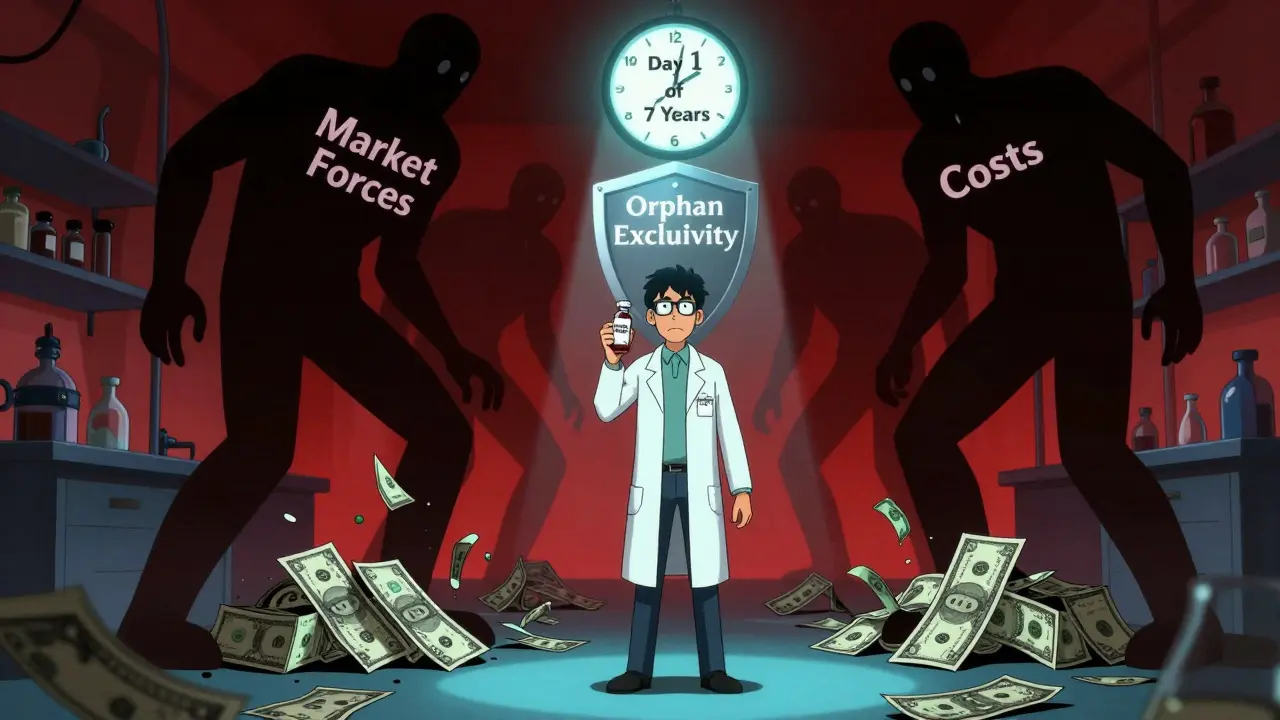
When a pharmaceutical company spends $150 million developing a drug for a disease that affects only 8,000 people in the U.S., it’s not just risky-it’s usually impossible to recoup costs without help. That’s where orphan drug exclusivity comes in. It’s not a patent. It’s not a subsidy. It’s a legal shield that gives a company seven years of exclusive rights to sell a drug for a specific rare disease, even if the drug’s chemical structure isn’t protected by a patent. This system was created in 1983 to fix a broken market: before then, fewer than 10 treatments for rare diseases had been developed in decades. Today, over 1,000 orphan drugs have been approved.
How orphan drug exclusivity works
The U.S. Food and Drug Administration (FDA) defines a rare disease as one affecting fewer than 200,000 people in the country. That’s about the population of Des Moines, Iowa. For companies developing treatments for these conditions, the math doesn’t add up. Even if every single patient took the drug, sales wouldn’t cover the cost of research. So Congress passed the Orphan Drug Act in 1983, giving companies a guaranteed seven-year window of market protection after FDA approval.
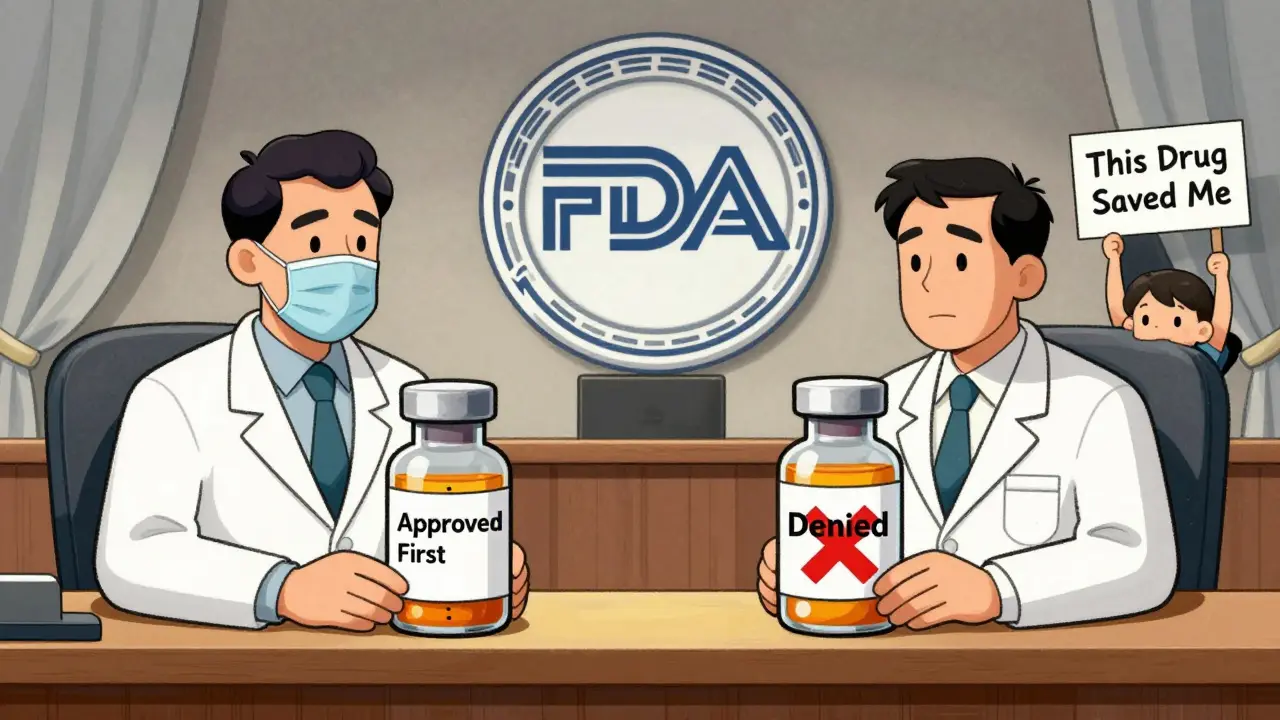
This exclusivity doesn’t stop other companies from developing the same drug. It stops them from getting approval for the same disease. If Company A gets FDA approval for a drug called X to treat Disease Y, Company B can’t get approval for the same drug for Disease Y during those seven years-unless they prove their version is clinically superior. That means showing it works better, has fewer side effects, or helps patients who don’t respond to the original drug. In over 40 years, only three cases have met this standard.
The clock starts ticking on the day the FDA approves the marketing application, not when the drug is first tested or when the company applies for orphan status. That’s why timing matters. Companies often apply for orphan designation during Phase 1 or Phase 2 trials, long before they file for approval. It’s a strategic move: the earlier they lock in the designation, the sooner the clock starts once approval comes.
What orphan exclusivity protects-and what it doesn’t
Orphan exclusivity protects a very specific thing: the combination of a drug and a disease. It doesn’t protect the drug itself. If a drug is approved for multiple conditions, exclusivity only applies to the rare disease. For example, a drug approved for both a rare neurological disorder and a common form of high blood pressure can still face generic competition for the high blood pressure use. The orphan protection only blocks competitors from copying the drug for the rare disease.
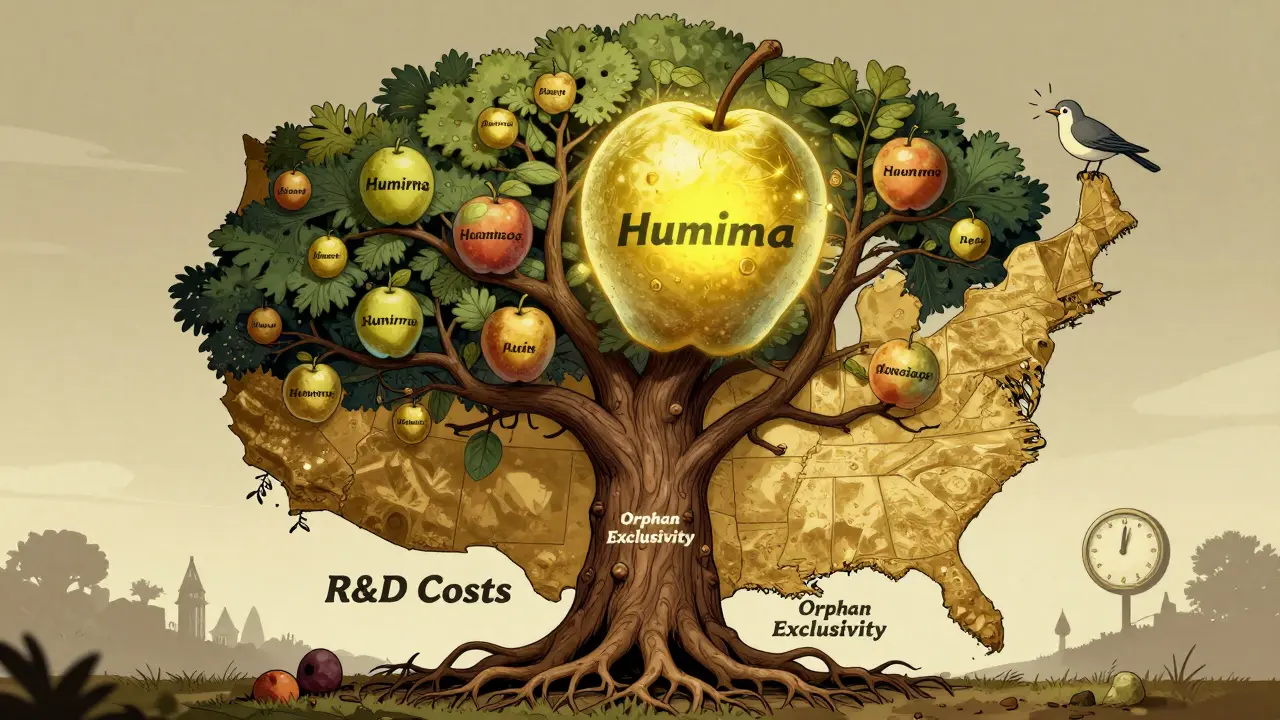
This creates a loophole some companies exploit. A drug like Humira, which generates over $20 billion in annual sales, has received multiple orphan designations for rare conditions even though its main use is for common autoimmune diseases. Critics argue this stretches the intent of the law. But under current rules, it’s legal. The FDA approves orphan designation based on prevalence, not on whether the drug was already profitable elsewhere.
Another key point: orphan exclusivity doesn’t block generics from making the same drug for a different disease. If a drug is approved for a rare cancer and later for a common skin condition, generics can enter the market for the skin condition as soon as the patent expires. The orphan exclusivity stays locked to the cancer use.
How it compares to patents and other incentives
Most people assume patents are the main reason drugs stay expensive. But for orphan drugs, that’s often not true. According to IQVIA’s analysis of 503 approved orphan drugs, patent protection was the main barrier to generic competition in 88% of cases. Orphan exclusivity only delayed competitors in 60 cases. Why? Because many orphan drugs are biologics-complex molecules made from living cells-that can’t be easily copied even if the patent expires. Others are too new to have patents yet.
Still, orphan exclusivity plays a role. When a drug’s patent runs out, orphan exclusivity can be the last thing standing between a company and generic competition. That’s why companies often file for orphan designation on drugs nearing patent expiry. It’s a way to extend market control without a new patent.
Compared to other incentives, orphan exclusivity ranks third. Tax credits for clinical trials (which cover 25% of costs) and user fee waivers (worth about $3.1 million per application) are more valuable to companies. But exclusivity is unique-it doesn’t just reduce cost, it guarantees revenue. No one else can sell the same drug for the same disease. That’s why 94% of biopharma companies say it’s critical to their rare disease strategies.
How other countries handle it
The U.S. gives seven years. The European Union gives ten. The EU also allows a two-year extension if the company studies the drug in children. But the EU has a twist: if a drug ends up making more money than expected, regulators can reduce the exclusivity from ten to six years. The U.S. doesn’t have that rule. If a drug becomes wildly profitable, the company still keeps its seven years.
That difference matters. The EU system is designed to balance incentive with fairness. The U.S. system is designed to get drugs to patients-no matter how profitable they become. That’s why some U.S. orphan drugs cost more than $500,000 per year. And why patient advocacy groups are split: 78% say the system is essential to get treatments developed, but 42% worry about pricing.
Real-world challenges and controversies
One of the biggest debates in recent years came over Ruzurgi, a drug approved in 2019 for Lambert-Eaton myasthenic syndrome (LEMS). The same drug had already been approved years earlier under a different name for the same condition. The FDA allowed the second approval, sparking confusion. Was this a case of abuse? Or just a loophole? The FDA later issued new guidance in May 2023 to clarify how it defines “the same drug.” The goal: prevent companies from getting multiple exclusivities for the same molecule by tweaking the formulation slightly.
Another issue: the “horse race” effect. Multiple companies can apply for orphan designation for the same disease. But only the first to get approval wins. That leads to duplicated efforts. One study found 12 different companies were developing drugs for the same ultra-rare disease. Only one would get exclusivity. The others would walk away with nothing. That’s inefficient-but it’s also what drives innovation. Companies don’t want to be the second one in.
What’s next for orphan drug exclusivity?
The number of orphan designations has skyrocketed-from 127 in 2010 to 434 in 2022. By 2027, Deloitte predicts 72% of all new drugs approved by the FDA will have orphan status. That’s up from 51% in 2018. The pipeline is full. But so are the questions.
Should there be a cap on how much a company can charge? Should exclusivity be tied to actual unmet medical need, not just patient count? Should the U.S. follow the EU and allow reductions for highly profitable drugs? The FDA is listening. Patient groups are pushing. Lawmakers are watching.
But one thing is clear: without orphan drug exclusivity, hundreds of rare disease treatments would never exist. The system isn’t perfect. It’s not meant to be. It’s meant to work when the market doesn’t. And for the 30 million Americans living with rare diseases, that’s enough.
What is orphan drug exclusivity?
Orphan drug exclusivity is a seven-year period of market protection granted by the FDA to a drug approved for treating a rare disease (affecting fewer than 200,000 people in the U.S.). During this time, the FDA cannot approve another company’s version of the same drug for the same condition unless it proves clinical superiority.
How is orphan exclusivity different from a patent?
A patent protects the chemical structure or method of using a drug and typically lasts 20 years from filing. Orphan exclusivity protects only the specific disease indication and lasts seven years from FDA approval. A drug can have both, but orphan exclusivity can protect a drug even if its patent has expired.
Can multiple companies get orphan exclusivity for the same drug?
No. Only the first company to receive FDA approval for a specific drug and rare disease combination gets the seven-year exclusivity. Other companies can apply for the same orphan designation, but they won’t get approval unless they prove their version is clinically superior.
Why do some orphan drugs cost so much?
Because the patient pool is tiny, companies must recover massive R&D costs from a small number of users. Orphan exclusivity lets them set high prices without competition. While the law wasn’t designed to enable high pricing, it removes the pressure to lower costs during the exclusivity period.
Does orphan exclusivity apply outside the U.S.?
No. The U.S. system is unique. The European Union offers ten years of exclusivity, with possible extensions for pediatric studies. Other countries have different rules, and many lack formal orphan drug incentives. The U.S. system remains one of the most generous in the world.
13 Comments

Jacob Hessler
March 23, 2026 at 20:36 PM
lol so u mean like if a drug cures some rare disease but costs 500k a yr its ok? smh. i thought this was america not wall street.

Amber Gray
March 24, 2026 at 19:49 PM
I mean… if the math doesn’t add up then why even try? 🤷♀️ But also… I’m glad they made it. My cousin has LEMS. Ruzurgi saved her. So… yeah. 💖

rebecca klady
March 26, 2026 at 18:41 PM
Just want to say: I’ve worked in rare disease advocacy for 12 years. Without orphan exclusivity, my sister wouldn’t be alive today. The system is flawed, yes - but it’s the only reason these drugs exist at all. Don’t throw the baby out with the bathwater.

Namrata Goyal
March 27, 2026 at 16:14 PM
You americans think capitalism is magic. In india we don’t let pharma companies charge 500k for a pill. Even if 10 people need it. You’re not saving lives - you’re running a monopoly. This isn’t innovation. It’s extortion.

Jefferson Moratin
March 28, 2026 at 04:12 AM
The orphan drug system operates on a utilitarian calculus: the cost of non-intervention (death, suffering, lost potential) vastly exceeds the economic burden of market exclusivity. To demand price controls is to demand that we sacrifice the few for the sake of ideological purity. But the few are not abstract - they are children, parents, spouses. The system works because it accepts that some moral costs are necessary to prevent greater ones.

Caroline Dennis
March 29, 2026 at 17:37 PM
Exclusivity ≠ monopoly pricing. But it enables it. The real issue is the lack of transparency in R&D costs. If companies had to disclose trial spending tied to orphan designation, we could tie exclusivity to actual unmet need - not just patient count. Biologics? Fine. But if it’s a repurposed statin? That’s gaming the system.

Zola Parker
March 30, 2026 at 12:36 PM
So we’re rewarding companies for exploiting loopholes? 🤔 Maybe the real orphan is the patient who can’t afford the drug. Or is that just part of the ‘free market’ magic? 😏

florence matthews
April 1, 2026 at 12:22 PM
I’m from a country where we don’t have orphan drug laws. We don’t have any drugs for rare diseases. But we have doctors who travel across provinces to see patients who’ve been told ‘there’s nothing we can do.’ So I see both sides. The system helps. But it shouldn’t be the only way. We need global solidarity - not just U.S.-style capitalism.

winnipeg whitegloves
April 1, 2026 at 23:42 PM
As a Canadian who’s seen our system work - we give 10 years, but we cap prices. And guess what? We still get innovation. Companies don’t cry when they make $2B instead of $5B. They just… make it. Maybe the U.S. doesn’t need to be the ‘most generous’ - just the smartest. Also, Winnipeg loves a good paradox.

Marissa Staples
April 3, 2026 at 15:58 PM
It’s funny how we praise this system as a miracle, but never ask who really benefits. The patients? Maybe. The investors? Definitely. The FDA? They get to approve more drugs. The companies? They get a 7-year monopoly on a molecule they didn’t even invent. I’m not against rare disease drugs. I’m against the myth that this is fair.

Rachele Tycksen
April 4, 2026 at 17:35 PM
i just read this and my brain is like ‘wait so they get to charge 500k??’ 😭

Grace Kusta Nasralla
April 6, 2026 at 09:56 AM
I used to believe in this system. I used to think it was noble. Then my brother died waiting for a drug that got approved… but cost $400,000. I couldn’t afford it. The system didn’t fail him because it didn’t work - it failed him because it was designed to work for someone else. I’m not angry. I’m just… hollow.
Katie Putbrese
March 23, 2026 at 20:05 PM
This system is a national disgrace. $500,000-a-year drugs for 8,000 people? We’re not in the business of bailing out Big Pharma billionaires. If they can’t make a profit on 200k patients, they shouldn’t be in pharma. Taxpayers fund the research, then corporations gouge the sick. It’s immoral. Fix this now or I’m calling my rep.