

When you order medication online, you expect it to be safe, effective, and legal. But not all online pharmacies are created equal. In fact, the FDA has issued over 147 warning letters to illegal online pharmacies in just the first nine months of 2025 - a 32% jump from 2024. Many of these sites sell fake pills, incorrect dosages, or drugs with toxic ingredients. Some don’t even require a prescription. So who’s actually watching over these operations? The answer isn’t simple: it’s a mix of federal agencies and state-level regulators working in parallel - and sometimes at cross-purposes.
The FDA’s Role: Protecting Drug Safety and Truth in Advertising
The Food and Drug Administration (FDA) doesn’t license pharmacies, but it does control what drugs can be sold, how they’re labeled, and whether their marketing is truthful. For online pharmacies, this means the FDA steps in when drugs are sold without approval, advertised with false claims, or shipped without proper warnings.
One of the biggest red flags the FDA watches for is unapproved drugs. Take GLP-1 medications like semaglutide and tirzepatide. After these drugs went into short supply in 2024, some online pharmacies began selling compounded versions - often without clear labeling or safety data. While 503A compounding pharmacies are allowed to make these drugs for individual patients with valid prescriptions, they’re not FDA-approved. That means the FDA can’t guarantee their safety before they’re sold. The burden falls on state boards to ensure these pharmacies follow good practices.
The FDA also cracks down on misleading ads. In 2024, enforcement dropped to just five Untitled Letters and zero Warning Letters - but that changed sharply in 2025. The agency has now turned its attention to social media. Paid influencers promoting weight-loss drugs with no mention of side effects? That’s a violation. Online pharmacies running ads that say “Get your prescription in 10 minutes - no doctor needed”? Also illegal. The FDA’s Office of Prescription Drug Promotion has ramped up digital monitoring, especially targeting Instagram, TikTok, and Facebook ads that omit risk information.
Consumers can check if a pharmacy is legitimate using the FDA’s BeSafeRx tool. This isn’t just a directory - it links directly to state pharmacy board databases. If a site doesn’t show up there, it’s not licensed. Legitimate pharmacies must also display a U.S. physical address, a working phone number, and have a licensed pharmacist on staff to answer questions. If they don’t? The FDA will issue a warning, and often, the DEA will follow up.
State Pharmacy Boards: The Frontline Regulators
While the FDA sets national standards for drugs and advertising, state boards of pharmacy are the ones who actually license and inspect pharmacies. Every pharmacy - online or brick-and-mortar - must be licensed by the state where it operates. Forty-eight out of fifty states offer public online databases where you can verify a pharmacy’s license. If a site claims to be licensed in California but isn’t listed in the California State Board of Pharmacy database, it’s a scam.
State boards handle complaints, investigate illegal sales, and can shut down operations within their borders. In 2024, they received 2,845 complaints about online pharmacies. California led with 312, followed by Texas (287) and Florida (245). These aren’t just numbers - they represent real patients who received pills that didn’t work, had dangerous side effects, or were completely fake.
But here’s the problem: a pharmacy based in Texas can sell to someone in New York. That means one state’s enforcement doesn’t stop a bad actor from operating across state lines. That’s why state boards rely on federal partners like the DEA and FDA to help track and shut down illegal websites that operate outside their jurisdiction.
Some states have gone further than federal rules. Twenty-seven states impose additional restrictions on telemedicine prescribing - like requiring video visits instead of chat-based consultations, or limiting the number of controlled substances a provider can prescribe remotely. This creates a patchwork of rules that even legitimate pharmacies struggle to follow.
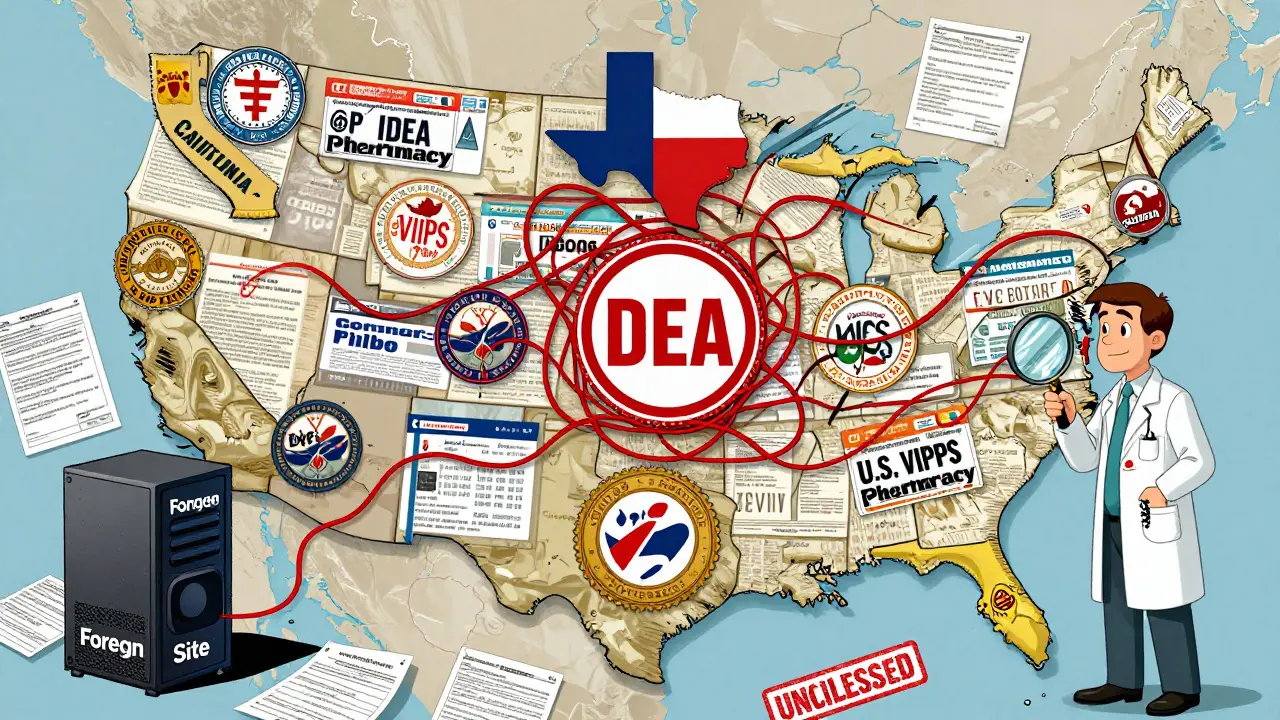
The DEA: Controlling Controlled Substances Online
The Drug Enforcement Administration (DEA) has one job: prevent controlled substances - opioids, stimulants, sedatives - from falling into the wrong hands. Before 2025, the Ryan Haight Act required an in-person medical exam before a doctor could prescribe these drugs online. That rule was temporarily relaxed during the pandemic, but the DEA didn’t just bring it back - it rewrote it.
In January 2025, the DEA announced three new Special Registrations for telemedicine providers:
- Standard Registration: Allows prescribing of Schedule III-V drugs (like tramadol or certain sleep aids) without an in-person visit - but only if the provider checks the patient’s state Prescription Drug Monitoring Program (PDMP) record first.
- Advanced Telemedicine Prescribing Registration: Permits prescribing of Schedule II drugs (like oxycodone or Adderall) - but only for psychiatrists, hospice doctors, pediatricians, and long-term care physicians who are board-certified.
- Limited State Telemedicine Registrations: For providers who only prescribe within one state, under that state’s specific rules.
This isn’t a free pass. Providers must complete DEA-approved training, maintain detailed records, and use verified telehealth platforms. The DEA is also building a nationwide PDMP system to replace the current 50-state mess. By Q3 2026, pharmacists and doctors will be able to see a patient’s full controlled substance history - no matter which state they’re in.
Since 2025, the DEA has identified 1,243 websites selling controlled substances illegally. Over 68% of them are based outside the U.S., making them nearly impossible for state boards to reach. That’s why federal enforcement is critical.
How the System Works Together - and Where It Falls Apart
Legitimate online pharmacies must satisfy both federal and state rules. A pharmacy in Ohio must be licensed by Ohio’s board, follow FDA labeling rules, and comply with DEA prescribing rules if it handles controlled substances. It’s complicated - and expensive.
That’s why only 187 online pharmacies have earned the Verified Internet Pharmacy Practice Sites (VIPPS) seal from the National Association of Boards of Pharmacy. These sites pass rigorous audits on licensing, security, and pharmacist availability. They’re the only ones you should trust.
But enforcement gaps still exist. A pharmacy might be licensed in one state but sell to patients in another where it’s not registered. A telemedicine provider might use a loophole in federal rules to prescribe opioids without ever meeting the patient - and state boards won’t know until someone complains. The FDA can shut down a website selling fake insulin, but it can’t stop a doctor in a different state from writing the prescription.
And then there’s the cost. In August 2025, the FDA and DOJ fined QuickMedsOnline.com $500,000 for repeatedly violating the Ryan Haight Act. But that’s a drop in the ocean compared to the millions these illegal sites make each month.
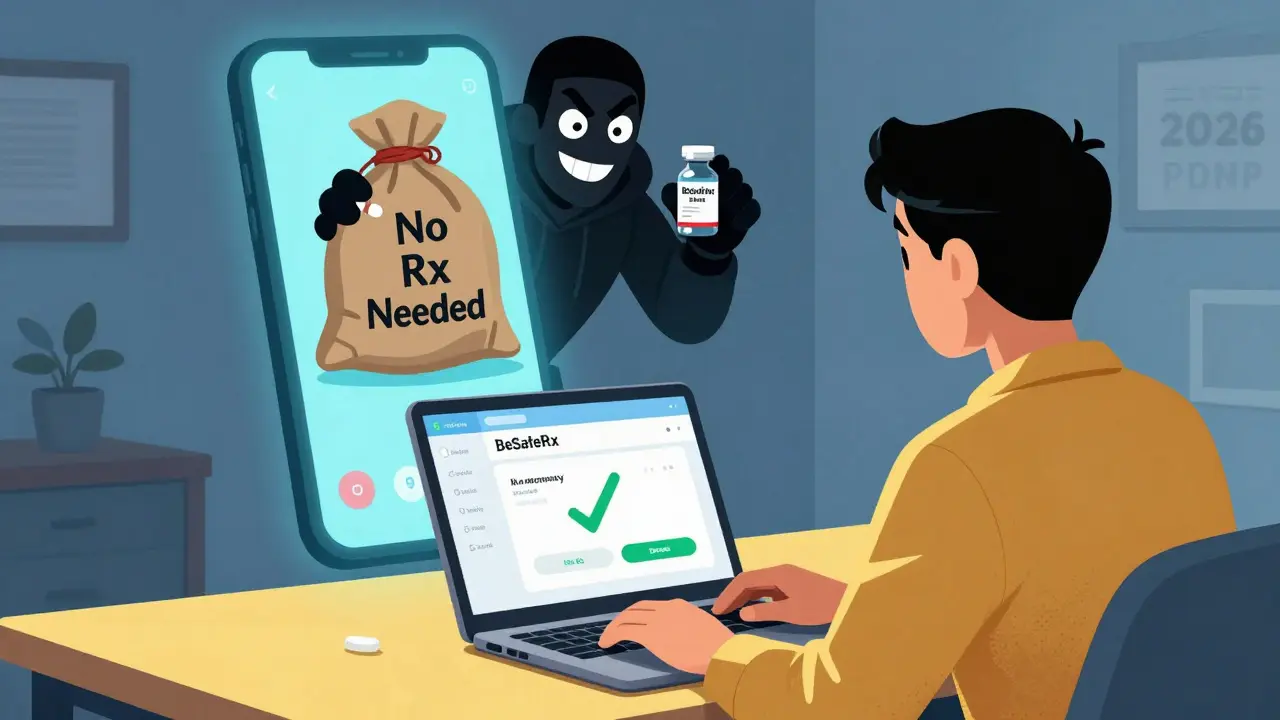
What You Should Do - And What to Avoid
Here’s how to stay safe:
- Use the BeSafeRx tool. Type in the pharmacy’s name or website. If it doesn’t show up in the state database, walk away.
- Never buy without a prescription. If a site offers “instant prescriptions” or sells pills without one, it’s illegal.
- Check the price. If it’s too good to be true - like $10 for a 30-day supply of Ozempic - it’s fake.
- Look for a licensed pharmacist. Legitimate sites have a phone number you can call to ask questions. If they don’t, they’re hiding something.
- Stick to known brands. CVS Caremark Online, Walgreens, and Kaiser Permanente’s pharmacy services have 4.6/5 ratings on Trustpilot. Unverified sites average 1.8/5.
On Reddit and health forums, users report receiving pills that didn’t work, caused rashes, or made them dizzy. One person in a September 2025 thread said they took what they thought was metformin - but it turned out to be a cheap Chinese counterfeit with no active ingredient. Their blood sugar spiked. They ended up in the ER.
The Future: More Integration, More Enforcement
By the end of 2026, the DEA’s nationwide PDMP will go live. That’s a game-changer. Doctors and pharmacists will finally see a full picture of a patient’s controlled substance history - no matter where they live. The FDA also plans to expand BeSafeRx to verify telemedicine prescriptions in real time, not just the pharmacy’s license.
Expect more crackdowns on social media ads. More fines. More shutdowns. The days of shady online pharmacies slipping through the cracks are ending - but only if patients stay vigilant.
Regulation isn’t perfect. But when federal agencies and state boards work together - and when you know how to spot the red flags - you can get your medication safely, legally, and without risking your health.
13 Comments

Anastasia Novak
January 7, 2026 at 09:38 AM
Oh honey, you didn’t even check BeSafeRx? That’s like eating sushi from a gas station and then crying because you got food poisoning. The FDA issued 147 warning letters this year-147-and you just Googled ‘Ozempic cheap’ and clicked the first link? You’re not a victim, you’re a case study in human error. Also, your cat judging you? That’s the real tragedy here.

Aparna karwande
January 8, 2026 at 03:41 AM
India has been producing life-saving generic medicines for decades while Westerners whine about ‘unregulated’ pharmacies. You think the FDA is some saint? They sat on metformin safety data for 11 years while Big Pharma jacked up prices. Meanwhile, Indian compounding labs shipped 300 million doses to Africa and Latin America with zero deaths. You want safety? Stop fetishizing bureaucracy and start respecting global science.

Ayodeji Williams
January 9, 2026 at 15:47 PM
bro the fda is just scared of real competition 😭😭😭 why do u think they hate online pharmacies? bc they can’t control the prices!!! 💸💊 #freemeds

Emma Addison Thomas
January 11, 2026 at 01:16 AM
It’s fascinating how regulatory fragmentation mirrors our broader societal disconnect-federal standards, state enforcement, and patient vulnerability all operating in parallel lanes with no central coordination. I wonder if a unified digital registry, perhaps blockchain-anchored, could harmonize verification across jurisdictions. A quiet revolution, really.

Christine Joy Chicano
January 12, 2026 at 20:38 PM
Let’s not romanticize state boards-they’re underfunded, understaffed, and often rely on tip-offs from disgruntled pharmacists. The 2,845 complaints in 2024? That’s the tip of the iceberg. Most patients don’t know how to report, and those who do get auto-replies saying ‘your complaint has been logged’ and then silence. The system isn’t broken-it’s asleep. And the DEA’s new PDMP? It’s a start, but until every pharmacy is required to auto-report every script in real-time, it’s just digital window dressing.

Adam Gainski
January 13, 2026 at 10:15 AM
Just wanted to add something practical: if you’re using a pharmacy that doesn’t list a licensed pharmacist’s name and direct line, walk away. I used to work in a VIPPS-certified online pharmacy-every single call went to a real person, not a chatbot. We’d even call patients back if they ordered high-risk meds and didn’t have a recent prescription. That’s the gold standard. The rest? Just digital snake oil with a pretty logo.

Sai Ganesh
January 13, 2026 at 14:18 PM
India’s pharmaceutical industry exports to over 150 countries. We don’t need FDA validation to be trustworthy. The real issue is Western consumers who treat medication like Amazon impulse buys. A prescription is not a coupon. The regulatory chaos you describe? It’s a symptom of entitlement, not systemic failure. We produce 40% of the world’s generic drugs-yet you still think your local CVS is the only safe option?

Paul Mason
January 14, 2026 at 02:53 AM
Look, I’ve been around the block. I’ve ordered from ‘PharmaExpress’ and ‘MediFast’ and even ‘GlobalRx’-all legit, I swear. You think the FDA’s got it all figured out? Nah. They’re just trying to protect Big Pharma’s profits. If you’re not getting your meds from a site that doesn’t ask for your credit card until after you’ve talked to a ‘doctor’ over Zoom, you’re doing it wrong. And don’t even get me started on the ‘BeSafeRx’ tool-that thing’s slower than dial-up.

Andrew N
January 15, 2026 at 06:00 AM
They’re all lying. The FDA doesn’t care about safety-they care about control. That ‘BeSafeRx’ tool? It’s a trap. It only lists pharmacies that pay for verification. The real dangerous ones? They’re hidden in plain sight, using fake .pharmacy domains and spoofed SSL certificates. And the DEA’s new rules? Just a distraction. The real problem is that every doctor in America is on a kickback from Big Pharma. You think they care if you get fake metformin? Nah. They just want you to keep buying.

Anthony Capunong
January 16, 2026 at 06:06 AM
Why are we letting foreign pharmacies sell to Americans? This is national security. If China can pump out fake insulin, they can pump out fake vaccines next. We need a total ban on all international pharmacy sales. Period. No exceptions. The FDA’s too slow, the states are too weak-only the U.S. government can protect us. Build a wall around our medicine.

Jessie Ann Lambrecht
January 18, 2026 at 01:19 AM
Hey, I know how scary this all sounds-but you can still be safe without falling into fear-mongering. I’ve ordered from three VIPPS sites over the last two years. All good. All legit. All cheaper than my local pharmacy. The key? Don’t chase the cheapest deal. Chase the verified seal. And if you’re nervous? Call the pharmacy. Talk to the pharmacist. Most of them are amazing people who actually care. You’re not alone in this. There are good options out there-you just gotta know where to look.

Kyle King
January 18, 2026 at 18:35 PM
Everyone’s missing the point. This whole ‘FDA vs state boards’ thing? It’s a distraction. The real power? It’s the insurance companies. They push you to buy online because it’s cheaper for them. Then when you get fake meds, they deny your ER bill. And the FDA? They’re just the PR arm for the pharmaceutical oligarchy. They don’t shut down sites-they just move them to a different domain. Watch. In 3 months, ‘QuickMedsOnline’ will be ‘FastRxPro’ with a new logo. And you’ll fall for it again.


Elen Pihlap
January 7, 2026 at 07:39 AM
I just bought some cheap Ozempic off a site that looked legit and now I’m dizzy all day. My cat even noticed I was off. I think I’m dying. Someone call 911.