
Bleeding Risk Calculator
Understand Your Bleeding Risk
This tool calculates your bleeding risk when taking an SSRI antidepressant with an anticoagulant based on the HAS-BLED scoring system. The article explains that patients with a score of 3 or higher are considered high-risk for serious bleeding events.
Select all risk factors that apply to you:
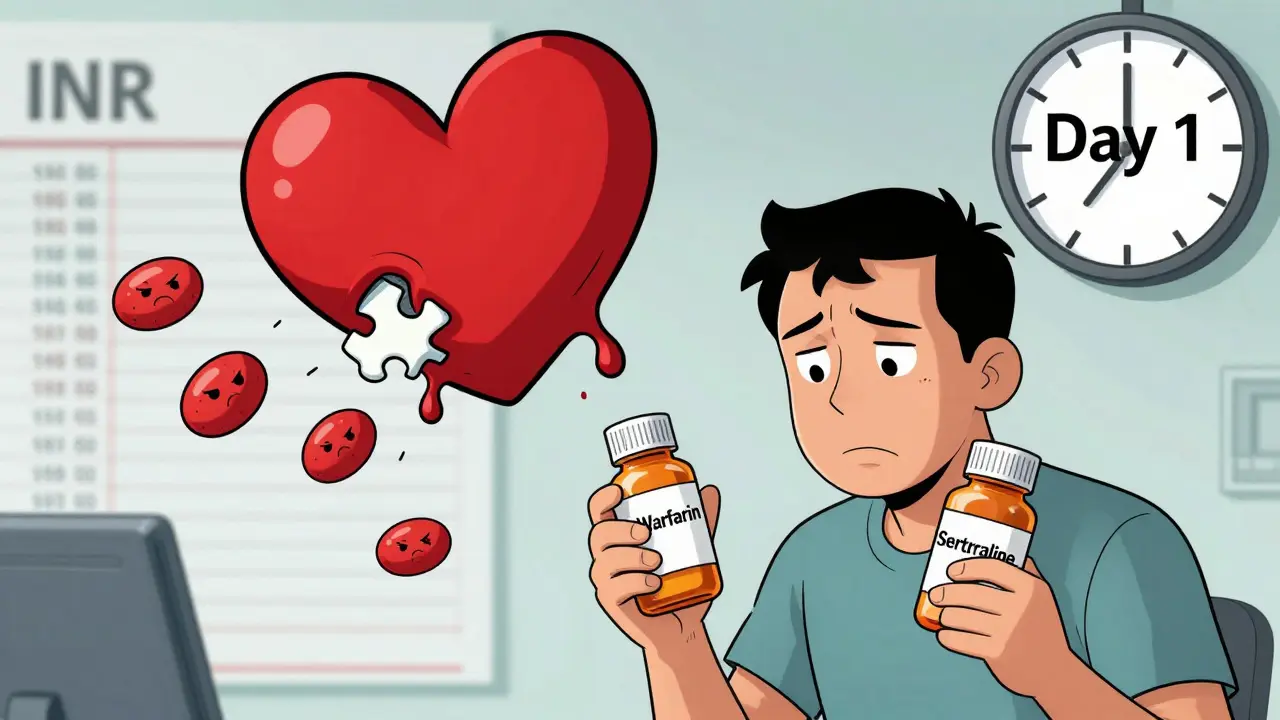
When you're taking an anticoagulant like warfarin, apixaban, or rivaroxaban to prevent strokes or blood clots, you're already managing a delicate balance. Now add an SSRI-like sertraline, escitalopram, or fluoxetine-for depression or anxiety. Sounds harmless? It’s not. The combination increases your risk of serious bleeding by 33%, and most of that risk shows up in the first 30 days.
Why SSRIs Make Anticoagulants More Dangerous
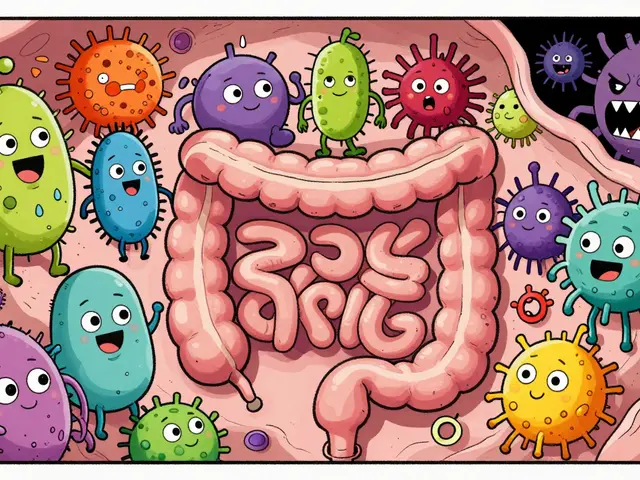
SSRIs don’t thin your blood the way warfarin does. Instead, they mess with your platelets-the tiny blood cells that plug leaks in damaged vessels. Platelets need serotonin to stick together and form clots. SSRIs block the serotonin transporter on platelets, draining their serotonin stores by up to 90%. Without enough serotonin, platelets can’t aggregate properly. This isn’t a minor effect-it cuts platelet function by 30-40%, as shown in lab tests. This isn’t theoretical. A 2024 study of over 42,000 people with atrial fibrillation found that those taking both an SSRI and an anticoagulant had a 33% higher chance of major bleeding than those on anticoagulants alone. The bleeding wasn’t random-it happened where you’d least want it: the gut (58% of cases), the brain (17%), or deep inside the body (25%).Not All Anticoagulants Are Equal
If you’re on warfarin, the risk is higher than if you’re on a DOAC like apixaban or dabigatran. The 2024 study showed a 28% increased bleeding risk with warfarin plus SSRI, versus 22% with DOACs. That difference didn’t reach statistical significance, but it’s still telling. Warfarin’s effects are harder to control-it swings with diet, other meds, and even your liver enzymes. DOACs are more predictable. So if you’re on warfarin and need an antidepressant, switching to a DOAC might lower your bleeding risk, even before changing the SSRI.Not All SSRIs Are the Same-But Not for the Reason You Think
You might assume stronger SSRIs like paroxetine (which blocks serotonin reuptake more aggressively) would cause more bleeding. But the data says otherwise. In the same 2024 study, paroxetine carried the same bleeding risk as escitalopram, even though escitalopram is less potent. This contradicts earlier small studies that suggested some SSRIs were safer. The truth? All SSRIs deplete platelet serotonin enough to matter. The dose doesn’t change the risk much either-it’s the class effect.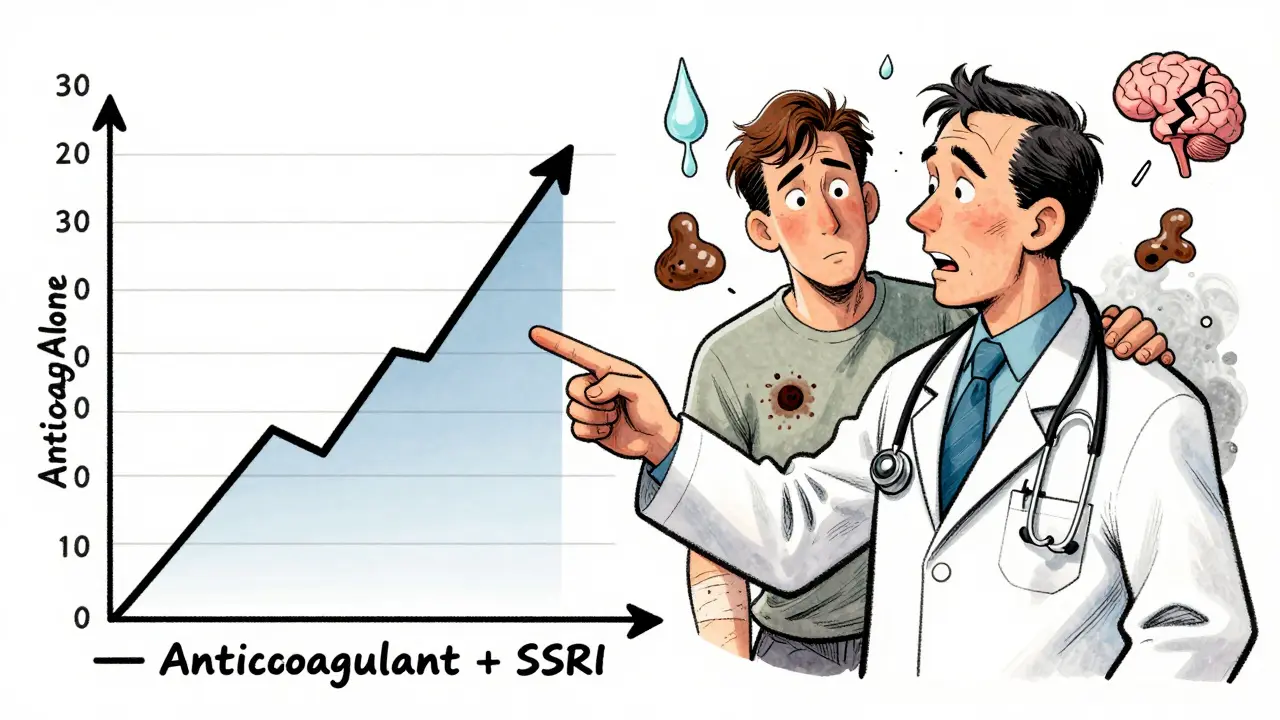
What About Other Antidepressants?
If you’re worried about bleeding, you’re not stuck with SSRIs. Mirtazapine and bupropion don’t affect platelets the same way. Mirtazapine works on different brain receptors and has no known platelet interaction. Bupropion is a norepinephrine-dopamine reuptake inhibitor-no serotonin effect on platelets. These are safer alternatives, especially for people with a high bleeding risk (like those with a HAS-BLED score of 3 or higher). But here’s the catch: SSRIs are still the first-line treatment for moderate-to-severe depression in over 87% of anticoagulated patients. Why? Because they work. And switching antidepressants isn’t always easy.When Is the Risk Highest?
The biggest danger isn’t after six months-it’s the first 30 days. That’s when your body is adjusting to both drugs. The 2024 study found the bleeding risk dropped sharply after three months and was nearly back to baseline by six months. That’s why the American Heart Association and FDA both warn: pay close attention in the first month. If you start an SSRI while already on an anticoagulant, watch for bruising that spreads, nosebleeds that won’t stop, dark or tarry stools, or sudden headaches. These aren’t normal side effects-they’re red flags.How Doctors Monitor This Risk
If you’re on both drugs, your doctor should be checking more than just your INR (if you’re on warfarin). Standard practice now includes:- Complete blood count (CBC) at baseline and monthly for the first three months
- Fecal occult blood test to catch silent gut bleeding
- INR checks twice a week during the first month if you’re on warfarin
- Asking about bruising, bleeding gums, or unusual fatigue
Who Should Avoid This Combo?
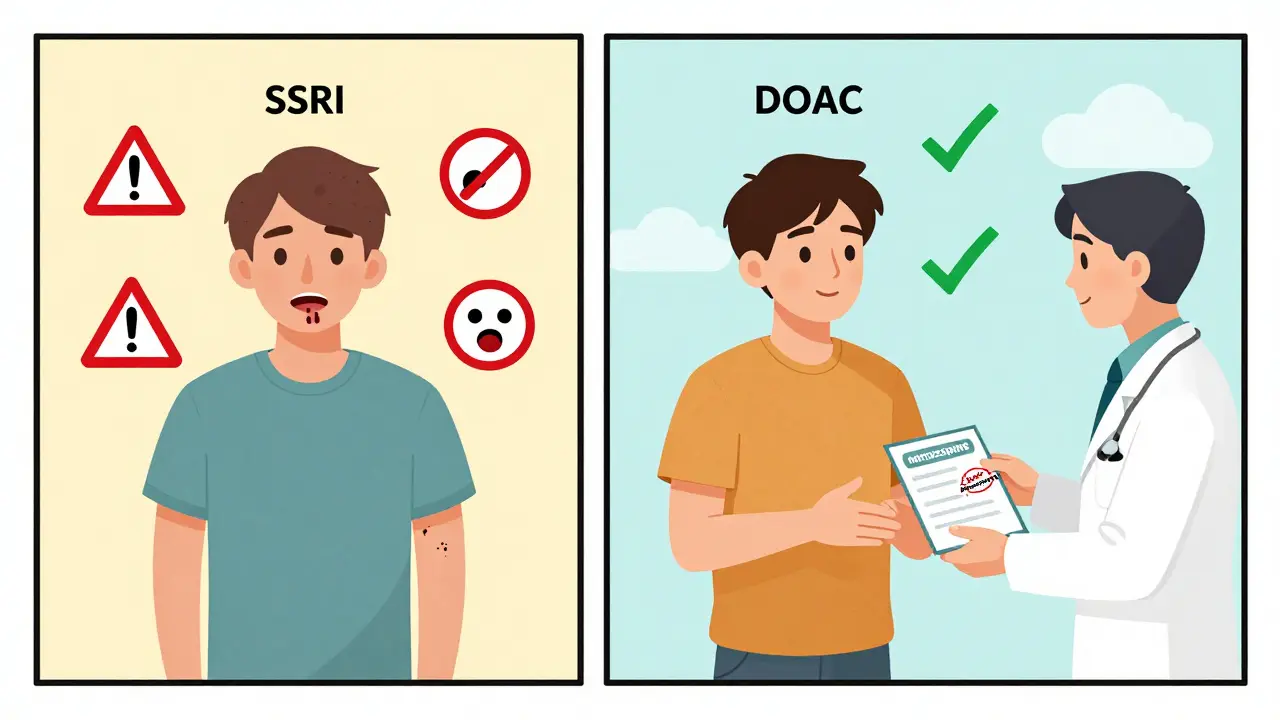
Not everyone needs to avoid SSRIs entirely. But if you have:- A HAS-BLED score of 3 or higher (high bleeding risk)
- A history of GI bleeding or ulcers
- Older than 75
- Chronic kidney disease
- Concurrent use of NSAIDs or aspirin
What’s New in 2025?
The FDA updated anticoagulant medication guides in January 2025 to include direct language about SSRI interactions. They now recommend: “Consider non-SSRI antidepressants in patients with additional bleeding risk factors.” That’s a shift-from vague warnings to clear clinical guidance. New research from January 2025 confirmed that SSRIs don’t directly affect coagulation factors like thrombin or fibrinogen. The bleeding is purely platelet-driven. That means if you’re bleeding, it’s not because your blood can’t clot-it’s because your platelets can’t stick together. The NIH is funding a major trial called PRECISION-AF, which is comparing bleeding rates between SSRIs and non-SSRI antidepressants in 5,000 anticoagulated patients. Results are due in late 2026. Until then, we rely on the best data we have: the 2024 JAMA study.What Should You Do?
If you’re on an anticoagulant and your doctor wants to start an SSRI:- Ask: “Is this the safest option for my bleeding risk?”
- Ask: “Could mirtazapine or bupropion work instead?”
- Ask: “Should I be tested for bleeding signs in the first month?”
- Don’t stop either drug without talking to your doctor.
This isn’t about avoiding treatment. It’s about choosing the safest path. Depression and anxiety are serious. So are strokes and internal bleeding. You don’t have to pick one over the other-you just need to pick the right combination.
Can I take an SSRI if I’m on warfarin?
Yes, but the risk of bleeding is 28% higher than if you were on warfarin alone. The risk is highest in the first 30 days. Your doctor should monitor you closely with frequent INR checks, CBC tests, and stool tests for hidden bleeding. Consider switching to a DOAC like apixaban if possible-it carries slightly lower risk when combined with SSRIs.
Are some SSRIs safer than others with anticoagulants?
No. Despite differences in potency, all SSRIs-paroxetine, sertraline, escitalopram, fluoxetine-carry the same bleeding risk when combined with anticoagulants. The effect isn’t about how strong the drug is; it’s about how they all block serotonin uptake in platelets. Don’t assume a "milder" SSRI is safer.
What are the signs of bleeding I should watch for?
Watch for: unexplained bruising, nosebleeds that won’t stop, bleeding gums, dark or tarry stools, vomiting blood, sudden severe headaches (could signal brain bleed), or unusual fatigue and dizziness (signs of internal bleeding). If you notice any of these, contact your doctor immediately.
Can I take aspirin or ibuprofen with SSRIs and anticoagulants?
Avoid them. Aspirin and ibuprofen also interfere with platelet function. Combining them with SSRIs and anticoagulants can multiply your bleeding risk. For pain relief, talk to your doctor about acetaminophen (paracetamol), which doesn’t affect platelets or clotting.
Is it safe to switch from an SSRI to another antidepressant?
Yes, especially if you’re at high risk for bleeding. Mirtazapine and bupropion are good alternatives because they don’t affect platelet serotonin. But don’t switch on your own. Stopping an SSRI suddenly can cause withdrawal. Work with your doctor to taper safely and start the new medication gradually.
14 Comments

suhani mathur
December 24, 2025 at 09:59 AM
Actually, the real problem is doctors who don’t check platelet function at all. INR means nothing if your platelets are basically drunk. I’ve been on apixaban + sertraline for 14 months - no bleed, but my PCP never ordered a CBC. Zero follow-up. That’s negligence disguised as ‘standard care.’

claire davies
December 24, 2025 at 11:11 AM
As someone who’s lived with both depression and a mechanical heart valve, I can tell you this: the fear of bleeding kept me from getting help for years. I thought ‘if I take an SSRI, I’ll just bleed out quietly in my sleep.’ But when I switched to mirtazapine with my cardiologist’s help, my mood lifted AND my bruises disappeared. It’s not about choosing between mental health and physical health - it’s about choosing the right tools. And yes, the first month is terrifying. But you’re not alone. Talk to your pharmacist. Ask for a bleeding risk checklist. You’ve got this.

Joseph Manuel
December 25, 2025 at 02:33 AM
The 33% increased risk figure is misleading without absolute risk context. In a low-risk population, a 33% increase from 0.5% to 0.67% is statistically significant but clinically negligible. The study’s population was high-risk AF patients - not representative of general SSRI users. Overinterpretation of relative risk is a common flaw in medical journalism. The real issue is poor risk stratification, not the combination itself.

Bret Freeman
December 25, 2025 at 07:21 AM
Of course the FDA updated their guidelines. Because someone finally got paid to write a press release. Meanwhile, real people are still getting prescribed sertraline while on warfarin and told ‘just avoid aspirin.’ No one’s talking about the 40 other OTC meds that inhibit platelets. Or the fact that 70% of elderly patients are on 5+ meds. This isn’t a drug interaction - it’s a systemic failure. And no, ‘watch for bruising’ isn’t a plan.

Joe Jeter
December 27, 2025 at 03:40 AM
You know what’s really dangerous? Letting pharmaceutical companies dictate treatment protocols. SSRIs were pushed hard because they’re profitable. Platelet effects? Buried in the appendix. And now we’re supposed to believe the ‘science’ that says all SSRIs are equal? That’s not science - that’s corporate groupthink. Someone’s getting rich off this. I bet it’s the same people who said smoking was safe.

Usha Sundar
December 28, 2025 at 03:55 AM
My mom took fluoxetine + warfarin. Got a brain bleed at 78. They said ‘it was just age.’ But she didn’t even know she was at risk. If this info was on the pill bottle, she’d have asked. It’s not the drugs. It’s the silence.

Dan Gaytan
December 29, 2025 at 18:47 PM
Just wanted to say - thank you for writing this. I’ve been on apixaban + escitalopram for 8 months now. I was terrified. But I followed the monitoring plan - CBC every month, stool test, no NSAIDs, and I’ve had zero issues. It’s not perfect, but it’s manageable. You’re not alone. Ask for help. You’re doing better than you think. 💪❤️

Bhargav Patel
December 30, 2025 at 19:06 PM
One must reflect upon the epistemological foundations of contemporary pharmacological paradigms. The reductionist model, which isolates serotonergic reuptake inhibition as the sole causal vector of hemorrhagic risk, neglects the holistic interplay of endothelial integrity, genetic polymorphisms in CYP450 enzymes, and the epigenetic modulation of platelet sensitivity. The statistical correlation observed in cohort studies does not necessarily imply mechanistic causality - particularly when confounders such as dietary vitamin K fluctuation, concurrent polypharmacy, and age-related thrombocytopenia remain unaccounted for in multivariate analyses. To prescribe clinical action based on relative risk ratios alone is to commit the fallacy of reification - treating a mathematical abstraction as ontological truth. A more nuanced hermeneutics of risk is required, one that acknowledges the patient not as a vector of pharmacokinetic variables, but as a sentient being navigating a labyrinth of biomedical uncertainty.

siddharth tiwari
December 30, 2025 at 23:05 PM
they told me it was safe but now i think the gov is hiding something… why dont they test platelet serotonin levels before prescribing? why is this not on every script? i think big pharma paid off the fda… and my doc just reads the paper and doesnt think. i know people who died from this. they said ‘it was a stroke’ but it was bleeding. they never asked about my antidepressant. i think they dont want us to know.

niharika hardikar
December 31, 2025 at 22:54 PM
It is imperative to recognize that the pharmacodynamic interaction between SSRIs and anticoagulants is mediated by the inhibition of the serotonin transporter (SERT) on platelet dense granules, thereby impairing the release of ADP and thromboxane A2 secondary to diminished intraplatelet serotonin stores. This results in a dysfunctional hemostatic response independent of coagulation cascade perturbation. Consequently, the clinical implication is not a ‘bleeding risk’ per se, but a failure of primary hemostasis - a distinction that must be communicated to patients to avoid misinterpretation of symptoms as ‘warfarin toxicity.’

Diana Alime
January 1, 2026 at 09:17 AM
i took sertraline and warfarin for 3 months and i was fine… so why is everyone freaking out? my doctor said it was fine. maybe i’m just lucky? or maybe this whole thing is overblown? i’m not gonna stop my meds because some guy on the internet says i might bleed. also i love ice cream and i’m not gonna stop eating it just because someone said sugar might kill me.

Rachel Cericola
January 3, 2026 at 02:51 AM
Let me be crystal clear: if you’re on an anticoagulant and your doctor hasn’t asked you about bruising, stool color, or gum bleeding in the last 3 months - find a new doctor. This isn’t complicated. It’s not ‘maybe.’ It’s not ‘some people.’ It’s a known, documented, preventable risk. And if your doctor dismisses it as ‘rare,’ they’re not keeping up. I’ve trained 12 residents on this exact combo in the last year. We do CBCs at week 1, 2, 4, then monthly. We screen for NSAID use. We offer mirtazapine as a first alternative, not a last resort. You deserve better than a 5-minute visit and a prescription. Advocate for yourself. Print this out. Bring it to your next appointment. You’re not being ‘difficult’ - you’re being smart.

bharath vinay
January 3, 2026 at 04:54 AM
They’re lying. The real reason SSRIs cause bleeding is because they’re laced with microchips that interfere with clotting factors. The FDA banned the test strips that detect this in 2023. You think they care if you bleed? They want you dependent. They want your data. Your platelets are being tracked. Don’t take anything with a barcode. Use herbal remedies. Turmeric. Ginger. Don’t trust science. Trust your gut.

Chris Buchanan
December 23, 2025 at 17:38 PM
So let me get this straight - we’re telling people to avoid SSRIs because they might bleed more, but we’re still prescribing them as first-line because they ‘work’? That’s not medicine, that’s gambling with a loaded gun and hoping the patient doesn’t pull the trigger. I’ve seen too many people get told ‘it’s fine’ until they’re in the ER with a GI bleed. We need better guidelines, not just ‘watch for signs.’