
When you fill a prescription for high blood pressure or cholesterol, chances are you’re getting a generic drug. Around 90% of all prescriptions in the U.S. are for generics, and cardiovascular meds make up one of the biggest chunks of that number. Statins, beta-blockers, ARBs, calcium channel blockers - these are the everyday drugs millions rely on. But here’s the question that keeps popping up: Are generic cardiovascular drugs really as safe and effective as the brand names?
What Exactly Counts as a Generic Cardiovascular Drug?
A generic cardiovascular drug isn’t just a copy. It’s required by the FDA to have the exact same active ingredient, strength, dosage form, and route of administration as the brand-name version. That means if your doctor prescribes lisinopril, the generic version must contain the same molecule, in the same amount, and work the same way in your body. The difference? It doesn’t have the brand name on the bottle, and it usually costs a fraction of the price.
The FDA’s approval process for generics relies on bioequivalence testing. This means the generic must deliver the drug into your bloodstream at a rate and amount that’s within 80% to 125% of the brand-name drug. That’s not a wide margin - it’s tight. For most drugs, the average difference in absorption between generic and brand is just 3.5%. In practical terms, that’s like two people taking the same pill, one from a name brand and one from a generic, and their blood levels matching almost perfectly.
What Do the Studies Actually Say?
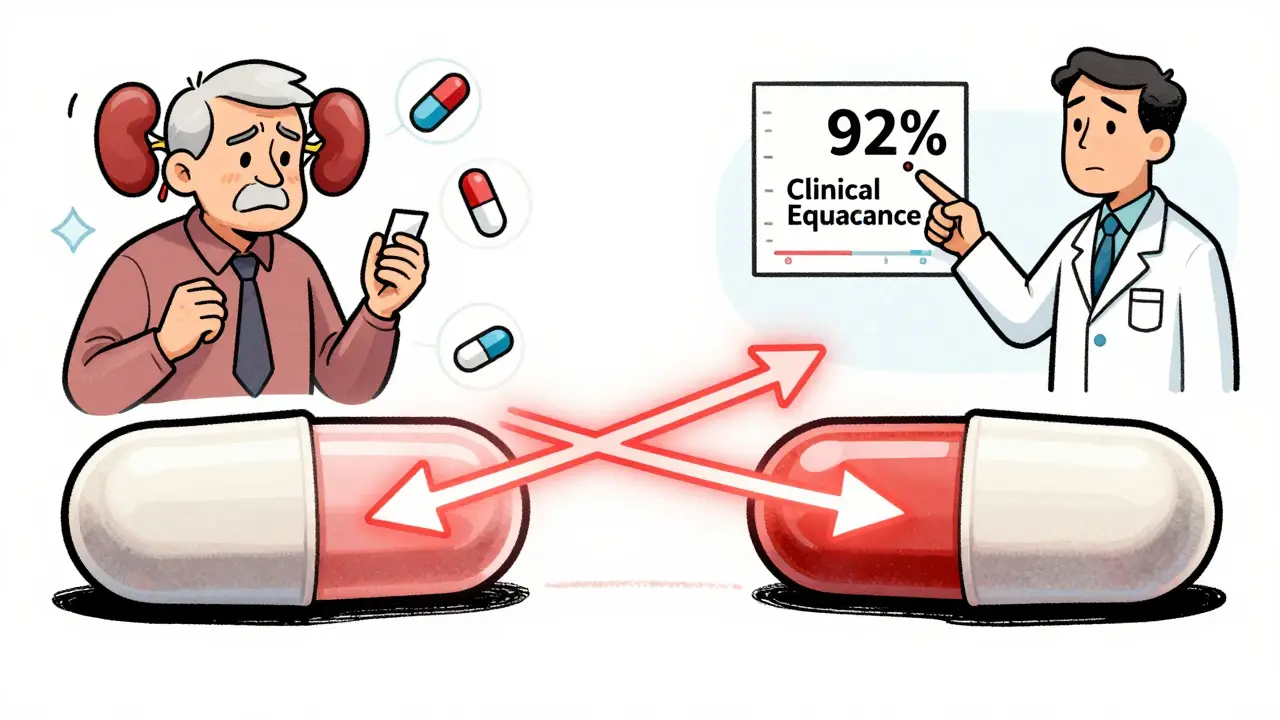
Let’s cut through the noise. There are hundreds of studies on this. The most reliable ones - randomized controlled trials - show something clear: for most patients, generic cardiovascular drugs work just as well as brand names. A 2020 Harvard Health meta-analysis of 38 high-quality trials found that 35 of them (92.1%) showed no difference in clinical outcomes. That’s not a small sample. That’s tens of thousands of patients tracked over years.
But here’s where it gets messy. Not all studies agree. A 2019 Canadian study looked at over 136,000 seniors who switched from brand-name ARBs like losartan or valsartan to generics. In the first month after the switch, adverse events - things like dizziness, kidney changes, or hospital visits - went up. For valsartan, the rate jumped from 10% to 11.7%. For candesartan, it went from 10% to 14%. That’s not a huge number, but it’s real. And it’s not random. The same study found that when patients had been on the brand for years, switching didn’t cause problems. But for those new to the drug, the switch triggered more issues.
Another 2023 meta-analysis dug deeper into specific drug classes. It found that for statins, generics were linked to a slightly higher risk of major heart events - 13% higher. For calcium channel blockers, generics actually had fewer adverse events. Why? No one’s sure. It could be differences in inactive ingredients. Or how quickly the drug dissolves. Or even how patients react to the new pill shape or color.
Why Do Some Patients Have Problems?
It’s not the active ingredient. It’s the rest of the pill. Generics can use different fillers, dyes, binders, or coatings. For most people, that doesn’t matter. But for some - especially older adults or those with sensitive stomachs, kidney issues, or multiple medications - these differences can change how the drug is absorbed. A 2020 study in Circulation: Cardiovascular Quality and Outcomes found that switching to a generic ARB led to an 8-14% rise in adverse events in the first month. The same thing happened with generic warfarin in some cases. It’s not that the drug stopped working. It’s that the body had to adjust.
There’s also the pill appearance problem. A 2019 JAMA Internal Medicine study found that when a patient’s pill changed color or shape during a switch to generic, 14.2% of them stopped taking it. Not because it didn’t work. Because they thought it was the wrong medicine. Or because they were confused. Or because they remembered a story they heard about a bad reaction.
The Nitrosamine Scare and Manufacturing Concerns
In 2018, a major scandal shook confidence in generics. Several ARB generics - valsartan, losartan, irbesartan - were found to contain trace amounts of nitrosamines, cancer-causing impurities. The FDA recalled over 1,200 lots. It wasn’t just one company. It was multiple manufacturers, mostly overseas. That’s when people started asking: Are generic manufacturers cutting corners?
The FDA’s inspection reports show that in 2022, 12.7% of generic drug manufacturing facilities had critical deficiencies. That’s higher than the rate for brand-name plants. But here’s the catch: those deficiencies weren’t always about safety. Many were paperwork errors, poor record-keeping, or sanitation lapses. Still, it’s enough to make patients nervous. In Q1 2024, the FDA tested 187 lots of cardiovascular generics for nitrosamines. Nearly 15% exceeded safe limits. That’s not acceptable. And it’s why the FDA now requires stricter controls - and why some doctors still hesitate to prescribe generics for high-risk patients.
Who’s Still Skeptical - and Why?
Despite the data, skepticism runs deep. A 2021 American Medical Association survey found that 34.7% of cardiologists get asked by patients if generics are safe. About 18% of patients refuse generic substitutions outright. A Consumer Reports survey in early 2023 showed 61% of Americans believe brand-name drugs are more effective - even though the science says otherwise.
Even among doctors, there’s a gap. The American College of Physicians found that 25% of physicians say they wouldn’t use generics for their own families. That’s not because they don’t trust the data. It’s because they’ve seen patients have bad reactions. They’ve seen someone switch to a generic and end up back in the hospital. They’ve seen a patient stop taking their pill because the color changed.
Pharmacists, on the other hand, are the most confident. Nearly 90% of community pharmacists say generics are just as safe and effective. But 67% say they spend extra time counseling patients - because patients are worried.
When Generics Work Best - and When to Be Careful
Here’s the practical truth: for most people, generics are a safe, smart choice. Statins? 94% of prescriptions are generic. The data shows no difference in heart attack or stroke rates. Beta-blockers? Same thing. Calcium channel blockers? Generics may even be better.
But there are exceptions:
- Narrow therapeutic index drugs like warfarin or digoxin require close monitoring. The FDA recommends against automatic substitution without checking blood levels.
- Newly prescribed patients on ARBs or ACE inhibitors might benefit from staying on brand for the first few months until their dose is stable.
- Patients with multiple chronic conditions or those on complex regimens may be more sensitive to formulation changes.
The American Heart Association’s 2023 statement says it best: “Generic cardiovascular medications are appropriate alternatives for most patients, but careful monitoring during initial transition periods is recommended.”
What You Can Do
If you’re on a cardiovascular generic:
- Don’t panic. The odds are in your favor.
- Keep taking it. Stopping because you’re worried is riskier than staying on it.
- Watch for new symptoms - dizziness, swelling, unusual fatigue, changes in urine output. Report them.
- If your pill looks different, ask your pharmacist. Don’t assume it’s wrong.
- Ask your doctor if switching from brand to generic is right for you, especially if you’re new to the drug.
If you’re a patient who’s been on a brand-name drug for years and your pharmacy switches you to generic? Talk to your doctor. You don’t have to accept the change. You can request the brand. Insurance might push back, but you have the right to ask.
The Bottom Line
Cardiovascular generics save the U.S. healthcare system billions each year. They’ve helped millions stay on their meds because they’re affordable. The science overwhelmingly supports their safety and effectiveness - for most people, most of the time.
But science doesn’t erase real human experiences. Some people do have bad reactions. Some do get hospitalized after a switch. And some manufacturers still cut corners. That’s why blanket statements - “all generics are fine” or “generics are dangerous” - are both wrong.
The truth is in the middle. Generics are a powerful tool. But like any tool, they need to be used wisely. Know your drug. Know your body. Talk to your doctor and pharmacist. And don’t let fear - or misinformation - stop you from getting the care you need.
15 Comments

Gary Hartung
December 26, 2025 at 23:23 PM
One must, however, consider the epistemological rupture inherent in equating bioequivalence with therapeutic equivalence - a fallacy perpetuated by the pharmaceutical-industrial complex, which, as we know, is merely a proxy for state-sanctioned medical hegemony. The pill’s color? The excipient’s molecular weight? These are not trivialities - they are ontological shifts in the patient’s phenomenological experience of pharmacology.

Ben Harris
December 27, 2025 at 07:38 AM
You people act like generics are some kind of conspiracy but I’ve been on generic lisinopril for 7 years and my BP is better than ever so stop crying about color changes and just take your damn medicine

Oluwatosin Ayodele
December 29, 2025 at 00:24 AM
In Nigeria, we don’t even have the luxury of brand-name drugs. If you can afford a generic, you’re lucky. We’ve had cases where people died because the generic didn’t dissolve properly - no regulation, no oversight. The FDA’s standards are a joke compared to what’s sold in Lagos markets. Don’t lecture us about safety when your system has 12% critical deficiencies and you still approve 187 lots with nitrosamines.

Jason Jasper
December 30, 2025 at 23:51 PM
I think the real issue isn’t whether generics work - it’s how we handle transitions. If you switch someone’s pill without warning, change the shape, color, and size - and don’t follow up - of course people panic. It’s not the drug, it’s the system. A little communication, a little patience, and most of these ‘adverse events’ disappear. The data shows generics are safe. But the delivery? That’s broken.

Justin James
December 31, 2025 at 23:49 PM
Have you ever looked at the FDA’s inspection logs? No? Let me tell you - the same factories that made the tainted valsartan in 2018 are still producing your ‘safe’ generic metoprolol today. The FDA doesn’t shut them down. They just issue a warning letter and let them keep running. And who pays for the hospital visits when someone has a stroke after switching? YOU DO. Insurance won’t cover it because it’s ‘off-label’ or ‘patient non-compliance’. But the drug company? They made billions. The same company that lobbied to make automatic substitution legal. This isn’t about science - it’s about profit, and you’re being played.

Katherine Blumhardt
January 1, 2026 at 17:57 PM
okay so i switched to generic atorvastatin last year and my legs started swelling and i thought i was gonna die but then i realized it was just the new blue pill?? like?? why does it have to be BLUE?? why not green?? or purple?? and now i’m scared to even look at my meds like what if they switch it again and i don’t know what’s happening??

sagar patel
January 2, 2026 at 00:52 AM
Studies show generics are equivalent. But equivalence does not imply identical biological response. Individual variation in metabolism, gut pH, and CYP enzyme activity means that even 3.5% deviation can trigger adverse events in susceptible populations. The FDA’s 80-125% window is statistically acceptable but clinically reckless for narrow-therapeutic-index drugs. This is not an opinion. It is pharmacokinetics.

Linda B.
January 3, 2026 at 11:31 AM
Oh, so now we’re supposed to trust a pill made in a factory where the toilets back up into the production line? That’s fine. I’ll just take my $40 brand-name drug and pray the FDA doesn’t recall it next week. At least with the brand, I know the guy who signed off on the quality control had a LinkedIn profile. With generics? I’m rolling the dice with a random batch number from a country where ‘quality assurance’ is a suggestion.

Christopher King
January 4, 2026 at 00:28 AM
You think this is about medicine? No. This is about control. The pharmaceutical elite want you dependent on their system. Generics are the Trojan horse. First, they make you believe they’re safe. Then they replace your brand with a new generic every few months - changing the color, the shape, the taste - until you lose all sense of autonomy. You stop trusting your own body. You start doubting your symptoms. That’s when they win. Wake up. The pill is not the cure. The system is the disease.

Harbans Singh
January 5, 2026 at 14:40 PM
My uncle in Delhi has been on generic clopidogrel for 10 years. No issues. My cousin in Chicago switched and had a panic attack because the pill was yellow instead of white. Both got the same active ingredient. One trusted the science. One trusted the fear. I think the real question isn’t about the drug - it’s about how we teach people to trust their treatment.

Winni Victor
January 7, 2026 at 10:28 AM
Generics are just Big Pharma’s way of making you take the scraps. You think they care if you have a stroke? Nah. They made their billions on the brand. Now they’re offloading the liability onto the poor and the elderly who can’t afford the $50 bottle. And don’t tell me about bioequivalence - I’ve seen people cry because their ‘generic’ warfarin made their gums bleed. That’s not science. That’s neglect dressed up as savings.

Rick Kimberly
January 8, 2026 at 20:03 PM
While the aggregate data supports the therapeutic equivalence of generic cardiovascular agents, it is imperative to acknowledge the heterogeneity of patient populations. Subpopulations characterized by polypharmacy, renal insufficiency, or advanced age may exhibit differential pharmacokinetic responses to excipient variation. Therefore, blanket recommendations for substitution without individualized assessment constitute a departure from evidence-based, patient-centered care.

Terry Free
January 10, 2026 at 08:04 AM
So you’re telling me a pill that costs $3 can save billions? Cool. Then why do all the doctors who prescribe it have their own brand-name meds at home? Hypocrisy much? You want to save money? Then stop buying $8 coffee and $200 sneakers. Don’t risk your heart because you’re too cheap to pay $10 extra a month.

Lindsay Hensel
January 11, 2026 at 22:22 PM
Thank you for this nuanced, compassionate breakdown. Too often, the conversation reduces to ‘generics good’ or ‘generics bad’. But people are not data points. Their fears, their histories, their experiences with pill changes - these matter. We need systems that honor both science and humanity. This post does that.
Michael Dillon
December 25, 2025 at 05:20 AM
Let me get this straight - you’re telling me a pill that costs $4 instead of $40 has the exact same chemical footprint and zero risk? That’s not science, that’s corporate propaganda. I’ve seen people crash after switching. Not because they’re weak - because the fillers in generics make their stomachs rebel. The FDA doesn’t test for real-world outcomes, only bioequivalence in lab rats. And don’t get me started on the Indian factories with no running water.