
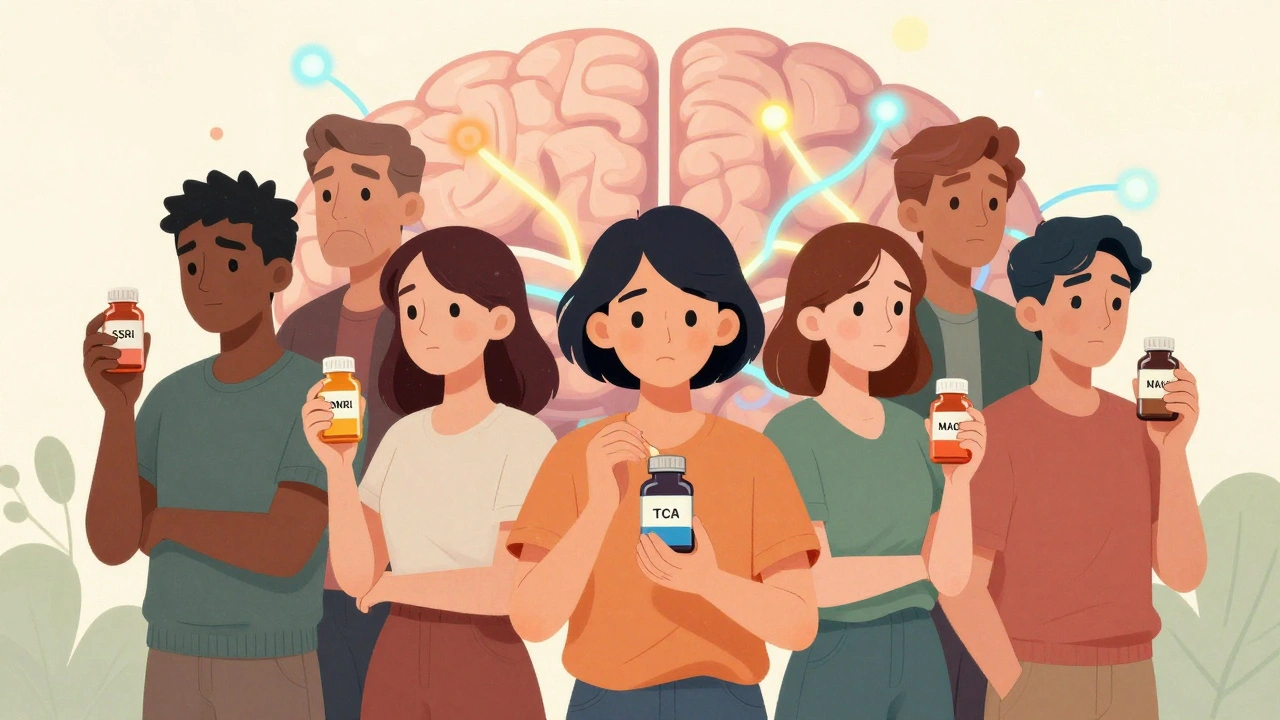
Antidepressants aren’t magic pills. But for millions of people struggling with depression, anxiety, or PTSD, they’re one of the few tools that actually help. If you’ve been told you might need one, or you’re already taking one, you’re probably wondering: which type is right for me, and what are the real risks?
What Are the Main Types of Antidepressants?
There are five main classes of antidepressants, each with different ways of working in the brain. The most common ones today are SSRIs and SNRIs. Older types like tricyclics and MAOIs are still used, but only when newer options don’t work.
- SSRIs (Selective Serotonin Reuptake Inhibitors): These include fluoxetine (Prozac), sertraline (Zoloft), escitalopram (Lexapro), and citalopram (Celexa). They work by increasing serotonin, a brain chemical tied to mood. They’re the first choice for most doctors because they’re well-tolerated and have fewer side effects than older drugs.
- SNRIs (Serotonin-Norepinephrine Reuptake Inhibitors): Venlafaxine (Effexor) and duloxetine (Cymbalta) raise both serotonin and norepinephrine. These are often used when someone has depression with physical pain, like nerve pain or fibromyalgia.
- Atypical Antidepressants: Bupropion (Wellbutrin) is the most common. It works on dopamine and norepinephrine, not serotonin. That’s why it’s often chosen for people who struggle with low energy or sexual side effects from SSRIs.
- Tricyclic Antidepressants (TCAs): Amitriptyline and nortriptyline are older, cheaper drugs. They’re effective but cause more drowsiness, dry mouth, and heart rhythm issues. Doctors usually avoid them unless other options fail.
- MAOIs (Monoamine Oxidase Inhibitors): Phenelzine and tranylcypromine are rarely used today. They require strict diet changes-no aged cheese, pickled foods, or red wine-because they can cause dangerous blood pressure spikes. They’re only for treatment-resistant cases.
According to the FDA, sertraline is the most prescribed antidepressant in the U.S., with over 38 million prescriptions in 2022. Why? It’s affordable, effective, and has a lower risk of severe side effects compared to others.
How Long Do Antidepressants Take to Work?
One of the biggest mistakes people make is quitting too soon. Antidepressants don’t work like painkillers. You won’t feel better the next day-or even the next week.
Most people start noticing small improvements after 4 to 6 weeks. Full benefits often take 8 to 12 weeks. If you stop after 2 weeks because you don’t feel different, you’re not giving it a fair shot.
Doctors usually wait at least 6 weeks before switching medications. If you’re on an SSRI and still feel hopeless after 8 weeks, your doctor might increase the dose or try a different one. It’s common to try two or three before finding the right fit.
What Are the Most Common Side Effects?
Side effects are real-but they’re not the same for everyone. Many fade after the first few weeks. Others stick around.
- Nausea: Happens in 15-20% of people, especially in the first 2 weeks. Taking the pill with food helps.
- Sexual problems: Up to 56% of people on SSRIs report reduced libido, trouble getting aroused, or delayed orgasm. This is one of the most common reasons people stop taking them.
- Weight gain: About half of long-term users gain 5-10 pounds. Not everyone, but it’s common enough to be a major concern.
- Drowsiness or insomnia: Some antidepressants make you sleepy (like mirtazapine), others keep you up (like fluoxetine). Timing the dose helps-take sleep-inducing ones at night.
- Emotional blunting: Some people say they feel "numb"-like they can’t cry or get excited, even about good things. This isn’t in every patient’s brochure, but it’s frequently reported in forums and clinical interviews.
A 2016 study in the PMC found that 73.5% of long-term users reported withdrawal symptoms when stopping, 71.8% had sexual side effects, and 65.3% gained weight. These aren’t rare outliers-they’re common experiences.
What Are the Serious Risks?
Most side effects are annoying. A few are dangerous.
Suicidal thoughts in young adults: The FDA requires a black box warning-the strongest safety alert-for antidepressants used in people under 25. Studies show a small increase in suicidal thinking in the first few weeks of treatment. That’s why doctors check in closely during the first month. It doesn’t mean antidepressants cause suicide-it means they can trigger agitation or anxiety before mood improves.
Withdrawal syndrome: Stopping suddenly can cause dizziness, electric-shock sensations (called "brain zaps"), nausea, anxiety, and insomnia. This happens in 50-70% of people who quit cold turkey. The risk is higher with drugs that leave your system fast, like paroxetine. Fluoxetine sticks around longer, so withdrawal is milder. Always taper off with your doctor’s help.
Pregnancy risks: If you’re pregnant or planning to be, talk to your doctor. Antidepressants taken in the third trimester can cause temporary issues in newborns: jitteriness, trouble feeding, low blood sugar, and breathing problems. But for many women, untreated depression poses a bigger risk to both mother and baby. The American College of Obstetricians and Gynecologists now says the benefits often outweigh the risks.
Long-term health risks: Some studies link long-term use to lower bone density (increasing fracture risk), low sodium levels (hyponatremia), and higher blood sugar. These aren’t common, but they’re real-especially in older adults or people on multiple medications.

How Do You Know If It’s Working?
It’s not about feeling "happy." It’s about feeling able.
Signs it’s working:
- You get out of bed without fighting it.
- You can talk to friends without dreading the conversation.
- You stop obsessing over every mistake.
- You feel less overwhelmed by small tasks.
- You start caring about things again-food, music, walks.
Many people say they feel like they’ve "gotten their self back." One Reddit user wrote: "After 3 weeks on sertraline, I finally felt like myself again after 2 years of being numb."
But if you feel worse-more anxious, angry, or hopeless-call your doctor immediately. Don’t wait. That’s not normal.
What About Combining Medication and Therapy?
Antidepressants alone aren’t enough for most people. Studies show the best results come from combining medication with therapy-especially cognitive behavioral therapy (CBT).
Why? Medication helps you feel calm enough to do the work. Therapy helps you change the thoughts and habits that keep depression going. One study found that patients who got both had half the relapse rate of those who only took pills.
If you’re not in therapy, ask your doctor for a referral. Many clinics offer sliding-scale fees. Online therapy platforms like BetterHelp or Talkspace are also options.
Is There a "Best" Antidepressant?
No. Not one.
A 2018 study in The Lancet reviewed 522 trials and found that escitalopram, sertraline, and mirtazapine were the most effective and best tolerated. But that doesn’t mean they’ll work for you.
Response varies wildly. Genetics, metabolism, other medications, and even your gut bacteria play a role. One person thrives on fluoxetine. Another gets terrible nausea on the same drug.
Doctors start with SSRIs because they’re safer. But if you’ve tried two or three and nothing worked, it’s not your fault. It’s just how the brain works.

What Should You Do Before Starting?
Ask your doctor these questions:
- Why are you recommending this specific drug?
- What side effects should I expect in the first week?
- How will we know if it’s working?
- What if I want to stop? How do I do it safely?
- Are there any interactions with my other meds or supplements?
Keep a journal. Note your mood, sleep, appetite, and side effects each day. It helps your doctor adjust your treatment faster.
What If It Doesn’t Work?
It’s not failure. It’s data.
One in three people don’t respond to the first antidepressant. Half need to try two or three before finding one that fits. That’s normal.
Options if one doesn’t work:
- Switch to a different class (e.g., from SSRI to SNRI or bupropion)
- Add a second medication (like low-dose lithium or thyroid hormone)
- Try a newer option like esketamine (Spravato) for treatment-resistant depression
- Consider non-drug options like TMS (transcranial magnetic stimulation)
There’s always another path. Don’t give up because one drug didn’t help.
Final Thoughts
Antidepressants are tools-not cures. They don’t fix your life. But they can give you the mental space to fix it yourself.
They’re not for everyone. They’re not perfect. But for people with moderate to severe depression, they can be life-changing. The key is knowing what you’re getting into: the timeline, the side effects, the risks, and the fact that you might need to try more than once.
Don’t be afraid to ask questions. Don’t be ashamed to say, "This isn’t working." And don’t stop without talking to your doctor. You’re not alone in this. Millions are walking the same path.
How long do antidepressants take to start working?
Most people start noticing small improvements after 4 to 6 weeks. Full benefits often take 8 to 12 weeks. It’s important to keep taking the medication even if you don’t feel better right away. Stopping too soon means you won’t know if it could have helped.
Can antidepressants make you feel numb or emotionless?
Yes, some people report emotional blunting-feeling less joy, sadness, or excitement. This is more common with SSRIs and can be mistaken for "feeling better." If you feel detached or flat, talk to your doctor. Switching to a different medication, like bupropion, often helps.
Do antidepressants cause weight gain?
About half of long-term users gain weight, typically 5-10 pounds. This is most common with SSRIs like paroxetine and mirtazapine. Bupropion is less likely to cause weight gain and may even help with weight loss. If weight is a concern, discuss alternatives with your doctor.
Is it safe to take antidepressants during pregnancy?
Some antidepressants can cause temporary issues in newborns if taken in the third trimester, like jitteriness or feeding problems. But for many women, untreated depression poses a greater risk. The American College of Obstetricians and Gynecologists recommends individualized decisions based on severity, history, and medication safety profiles.
What happens if I stop antidepressants suddenly?
Stopping abruptly can cause withdrawal symptoms like dizziness, "brain zaps," nausea, anxiety, and insomnia. This affects 50-70% of people. Drugs with short half-lives (like paroxetine) cause worse symptoms. Always taper off slowly under medical supervision.
Are antidepressants addictive?
No, antidepressants are not addictive. They don’t create cravings or a high. But your body can become used to them, so stopping suddenly causes withdrawal symptoms. That’s not addiction-it’s physical adaptation. Always work with your doctor to stop safely.
Can I drink alcohol while taking antidepressants?
It’s not recommended. Alcohol can worsen depression, increase drowsiness, and interfere with how your body processes the medication. Even a drink or two can make side effects worse. If you choose to drink, do so very sparingly and only after talking to your doctor.
10 Comments

Bee Floyd
December 4, 2025 at 06:31 AM
There’s a quiet dignity in the way antidepressants don’t promise euphoria-they just return the capacity to feel. Not the manic highs of ‘fixing’ yourself, but the gentle return of baseline humanness: the ability to notice sunlight on the kitchen floor, to care if your plants live or die, to sit with silence without it feeling like a failure.
It’s not about becoming someone new. It’s about remembering who you were before the weight of everything turned your bones to lead. And yeah, the side effects? Real. The withdrawal? Brutal. But the alternative-staying in the fog-is worse than any brain zap.

Jeremy Butler
December 6, 2025 at 05:59 AM
It is of paramount importance to recognize that the pharmacological modulation of monoaminergic neurotransmission constitutes a form of neurochemical intervention that, while statistically efficacious in controlled clinical trials, does not address the ontological underpinnings of depressive phenomenology. The conflation of symptomatic alleviation with therapeutic cure represents a profound epistemological error, perpetuated by the biomedical paradigm’s reductionist hegemony.
One must interrogate the sociopolitical apparatuses that incentivize pharmaceutical intervention over systemic reform-housing instability, wage slavery, and the erosion of communal bonds-as root causes that antidepressants merely buffer, not resolve.

Shashank Vira
December 7, 2025 at 00:55 AM
Oh, so we’re just going to swallow chemicals like they’re gummy vitamins now? How quaint. The West has turned the human soul into a malfunctioning circuit board. You don’t fix grief with serotonin. You don’t cure existential despair with a prescription from a 3-minute telehealth visit.
I studied neuroscience in Cambridge. I’ve seen the data. Antidepressants? They’re a Band-Aid on a severed artery. And yet, here we are-millions popping pills while the world burns, pretending that mood regulation is a personal failure rather than a societal collapse.
But sure, keep telling yourself it’s ‘just chemistry.’ It’s easier than facing the truth: we’ve built a world that breaks people, then sells them the cure.

Jack Arscott
December 8, 2025 at 10:15 AM
Been on bupropion for 18 months. Zero sexual side effects, lost 8 lbs, and I finally started running again 🏃♂️🔥
Also, brain zaps? Only when I forgot my pill for 2 days. Lesson learned. Taper like your life depends on it-because it kinda does.

Walker Alvey
December 10, 2025 at 01:52 AM
Of course it works. You just need to stop being a victim and start being a responsible adult. Everyone’s got problems. You think the Romans had SSRIs? No. They had stoicism. And discipline. And a damn good bath.
But hey, if you need a chemical crutch to get out of bed, go ahead. Just don’t call it ‘mental health.’ Call it weakness with a prescription.

Adrian Barnes
December 11, 2025 at 05:48 AM
Let me be clear: antidepressants are not a treatment. They are a social coping mechanism for a culture that has abandoned its most vulnerable. The fact that we rely on pharmaceuticals to manage the emotional fallout of systemic neglect is not progress-it is pathology.
And the statistics you cite? They’re not anomalies. They’re symptoms. 73% withdrawal? 71% sexual dysfunction? That’s not a drug. That’s a chemical cage. And you’re proud of this? You’ve been sold a lie wrapped in a white pill.
Therapy? Sure. But therapy without structural change is just emotional janitorial work. Clean up the mess while the house keeps burning down.

Jaswinder Singh
December 12, 2025 at 10:53 AM
Bro, I tried 4 different ones. Zoloft made me feel like a zombie. Lexapro gave me brain zaps so bad I thought I was having seizures. Then I switched to Wellbutrin and boom-woke up one morning and actually wanted to go outside. No weight gain, no sex issues, just… me again.
Don’t give up. It’s trial and error. Your brain isn’t broken. It’s just confused. And it needs time to unlearn the pain.

Priyam Tomar
December 12, 2025 at 17:48 PM
Everyone talks about SSRIs like they’re the golden ticket. But have you even read the FDA’s own meta-analyses? The effect size is tiny. Like, barely above placebo. And you know who profits? Big Pharma. Not you.
And emotional blunting? That’s not a side effect-that’s the point. They don’t want you to feel too much. Just enough to function, but not enough to question why you’re so damn miserable in the first place.
Try fasting. Try cold showers. Try talking to a real human for 10 hours straight. Not a therapist paid by insurance. A friend. A mentor. Someone who doesn’t have a 15-minute slot.

Matt Dean
December 13, 2025 at 17:18 PM
Y’all are overthinking this. I was suicidal in 2020. Took Prozac. Felt like shit for 3 weeks. Then one day, I made coffee and didn’t cry. That’s it. No epiphany. No spiritual awakening. Just… better.
It’s not magic. It’s not a weakness. It’s medicine. Like insulin for diabetes. If you wouldn’t shame someone for needing insulin, don’t shame someone for needing an SSRI.
And yes, I gained weight. So what? I’m alive. I’m working. I’m texting my sister. That’s the win.
Courtney Co
December 3, 2025 at 00:03 AM
I started sertraline last year and honestly? It turned my life around. I was crying in the shower every morning, now I’m baking sourdough and calling my mom just because. But the first two weeks? Pure hell. Nausea, insomnia, felt like my brain was being rewired with a butter knife. I almost quit. Don’t. Stick it out. The numbness? Yeah, that hit me too. I couldn’t laugh at my favorite memes. But then one day, I heard a song I hadn’t listened to since college and I just… cried. Not sad tears. Happy ones. That’s when I knew it was working.
Also, weight gain? I put on 12 lbs. I don’t care. I’m alive. And I’m not ashamed of it.